
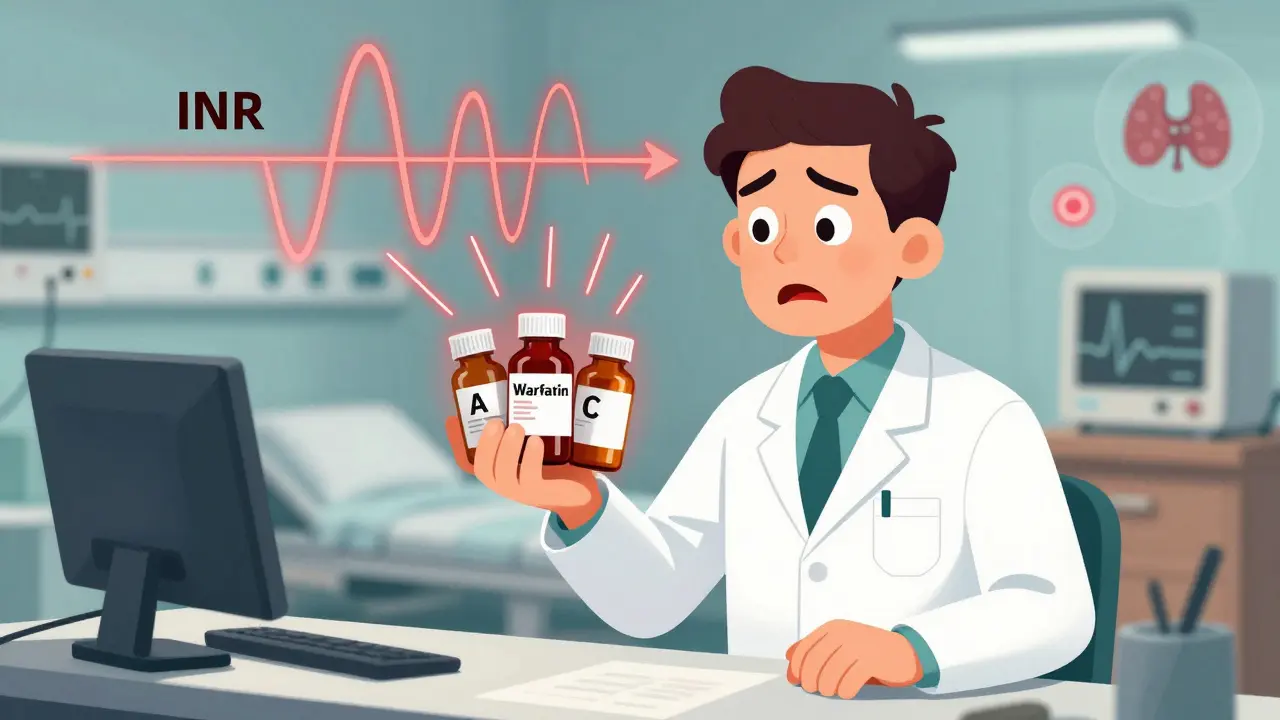
When a pharmacist hands a patient a generic version of warfarin, levothyroxine, or phenytoin, they’re not just filling a prescription-they’re making a clinical decision. These are NTI generics, or narrow therapeutic index drugs, where even a tiny change in blood concentration can mean the difference between healing and harm. For pharmacists, this isn’t theoretical. It’s daily reality.
What Makes a Drug an NTI Drug?
NTI stands for narrow therapeutic index. That means the gap between a safe, effective dose and a toxic or ineffective one is razor-thin. A 10% drop in blood levels might make the drug useless. A 10% rise could cause bleeding, seizures, or heart rhythm problems. The FDA doesn’t publish an official list, but it flags certain drugs in the Orange Book with a ‘B’ therapeutic equivalence code-meaning substitution isn’t automatically safe.
Drugs like warfarin (a blood thinner), levothyroxine (for thyroid function), and phenytoin (for seizures) are classic NTI drugs. They’re not rare. They’re essential. But they’re also unforgiving. A patient on warfarin needs their INR to stay between 2.0 and 3.0. If a generic switch pushes that to 4.0, they risk a stroke or internal bleeding. If it drops to 1.5, they could clot.
Why Pharmacists Are Worried
Since the Hatch-Waxman Act in 1984, generic drugs have been approved based on bioequivalence: they must deliver 80-125% of the active ingredient compared to the brand. That range works fine for most drugs. But for NTI drugs? It’s too wide.
The FDA now recommends a tighter range-90-111%-for specific NTI drugs. Still, not all manufacturers follow this. And when a patient switches from one generic to another, even if both meet FDA standards, their blood levels can swing. A 2024 ASHP survey found that 68% of pharmacists have seen or heard of adverse events tied to switching NTI generics. One hospital pharmacist in Ohio reported three INR spikes in six months after switching warfarin brands. All three patients ended up in the ER.
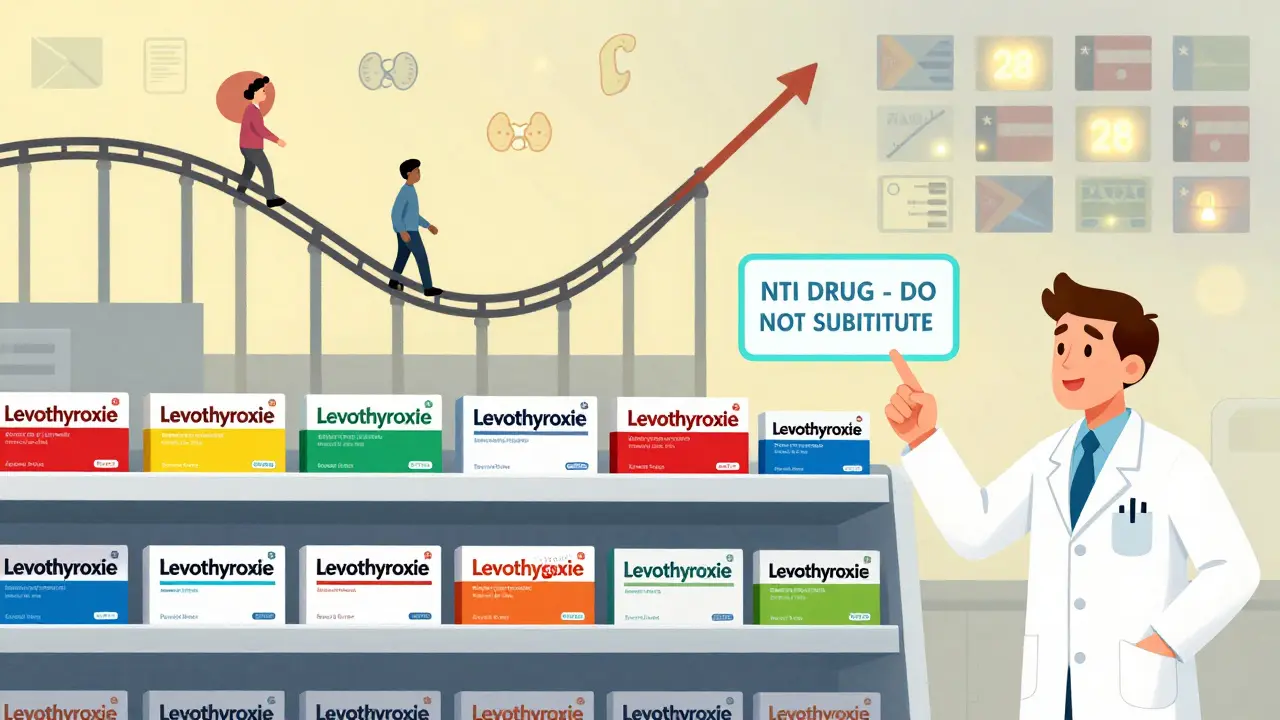
It’s not just about one switch. It’s about multiple switches. The FDA says 23% of NTI drug shortages are worsened by pharmacies switching between different generic suppliers. Imagine a patient on levothyroxine who gets Brand A one month, Brand B the next, then Brand C. Their TSH levels jump. Their doctor adjusts the dose. They feel tired. Then the pharmacy runs out of Brand C and switches back to Brand A. The cycle repeats. No one knows why they’re not feeling right-until the pharmacist connects the dots.
Cost vs. Risk: The Real Trade-Off
Generics save money. That’s a good thing. NTI generics cost 80-85% less than brand-name versions. For patients on fixed incomes, that’s life-changing. One community pharmacy owner in Arizona told me his patient abandonment rate for levothyroxine dropped 35% when generics became available. That’s a win.
But cost savings shouldn’t come at the cost of safety. Between 2020 and 2024, the FDA’s adverse event database recorded 1,247 reports linked to NTI generic substitutions. For non-NTI generics? Only 382. That’s a threefold difference. And those numbers are just the ones reported. Many go unreported.
What’s worse? The system doesn’t track which generic brand a patient gets. No pharmacy system flags “this is an NTI drug-do not substitute.” Most automated systems treat all generics the same. Pharmacists are left to catch the gaps.
State Laws Are a Patchwork
As of January 2025, only 28 states have laws restricting automatic substitution of NTI drugs. In 22 states, prescribers must write “dispense as written” or “no substitution” on the prescription. Six states ban automatic substitution entirely. The rest? It’s up to the pharmacist’s judgment-and their courage to push back.
Independent pharmacists report that 73% of their prescribers now specifically request no substitution for NTI drugs. Warfarin leads the list at 68%, followed by levothyroxine at 52%, and carbamazepine at 47%. But not all prescribers know the difference. Some think “generic = same.” Pharmacists are often the last line of defense.
What Pharmacists Are Doing About It
Smart pharmacies have built protocols. The ASHP recommends sticking to one generic manufacturer for each NTI drug whenever possible. Sixty-three percent of hospital systems now do this. Once a patient stabilizes on a specific brand, they stay on it. No switching.
Therapeutic drug monitoring is non-negotiable. For warfarin, that’s INR checks every week after a switch. For phenytoin, it’s serum level checks every 2-4 weeks. Pharmacists are now trained to interpret these results-not just dispense pills. Eighty-one percent of pharmacy residency programs now include NTI drug management. That’s new. That’s progress.
Some pharmacies use color-coded labels. Red for NTI drugs. Red means: “Stop. Talk to the prescriber. Don’t substitute.” Others have digital alerts in their systems that pop up when an NTI drug is scanned. These aren’t fancy tech. They’re simple, low-cost fixes that work.
The Supply Chain Is Fragile
Here’s the quiet crisis: 80% of generic drugs, including NTI drugs, are finished in foreign countries. The FDA doesn’t inspect every facility. When a factory in India or China has a quality issue, the ripple effect hits U.S. pharmacies. In 2024, there were 47 NTI drug shortages-17.4% of all shortages-despite NTI drugs making up only 6% of generic prescriptions.
That’s why switching between generics isn’t just a clinical risk-it’s a logistical nightmare. A pharmacy runs out of Generic A. They grab Generic B. But Generic B just had a recall. Now they’re out of stock. The patient goes without. Their condition destabilizes. It’s not the pharmacist’s fault. But they’re the one who gets the call.
What’s Changing in 2025 and Beyond
The FDA announced a new bioequivalence framework in April 2025, targeting 12 high-risk NTI drugs with stricter standards by 2026. That’s a step forward. But it’s not enough. Pharmacists want mandatory therapeutic equivalence testing-not just bioavailability. They want to know the drug behaves the same in the body, not just that it releases the same amount of chemical.
Medicare’s new drug price negotiation program includes three NTI drugs among its first 10. That’s a problem. The 21-day reimbursement delay under the program could make it harder for small pharmacies to stock these drugs. Lisa Schwartz of NCPA warned that this could lead to more shortages-exactly what we’re trying to avoid.
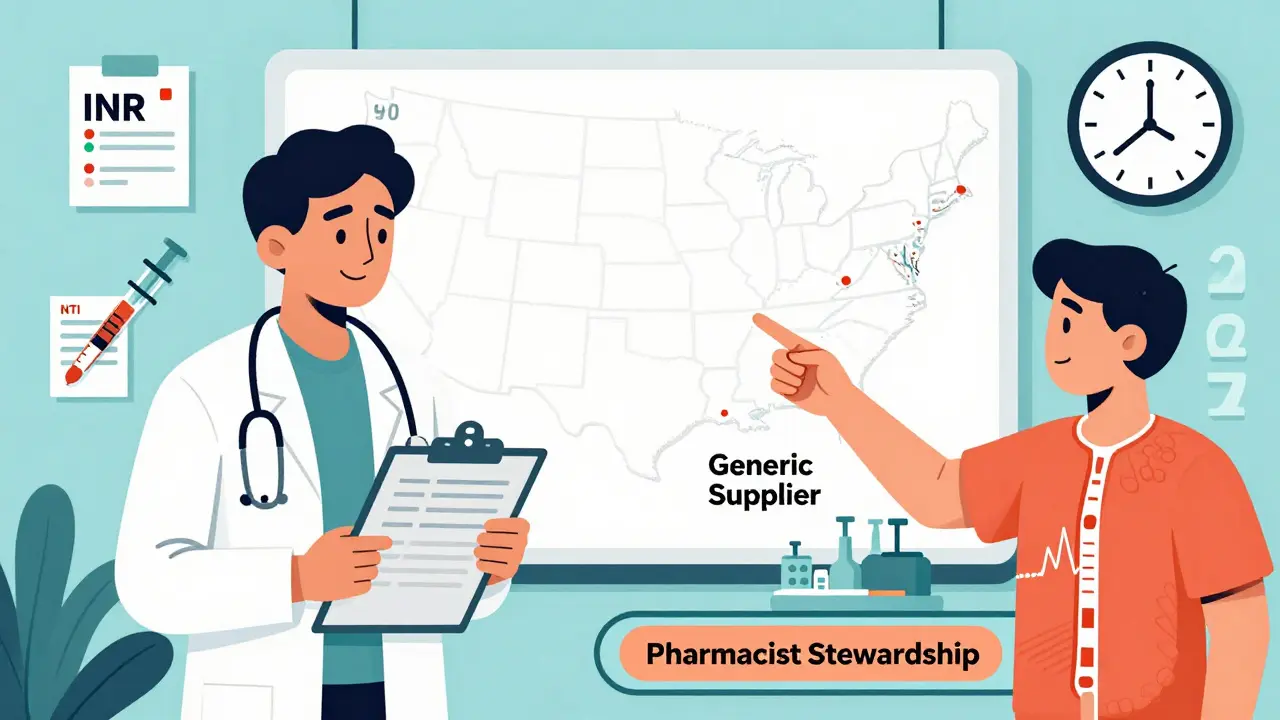
By 2027, 74% of healthcare systems plan to put pharmacists in charge of NTI drug stewardship. That means pharmacists will review all NTI prescriptions, track substitutions, coordinate with prescribers, and monitor labs. It’s not just filling bottles anymore. It’s managing outcomes.
What You Can Do
If you’re a patient: Ask your pharmacist if your drug is an NTI drug. Ask if you’ve been switched between generics. Ask if your levels have been checked since the switch.
If you’re a prescriber: Write “dispense as written” on NTI prescriptions. Don’t assume your patient knows the difference. Don’t let the pharmacy make the call.
If you’re a pharmacist: Know your NTI drugs. Know your state laws. Use your voice. Push for protocols. Document every substitution. Advocate for better systems. You’re not just a dispenser. You’re a clinician.
NTI generics aren’t inherently bad. They save money. They increase access. But they demand more-more knowledge, more caution, more communication. The system was built for convenience. But these drugs need care. And pharmacists are the ones holding the line.

14 Comments
Why are we letting foreign labs make our life-saving meds? India and China don't care if we bleed out. This is national security. Stop the imports.
I get it, generics save money. But when someone’s INR goes from 2.5 to 4.8 because they switched brands? That’s not a cost-saving-it’s a tragedy waiting to happen. 🙏 We owe it to patients to be smarter than this.
Wait so you’re saying generics aren’t perfect? Shocking. Next you’ll tell me water isn’t wet.
Pharmacists are the real MVPs. No cap. While everyone’s scrolling TikTok, they’re the ones holding the line between life and death. Respect.
i had a friend who switched generics for thyroxine and she just felt so off for months no one knew why until her pharmacist said ohhh this is prob why
This whole system is broken because we’ve lost touch with the sacredness of healing. We treat medicine like a commodity. But when your life hangs on a 10% fluctuation, it’s not a product-it’s a covenant. The FDA doesn’t get it. Corporations don’t care. Only the pharmacist sees the blood on the floor.
The fact that the FDA allows an 80-125% bioequivalence window for NTI drugs is a scandal. It’s not oversight-it’s negligence. And now we’re outsourcing production to countries with less than 1% inspection rates? This isn’t capitalism. It’s biopolitical roulette.
you think this is about drugs? nah. this is about western elites letting china control our medicine so they can control our minds. they put tracking chips in the pills. thats why your INR goes wild. its not the brand. its the signal.
This is such an important conversation. Pharmacists are the unsung heroes of healthcare. If you’re a prescriber reading this-please, write ‘dispense as written’ on NTI scripts. It’s a small act with huge impact. Thank you to every pharmacist who speaks up.
I mean... it's not like the FDA is incompetent... but also... they are? Like, 80-125%? That's like saying two cars are 'equivalent' if one can go 50mph and the other 125mph. And now we're outsourcing to... *gasp*... ASIA?!? What even is this?!!??
I’m so grateful for pharmacists who push back. 🙌 I had a pharmacist stop me from switching my levothyroxine last year-I didn’t even know I should’ve been worried. She printed out a whole sheet on NTI drugs. I cried. Thank you for being the calm in the storm.
It’s fascinating how society has outsourced moral responsibility to frontline clinicians. The system is designed to fail, and yet we expect pharmacists to be saints. We created this machine-and then blamed the gears for breaking.
It’s wild how a pill can be the difference between peace and panic. We don’t talk enough about the quiet work of pharmacists. They’re not just handing out meds-they’re holding people together.
This is why you don’t trust the system. You think this is about safety? Nah. It’s about profit. The FDA is a puppet. The manufacturers are puppets. And you? You’re the puppet who thinks generics are ‘the same.’ Wake up.