

Medication & Fiber Timing Calculator
How to Use This Tool
Enter your medication times and fiber supplement time. The calculator will show if your timing is safe based on FDA and clinical guidelines. For best results, follow the recommended timing of at least 1 hour before or 2-4 hours after medications.
Key Recommendations
According to the FDA and major medical institutions, take fiber supplements either:
- 1 hour before taking medications
- 2-4 hours after taking medications
For best results, take fiber with your largest meal of the day to help with appetite control.
Many people take fiber supplements to help with digestion, lower cholesterol, or manage blood sugar. But if you're also on medication, you could be risking your treatment without even knowing it. Taking fiber at the wrong time can make your pills less effective-or even useless. This isn’t a rare issue. It happens every day, and most people don’t realize it until their blood tests show something’s off.
Why Fiber Messes With Your Medicines
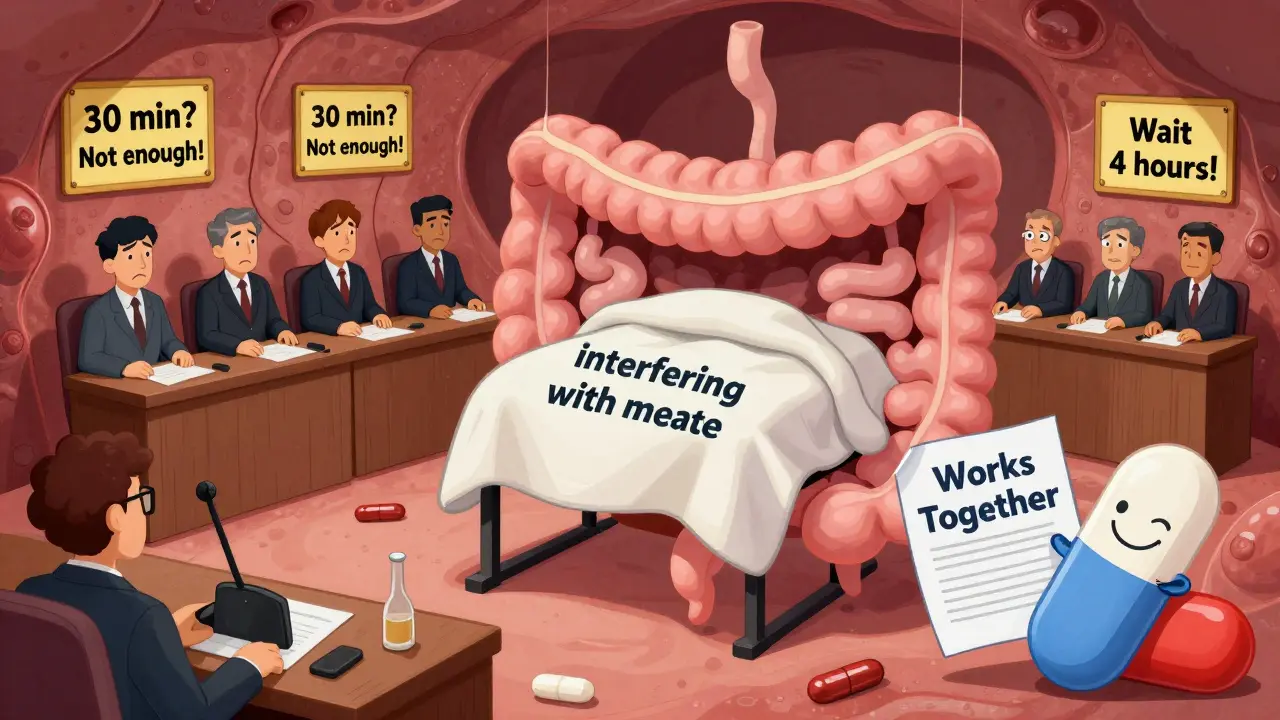
Fiber supplements like psyllium (found in Metamucil), methylcellulose, or inulin don’t just add bulk to your stool. When they hit your gut, they soak up water and turn into a thick, sticky gel. That’s great for moving things along, but it’s a problem for pills. That gel can wrap around medications like a blanket, stopping them from being absorbed into your bloodstream. Some studies show this can cut absorption by as much as 50%. It’s not just about slowing things down. The gel forms fast-within 30 minutes of taking fiber. And once it’s there, it sticks around for hours. So if you take your blood pressure pill and then a fiber supplement 20 minutes later, your body might only get half the dose. That’s not a small risk. It’s a real danger.Medications That Can Be Affected
Not all drugs are equally sensitive, but some are especially vulnerable:- Levothyroxine (for thyroid conditions): One study found fiber reduced absorption by nearly 29%. Patients reported their TSH levels stayed high even after increasing their dose-until they stopped taking fiber at the same time.
- Warfarin (a blood thinner): If fiber blocks absorption, your INR levels can swing dangerously. One nurse on Reddit shared a case where a patient’s blood clotting risk shot up because they were taking Metamucil with their warfarin.
- Metformin (for diabetes): Fiber can delay how fast this drug gets into your system, which might throw off your blood sugar control.
- Tetracycline and other antibiotics: These need to be absorbed quickly. Fiber can trap them in the gut, making them less effective against infections.
- Blood pressure medications: Beta-blockers and calcium channel blockers can be affected too. Patients have reported dizziness or elevated readings after starting fiber supplements.
And here’s the twist: some people don’t even realize they’re taking a medication that interacts with fiber. Many take over-the-counter thyroid pills, blood pressure meds, or even cholesterol drugs without knowing the risks.
The Right Timing: 1 Hour Before or 2-4 Hours After
The rule is simple: separate fiber and medications by at least 1 hour before or 2 to 4 hours after. This isn’t just advice-it’s backed by the FDA, Mayo Clinic, Cleveland Clinic, and the American Pharmacists Association.Most people find it easiest to take fiber supplements either:
- First thing in the morning, 2-4 hours before taking any meds
- Or right before bed, but only if you don’t take meds at night
Wait-before bed? Not so fast.
Some sources suggest taking fiber at night. But research from Hilma (2023) shows 68% of people who took fiber within two hours of bedtime got bloated, gassy, or had stomach cramps that woke them up. FreeRx Blog even says Metamucil specifically can cause nighttime discomfort. So if you’re taking fiber before bed, you might be trading sleep for constipation relief-and that’s not worth it.
Instead, try taking fiber with your largest meal of the day. That’s when your gut is already active. It helps with appetite control, too. But still, wait 1 hour after eating before taking any meds. And if you take meds with food? Then wait at least 4 hours after the meal before taking fiber.
Special Cases: Surgery, IBS, and Even Statins
Not everyone fits the same mold.After bariatric surgery: Your stomach is smaller. Your gut moves faster. Fiber can block absorption even more easily. Experts say to start with just 1-2 grams per day and increase slowly. Always wait at least 1 hour before or 2-4 hours after meds.
With IBS: About 42% of people with irritable bowel syndrome find fiber makes symptoms worse if taken on an empty stomach. If you have IBS, take fiber *with* meals, not before or after. And stick to soluble fiber like oats or psyllium-avoid inulin or chicory root, which can trigger gas.
With statins: Here’s the exception. A 2015 study found that taking psyllium (15 grams a day, split into two doses) with a low dose of simvastatin actually lowered LDL cholesterol more than the statin alone. The fiber didn’t block absorption-it helped. But this only works with careful timing: take the fiber *before* meals, not mixed with the statin. Don’t try this without your doctor’s approval.
How to Make It Work in Real Life
You don’t need to be a pharmacist to get this right. Here’s how to make it stick:- Start low: Begin with 1-2 grams of fiber daily. Increase slowly over 2-4 weeks. Jumping to 10 grams overnight? You’ll regret it-bloating, gas, cramps.
- Drink water: Fiber needs water to work. Take at least 8 ounces with each dose. Aim for 64-80 ounces total per day. Dehydration turns fiber into a brick, not a gel.
- Use reminders: Set phone alarms for when to take fiber and when to take meds. Consistency beats perfection. Missing one day isn’t a disaster. But doing it wrong every day is.
- Make a chart: Write down all your meds and supplements. Note the time you take each. Then mark where fiber fits in. Look for gaps of at least 2 hours. If you can’t find a clean window, talk to your pharmacist.
One user on Amazon wrote: “I was taking my fiber with my morning pills. My blood pressure kept creeping up. I started taking fiber 3 hours after my meds-and my numbers dropped back to normal. I wish I’d known this sooner.”

Why So Many People Don’t Know This
A 2022 survey found only 38.7% of patients got clear timing instructions from their pharmacist when buying fiber supplements. Most assume it’s just “safe fiber.” But it’s not. It’s a physical barrier in your gut. And it doesn’t care if your pill is for diabetes, thyroid, or heart disease.Pharmacists are busy. Doctors are overloaded. You can’t rely on them to catch every interaction. You have to be your own advocate.
What’s Coming Next
Researchers are working on time-release fiber formulas that form gel more slowly, so they don’t interfere with meds. One is in Phase 2 trials (as of March 2023). But until then, the old rule still stands: separate, don’t combine.The global fiber supplement market is growing fast-projected to hit $3.7 billion by 2030. More people are using it. That means more people need to know this. Don’t be one of them who learns the hard way.
Can I take fiber and levothyroxine together if I wait 30 minutes?
No. Even 30 minutes isn’t enough. Studies show fiber can reduce levothyroxine absorption by nearly 30% when taken within 2 hours. To be safe, wait at least 4 hours after taking levothyroxine before taking fiber, or take fiber at least 1 hour before your thyroid pill. Many patients only see their TSH levels normalize after making this change.
Is psyllium the only fiber that causes problems?
No. Psyllium is the most studied because it forms the thickest gel, but methylcellulose, inulin, and oat bran can also interfere with drug absorption. Any fiber that turns into a gel in your gut has the potential to block pills. If you’re on medication, assume all fiber supplements could interact-until proven otherwise.
What if I forget and take fiber with my meds?
Don’t panic. One mistake won’t ruin your treatment. But don’t do it again. If it happens once, note the date and monitor for changes: Are your symptoms worse? Did your blood pressure spike? Did your thyroid test go off? Talk to your doctor. They may need to check your drug levels or adjust your dose.
Can I take fiber at night if I take all my meds in the morning?
Yes-if you take your last medication at least 4 hours before bedtime. But even then, many people report bloating and gas when taking fiber right before sleep. If you notice trouble sleeping, move fiber to the morning. Try taking it 30 minutes before breakfast, then wait 2-4 hours before your meds. That’s often the safest and most comfortable option.
Should I talk to my pharmacist about fiber and my meds?
Absolutely. Pharmacists are trained to spot these interactions. Bring your full list of medications and supplements-even vitamins and OTC pills. Ask: “Is there any timing issue with my fiber supplement and my other drugs?” Most won’t bring it up unless you do. Don’t assume they know you’re taking fiber.





15 Comments
This is such a critical but overlooked interaction. Fiber isn't just 'good for you'-it's a physical barrier that can literally neutralize meds. I've seen patients on levothyroxine with stubbornly high TSH, and when we asked about supplements, it was always Metamucil taken with breakfast. One adjustment, 4-hour separation, and their numbers normalized. It's not magic. It's physiology.
Also, the statin exception? Wild. Psyllium + simvastatin actually synergizes? That's not a bug, that's a feature. But only if timed right. Don't just assume all fiber is equal.
I appreciate how thorough this is. As a nurse, I’ve had patients come in with erratic INR levels, and the culprit was almost always Metamucil taken with warfarin. No one ever thinks to mention it. I wish every pharmacy had a sticker on fiber bottles: 'DO NOT TAKE WITH MEDS.'
Also-yes, bedtime fiber is a trap. I’ve had elderly patients tell me they 'just wanted to be regular at night.' Instead, they were wide awake at 3 a.m. with bloating. Morning, with water, and 4 hours before meds? That’s the sweet spot.
Fascinating. The idea that fiber forms a gelatinous sheath around pharmaceuticals is almost poetic-nature’s own time-release mechanism, but one that sabotages intent. We treat supplements as harmless, but they’re not inert. They’re bioactive. And if you’re on chronic meds, your gut becomes a battlefield.
It’s ironic: we’re told to eat more fiber, yet the very substance that cleanses the system can also obscure the very drugs meant to heal it. A quiet paradox of modern health.
So... let me get this straight. Fiber is basically a drug-blocking sponge. And we're all just walking around taking it with our pills like it's oatmeal?
And the fact that pharmacists don't bring this up? That's not negligence. That's a system failure. I don't need a PhD to know this is a massive blind spot. Someone's gonna die from this. Probably someone who thought 'natural' meant 'safe.'
I must say, this is the most rigorously researched piece on fiber-drug interactions I've ever read. The citations are impeccable. The timing protocols are clinically sound. And the inclusion of IBS and post-bariatric guidance? Exceptional.
One quibble: the suggestion to take fiber with your largest meal assumes you have a 'largest meal.' For those of us on intermittent fasting or with irregular eating patterns, this advice is less helpful. Perhaps a more universal guideline: 'separate by 2-4 hours, regardless of meal timing.'
Yessss this is so important!! 🙌 I used to take my fiber with my thyroid med and wondered why my TSH stayed high. Turned out I was blocking 30% of my dose. After switching to morning fiber (3 hrs before meds), my levels dropped like magic.
Also-water. Don’t skip it. Fiber without water = concrete. I learned that the hard way. 💧 Now I have a water bottle on my nightstand with a sticky note: 'FIBER + WATER = GOOD. FIBER + NO WATER = BAD.'
I’ve been taking Metamucil for 5 years and never knew this. I take it right after my blood pressure med. No wonder I kept getting dizzy. My doctor just kept upping my dose. I was like, 'Why am I still dizzy?!'
Now I take fiber at 6 a.m., meds at 9 a.m. My BP’s been stable for 3 months. Thank you. This could’ve killed me.
The phrase 'fiber turns into a thick, sticky gel' is not just accurate-it's terrifying. Imagine your medication, a carefully engineered molecule, being swallowed whole by a biological marshmallow. This isn't nutrition. This is bioengineering sabotage.
And yet, the supplement industry markets this as 'natural wellness.' Natural? Yes. Harmless? Absolutely not. We need warning labels. Not suggestions. Labels. Bold. Red. Unignorable.
As someone managing diabetes and psyllium, this resonates. The delay in metformin absorption can lead to postprandial spikes if timing is off. I now take fiber 1 hour before breakfast and meds 2 hours after. My HbA1c dropped 1.2% in 3 months.
Key insight: soluble fiber (psyllium, oats) is more predictable than insoluble (wheat bran). Inulin? Avoid. It’s a gut grenade. Stick to what’s studied.
I used to take fiber at night because I thought it would help me 'detox' while I slept. Instead, I was tossing and turning with gas. I switched to morning, 1 hour before meds, and now I sleep like a baby. Also, I started using a pill organizer with separate slots for meds and fiber. Game changer.
PS: I love that you mentioned the Amazon user story. Real people. Real results. That’s what makes this stick.
Of course the FDA doesn't mandate warnings. Big Pharma doesn't want you to know fiber can interfere with their billion-dollar drugs. They profit from people who take meds and supplements together-then come back for higher doses. This isn't negligence. It's business.
And don't get me started on 'natural' supplements. They're not regulated. No testing. No oversight. Just a guy in a warehouse mixing psyllium with glitter and calling it 'gut detox powder.' Wake up.
So... I take fiber with my meds. And I'm fine. So maybe this is just overblown?
Knowledge is power. Understanding how fiber interacts with medication isn't just about avoiding side effects-it's about honoring the science of your own body. You're not just taking pills. You're participating in a biological process. Treat it with respect.
Timing matters. Hydration matters. Consistency matters. Small changes. Big results.
You know what’s wild? People will read this, nod along, and then go right back to taking fiber with their meds. Why? Because 'I’ve always done it this way.'
It’s not ignorance. It’s inertia. And inertia kills. So here’s your nudge: tomorrow morning, move your fiber. Just one day. See how you feel. Then do it again. You don’t need a PhD to change your routine. Just a little curiosity.
I appreciate the comment from 8040-'I take fiber with my meds and I'm fine.' That’s the most dangerous mindset of all. Absence of evidence is not evidence of absence. You might not feel it now. But your TSH, INR, or glucose levels? They’re recording the damage. Silent. Systematic. Unseen.
That’s why we need data-not anecdotes. And why this post is so vital.