
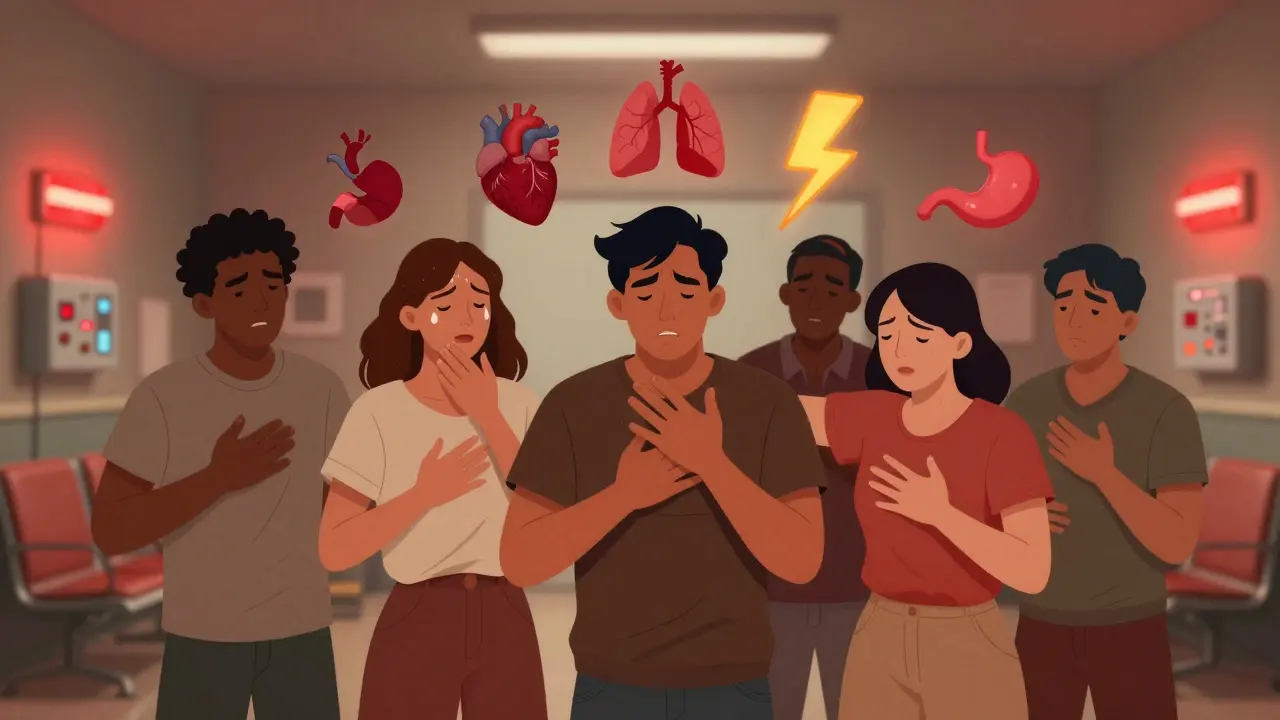
When your chest hurts, your brain screams heart attack. But not every ache means your heart is failing. Chest pain is one of the most common reasons people rush to the emergency department - and also one of the most misunderstood. About 6 to 8 million people in the U.S. show up with chest pain every year. Only 10 to 15% of them are having a heart attack. The rest? Anxiety, acid reflux, muscle strain, lung issues, or something else entirely. The problem isn’t just the pain - it’s knowing when to panic and when to wait.
What Chest Pain Really Looks Like
Chest pain isn’t always a sharp stab or a crushing weight. The 2021 American Heart Association guidelines define it broadly: pressure, tightness, burning, or discomfort in the chest, shoulders, arms, neck, jaw, upper back, or even the upper belly. It can come with shortness of breath, nausea, cold sweat, or sudden fatigue. These are called anginal equivalents - signs your heart might be starved for oxygen, even if you don’t feel classic chest pain.Think about it this way: a 68-year-old woman with diabetes might not feel chest pressure at all. Instead, she feels like she’s been hit by a truck - exhausted, dizzy, nauseous. She doesn’t think it’s her heart. But that’s exactly how many heart attacks present in women, older adults, and people with diabetes. Ignoring those symptoms because they don’t match the movies can be deadly.
When You Must Go to the Emergency Department
Don’t wait. Don’t call a friend. Don’t Google it. If you’re experiencing any of these, call emergency services (000 in Australia) right away:- Chest pain that lasts more than 10 minutes and doesn’t go away with rest or antacids
- Pain that spreads to your arm, jaw, neck, or back
- Breaking out in a cold sweat for no reason
- Shortness of breath that comes with chest discomfort
- Dizziness, fainting, or feeling like you’re about to pass out
- Nausea or vomiting with chest pressure
- Heart rate over 100 beats per minute or very low blood pressure
- Crackling sounds in your lungs or swelling in one leg
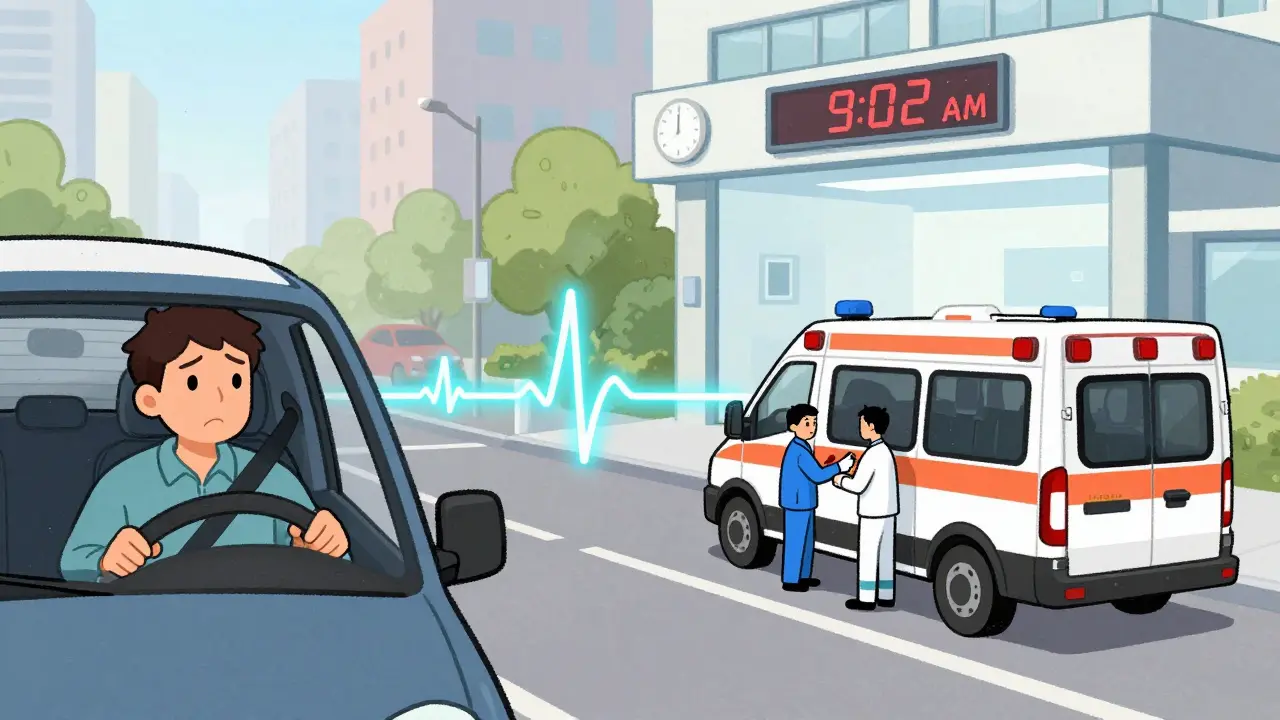
These aren’t guesses. These are red flags backed by clinical evidence. If you have any of these, your body is screaming for immediate help. Emergency medical services (EMS) can start treatment on the way - like giving you aspirin, oxygen, or a 12-lead ECG - and alert the hospital before you even arrive. Driving yourself? That increases your risk of complications by 25 to 30%.
What Happens in the Emergency Department
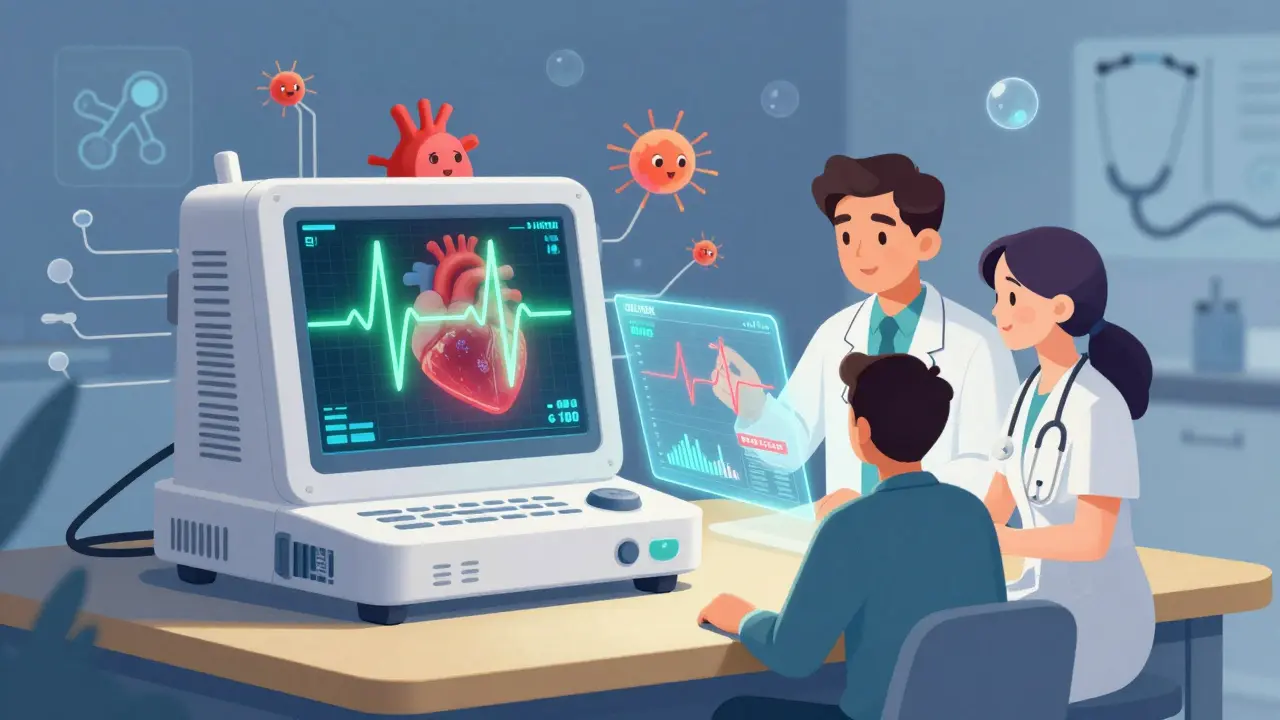
When you arrive, the first thing they do is check if you’re sick or not sick. That’s the clinical gut check. Are you pale? Sweating? Gasping? Is your heart racing? Are you confused? If yes - they move fast.Within 10 minutes of arrival, you’ll get a 12-lead ECG. It’s not optional. It’s mandatory. This simple test can show if you’re having a STEMI - a full blockage in a heart artery. If it does, they activate the cath lab immediately. The goal? Get you to the angioplasty table in under 90 minutes. Every minute counts.
At the same time, they’ll draw blood for a high-sensitivity troponin test. Troponin is a protein released when heart muscle is damaged. The old tests took hours. The new ones? They can rule out a heart attack in as little as one to two hours. About 70 to 80% of chest pain patients can be safely sent home within that window - no unnecessary scans, no overnight stays.
But here’s the catch: these fast protocols only work with modern high-sensitivity troponin assays. If your hospital still uses old equipment, the timeline stretches. That’s why knowing your local hospital’s capabilities matters - especially if you’re at risk.
What They Look For Beyond the Heart
The ER team doesn’t just check for heart attacks. They rule out other life-threatening causes:- Pulmonary embolism: A blood clot in the lung. Often presents with sudden shortness of breath and sharp, stabbing chest pain that gets worse when you breathe.
- Aortic dissection: A tear in the main artery. Pain feels like a ripping or tearing sensation, often starting in the chest and moving to the back.
- Pneumonia or pleurisy: Inflammation in the lungs or lining. Pain is sharp and worsens with breathing or coughing.
- GERD or esophageal spasm: Burning pain behind the breastbone, often after eating, relieved by antacids.
- Costochondritis: Inflammation of the rib cartilage. Pain is localized, tender to touch, and gets worse with movement.
Doctors use tools like the HEART score - a simple checklist of History, ECG, Age, Risk factors, and Troponin - to decide if you’re low, medium, or high risk. A score of 0 to 3? You’re likely safe to go home with follow-up. A score of 7 to 10? You’re going straight to the cath lab.
Why You Shouldn’t Wait or Self-Diagnose
Too many people delay because they think it’s “just gas” or “stress.” One patient in Perth told me he ignored chest pressure for three days because he was “too busy.” He ended up in the ER with a blocked artery and a 70% heart attack. He survived. But he lost months of his life recovering.Another common mistake: taking nitroglycerin or aspirin without knowing if it’s safe. Aspirin helps if it’s a heart attack - but if it’s a bleeding ulcer or aortic tear, it could make things worse. Nitroglycerin lowers blood pressure. If your blood pressure is already low - say, from a pulmonary embolism - it can drop you into shock.
Bottom line: if you’re unsure, go. The worst-case scenario isn’t embarrassment. It’s dying because you waited.
What Happens After the Emergency
If you’re cleared of a heart attack, you still need follow-up. Many people leave the ER thinking they’re fine - but they might have INOCA (ischemia with nonobstructive coronary arteries). That’s when your heart doesn’t get enough blood, even though no artery is blocked. It’s real. It’s common. And it’s often missed.For these patients, stress tests or cardiac MRI might be needed later. Some might need medications like beta-blockers or nitrates. Others need lifestyle changes - quitting smoking, managing blood pressure, starting cardiac rehab.
Even if you’re low risk, don’t ignore recurring symptoms. A single episode of chest pain could be a warning sign of something building. That’s why the guidelines stress shared decision-making: you and your doctor talk about risks, costs, radiation exposure from scans, and alternatives. You’re not just a case number. You’re the person who lives with the outcome.
What’s Changing in 2025
AI is starting to play a role. Early studies show algorithms can detect subtle ECG changes humans miss - like tiny ST-segment shifts that signal early ischemia. By 2025, 75% of U.S. hospitals are expected to use AI-assisted ECG interpretation. That means faster, more accurate diagnoses - especially in places with fewer specialists.In Australia, the rollout is slower but steady. Major hospitals in Perth, Sydney, and Melbourne are already testing these tools. The goal? Cut diagnosis time by 15 to 20 minutes. That’s not just efficiency - it’s lives saved.
The 2021 AHA/ACC guidelines are still the gold standard. No major overhaul is expected until 2026. But experts agree on one thing: the future of chest pain evaluation is faster, smarter, and more personalized. And it starts with you knowing when to act.
Is chest pain always a sign of a heart attack?
No. Only about 10 to 15% of chest pain cases in emergency departments turn out to be heart attacks. Other causes include acid reflux, muscle strain, anxiety, lung infections, or inflammation of the rib cartilage. But because heart attacks can be silent or atypical, it’s never safe to assume it’s "just something else." Always get checked.
Can I drive myself to the hospital if I have chest pain?
It’s strongly discouraged. Calling emergency services (000) is safer. EMS crews can start treatment en route - like giving you aspirin, oxygen, or a 12-lead ECG - and alert the hospital before you arrive. Driving yourself increases your risk of complications by 25 to 30%, especially if you suddenly lose consciousness or go into cardiac arrest.
What’s the most important test for chest pain?
The 12-lead electrocardiogram (ECG). It’s fast, cheap, and gives critical information within minutes. It can detect a heart attack in progress, especially ST-elevation myocardial infarction (STEMI). Even if the ECG looks normal, it still helps rule out certain conditions and guides further testing. Every emergency department is required to get an ECG within 10 minutes of arrival.
Can high-sensitivity troponin tests rule out a heart attack quickly?
Yes - if your hospital uses modern high-sensitivity assays. With these tests, doctors can rule out a heart attack in 1 to 2 hours using a zero and one-hour protocol. About 70 to 80% of chest pain patients can be safely discharged after this. But older troponin tests take longer and aren’t reliable for rapid rule-out. Always ask if your hospital uses the newer version.
What if I have chest pain but no heart disease risk factors?
You still need evaluation. Heart attacks can happen in people with no traditional risk factors - like young, fit individuals with genetic conditions, smoking, or severe stress. Women, especially, often present without classic symptoms. Age and risk factors help doctors assess probability, but they don’t eliminate the need for testing. Never assume you’re "too young" or "too healthy" to have a heart issue.
Should I take aspirin before going to the ER?
Only if you’re certain it’s a heart attack and you don’t have a known allergy or bleeding disorder. Chewing one 325mg aspirin can help reduce damage during a heart attack. But if your pain is from a different cause - like a torn artery or stomach ulcer - aspirin could make it worse. If you’re unsure, wait until you’re in the ER. Don’t self-medicate.
What is INOCA, and why does it matter?
INOCA stands for ischemia with nonobstructive coronary arteries. It means your heart isn’t getting enough blood, even though no artery is blocked. It affects 5 to 10% of chest pain patients and is often missed because standard tests like angiograms show "normal" arteries. Symptoms can be just as disabling as a heart attack. Treatment may include medications, lifestyle changes, or specialized testing like stress MRI or coronary flow reserve studies.
Can AI really help diagnose chest pain faster?
Yes. Early AI tools can detect subtle ECG patterns humans overlook - like tiny changes in ST segments or T waves that signal early ischemia. Studies show these systems are over 98% accurate in identifying these signs. By 2025, most major hospitals will use AI to support ECG interpretation, reducing diagnosis time by 15 to 20 minutes. That’s not just convenience - it’s saving heart muscle.
What to Do Next
If you’ve had chest pain - even once - schedule a follow-up with your GP or a cardiologist. Don’t wait until it happens again. Ask about your HEART score, whether your hospital uses high-sensitivity troponin, and if you need further testing like a stress test or echocardiogram.Know your risk factors: high blood pressure, high cholesterol, smoking, diabetes, family history, obesity. Even if you feel fine, managing these matters. And if you live alone or have a history of heart disease, make sure someone knows your plan - what to do, who to call, where your medications are.
Heart attacks don’t wait. Neither should you.


13 Comments
I know this sounds wild, but have you ever considered that the whole chest pain emergency system is just a big money grab by hospitals and pharmaceutical companies? They push all these tests because they make bank off them. I’ve seen people get pumped full of contrast dye and radiation for nothing. The real cause? Electromagnetic pollution from 5G towers messing with your heart rhythm. They don’t tell you that. But I’ve got the scans. And the data. And I’m not crazy - I just know what they’re hiding.
Your article contains multiple grammatical errors and inconsistent punctuation. For instance, you write '000 in Australia' - that’s incorrect. It’s 000 in Australia, but 911 in the U.S., and 112 in the EU. Also, 'anginal equivalents' is not capitalized consistently. And you use 'ECG' and 'electrocardiogram' interchangeably without defining the acronym on first use. This is amateurish. The science is sound, but the presentation undermines credibility. Fix your orthography before publishing again.
The human body has always communicated in ways beyond the clinical lexicon. Chest pain, in its many forms, is not merely a physiological event - it is a cry of the soul, a disruption in the harmony between mind and matter. Modern medicine, with its algorithms and troponin assays, seeks to quantify the ineffable. Yet, in the silence after the ECG, after the discharge papers, what remains is the question: did we heal the person, or merely diagnose the symptom? Perhaps the most vital test is not the one performed in the ER, but the one taken in the stillness of the evening, when one asks - why now? And what have I ignored?
The HEART score has well-documented limitations in low-prevalence populations. Sensitivity drops below 85% in patients under 45 without traditional risk factors. The high-sensitivity troponin protocols assume a Gaussian distribution of biomarkers, which is invalid in metabolic syndrome cohorts. Also, AI-assisted ECG interpretation is still prone to adversarial artifacts - particularly in patients with atrial fibrillation or paced rhythms. The literature from the 2023 JACC meta-analysis confirms this. You’re oversimplifying a complex diagnostic ecosystem.
Let me tell you something they don’t want you to know. The entire emergency chest pain protocol is a scam orchestrated by the AMA, the FDA, and Big Pharma. They need you scared. They need you coming in. They need you getting stents, getting prescriptions, getting billed. That ‘90-minute cath lab’ target? It’s not about saving lives - it’s about hitting revenue targets. And those ‘high-sensitivity troponin’ tests? They’re designed to catch *everyone* - even the healthy - so they can label you ‘at risk’ and sell you statins for the next 40 years. Wake up. This isn’t medicine. It’s a profit engine.
Honestly, I’m appalled by how casually this is being presented. Chest pain isn’t some ‘maybe it’s heartburn’ situation - it’s a profound existential crisis disguised as physiology. People treat it like a minor inconvenience, when in reality, it’s the body’s final, desperate plea before collapse. And now we’re talking about AI? As if reducing human suffering to a machine-learning model is progress. Please. We’ve lost our way. This isn’t innovation - it’s dehumanization dressed in white coats.
I read this whole thing. And I’m just gonna say it - you’re wrong. I had chest pain for 3 weeks. Went to the ER. They said ‘it’s anxiety.’ I went to a second doctor. Said ‘costochondritis.’ Third doctor - said ‘it’s your posture.’ I didn’t have a heart attack. But I also didn’t get better. So now I’m just supposed to trust the HEART score? That’s a 3-minute checklist. What if your ‘history’ is ‘I’m a 30-year-old vegan who doesn’t smoke’? You’re still labeled low risk. Meanwhile, my left arm still goes numb at 3 a.m. So yeah - I’m not convinced.
I get what you’re saying but honestly? I think we’re overcomplicating this. Like, if your chest hurts and you’re sweating, just go to the ER. Who cares if it’s gas or a heart attack? Better safe than sorry. Also, AI is kinda cool? 🤖❤️ I watched a TikTok about it and now I’m obsessed. Maybe one day my Fitbit will just call 911 for me. That’s the future.
In my community, many elders avoid the ER because they fear the cost, the language barrier, or the stigma of being a burden. I’ve translated these guidelines into Spanish and Hmong for my patients. The real challenge isn’t the science - it’s access. If someone can’t get to a hospital with high-sensitivity troponin, the guidelines mean nothing. We need community health workers, mobile units, and culturally competent triage - not just algorithms. Medicine is not just about what’s in the test tubes - it’s about who’s holding them.
so like i read this whole thing and honestly? i think theyre just tryna scare ppl into going to the er. i had chest pain last year and it was just my bra too tight lmao. also why do they always say 'call 911' but never say 'dont drive yourself' in big letters? like bro i drove myself and i lived. also ai? are we getting robot doctors now? that sounds like a nightmare.
I just want to say - thank you for writing this. I lost my dad to a silent heart attack. He thought it was indigestion. He didn’t want to bother anyone. I wish someone had told him - gently - that it’s okay to be scared. That it’s okay to go. That asking for help isn’t weakness. You didn’t just write a medical guide. You wrote a lifeline. And for that, I’m truly grateful.
This is all fake. The heart attack stats are manipulated. The WHO and CDC are in bed with the medical-industrial complex. In India, we see people die from chest pain because they can't afford tests - yet here you talk about AI and troponin as if everyone has access. This is Western elitism wrapped in science. Real medicine is in the herbs, the breath, the fasting. Not in machines. Not in labs. Not in your algorithms. You're missing the point.
This is exactly the kind of info we need more of. I work in a rural clinic - we don’t have AI, we don’t have high-sensitivity troponin, but we have people who care. I showed this to my team and we’re making a poster for the waiting room. Simple. Clear. No jargon. Just: ‘If you’re unsure - go. You’re not overreacting. You’re being smart.’ And yeah - I’m gonna print this out and give it to my mom. She’s 67. She’s got diabetes. She doesn’t know any of this. Thank you.