
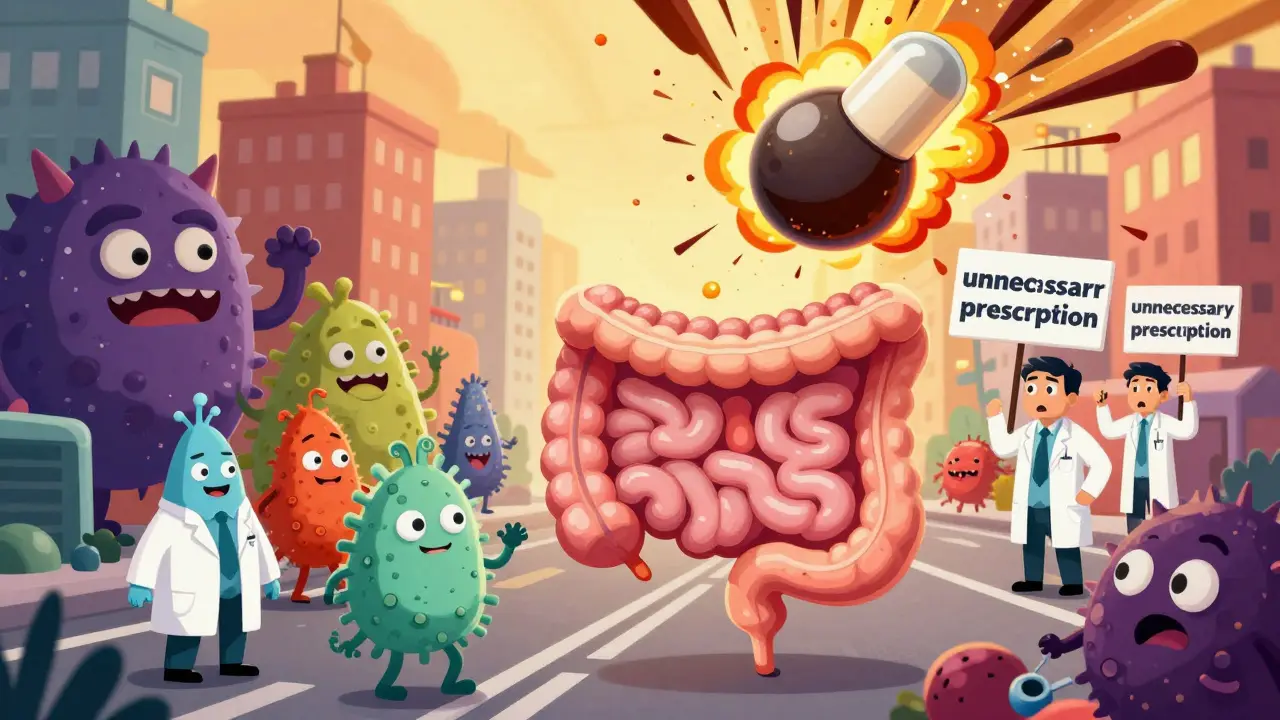
Every year, millions of people take antibiotics. Many feel better quickly. But for too many, the relief comes with a hidden cost: severe diarrhea, allergic reactions, yeast infections, or even life-threatening complications like Clostridioides difficile (C. diff) colitis. The problem isn’t always the drug itself-it’s how and when it’s used.
Why Antibiotics Can Hurt Even When They’re Needed
Antibiotics are powerful. They kill bacteria. But they don’t pick and choose. When you take an antibiotic, it doesn’t just target the bad bugs causing your infection. It wipes out the good bacteria in your gut, mouth, and skin too. These good bacteria help digest food, train your immune system, and keep harmful microbes in check. When they’re gone, dangerous ones like C. diff can take over. The CDC reports that at least 30% of antibiotics prescribed in doctor’s offices and 20% in hospitals are unnecessary. That means nearly one in three courses of antibiotics given to patients in the U.S. offers no benefit but still carries risk. Unnecessary use doesn’t just fuel antibiotic resistance-it directly increases side effects. Patients who get antibiotics when they don’t need them are 7 to 10 times more likely to develop C. diff infections. And C. diff isn’t just uncomfortable. It can cause severe dehydration, organ failure, and even death.What Antibiotic Stewardship Actually Means
Antibiotic stewardship isn’t about avoiding antibiotics altogether. It’s about using them wisely. The formal definition from the CDC and Infectious Diseases Society of America is simple: the right drug, at the right time, in the right dose, for the right bug, for the right duration. This means:- Only prescribing antibiotics when there’s clear evidence of a bacterial infection-not for colds, flu, or most sore throats, which are viral.
- Choosing the narrowest-spectrum antibiotic that will work, instead of reaching for the broadest one “just in case.”
- Using the correct dose based on weight, kidney function, and infection severity.
- Stopping the antibiotic as soon as it’s safe to do so-often in 5 to 7 days, not the full 10 to 14 days that were once standard.
How Hospitals Are Getting It Right
In hospitals, stewardship programs work because they have structure. A typical program includes:- A clinical pharmacist with specialized training who reviews every antibiotic order daily.
- An infectious disease physician who advises on complex cases.
- Electronic alerts that prompt doctors to justify broad-spectrum antibiotics.
- Regular feedback-doctors see how their prescribing compares to peers.
Why Outpatient Stewardship Is Lagging-and How to Fix It
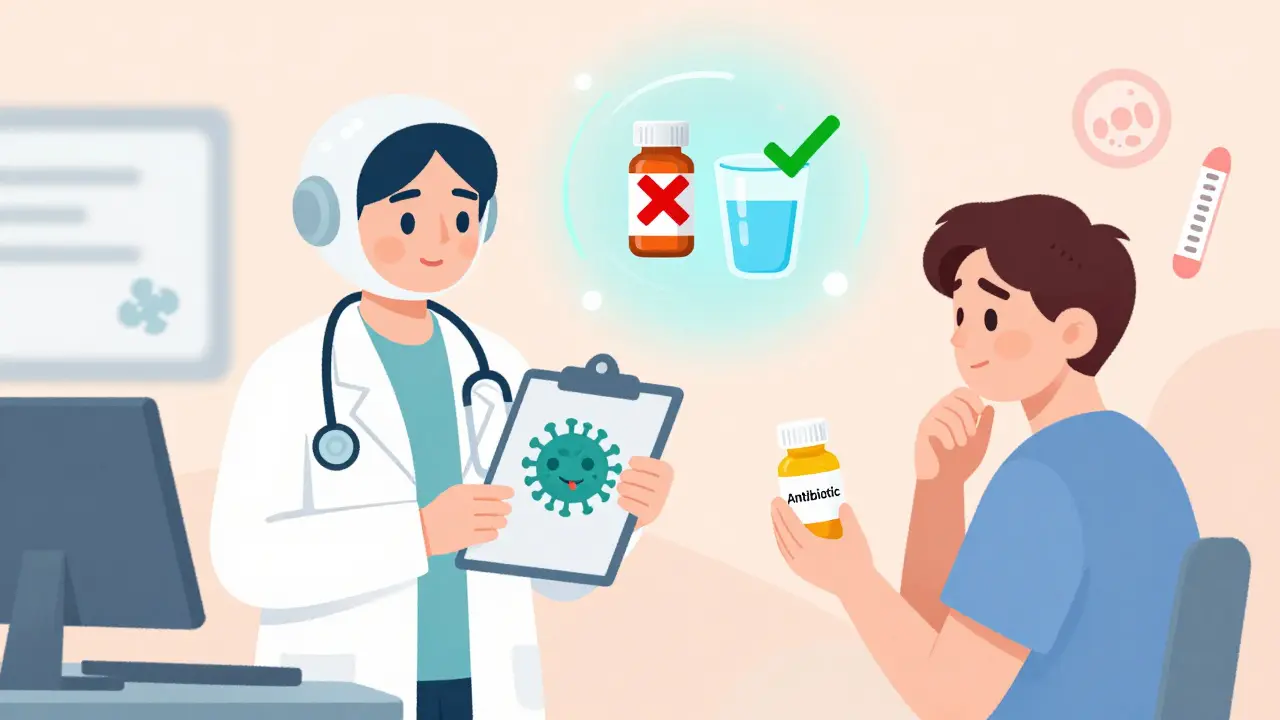
While hospitals have made progress, outpatient care is still a mess. In 2023, the CDC estimated that 47 million unnecessary antibiotic prescriptions are written each year in doctor’s offices and emergency rooms. Most are for viral infections: sinus infections, bronchitis, earaches in kids. Why? Doctors feel pressure. Patients expect a pill. Time is short. Many providers don’t have access to rapid tests or decision tools. The fix isn’t complicated:- Use delayed prescriptions: Give a script but tell the patient to wait 48 hours unless symptoms worsen.
- Offer symptom-based advice: “Here’s how to manage the pain and fever while your body fights the virus.”
- Use decision aids: Electronic systems that remind doctors, “This is likely viral-consider watchful waiting.”
- Train staff to explain why antibiotics won’t help-and what will.
The Real Cost of Not Acting
The financial cost of poor antibiotic use is staggering. The CDC estimates antibiotic-resistant infections cost the U.S. healthcare system $20 billion a year in extra care. But the human cost is worse. Every year, 35,000 Americans die from antibiotic-resistant infections. Many of those deaths are preventable. And for every death, dozens more suffer long-term damage: chronic diarrhea, kidney injury from nephrotoxic antibiotics, recurrent yeast infections, or even permanent gut microbiome disruption. The Joint Commission now requires all accredited U.S. hospitals to have an antibiotic stewardship program. That’s a big step. But only 48% of nursing homes have one. That’s dangerous. Elderly patients in long-term care are the most vulnerable to side effects. They’re often on multiple drugs, have weaker immune systems, and are exposed to antibiotics for longer periods.
What You Can Do-As a Patient or Caregiver
You don’t need to be a doctor to help. Here’s how you can protect yourself and your family:- Ask: “Is this really a bacterial infection? Could it be viral?”
- Ask: “Do I need an antibiotic right now, or can we wait?”
- Ask: “Is there a narrower, safer antibiotic I can take instead?”
- Never save antibiotics for later or share them with someone else.
- If you’re on antibiotics, take them exactly as prescribed-no skipping doses, no stopping early unless your doctor says so.
- Consider probiotics during and after treatment-some studies show they reduce diarrhea risk by 40-60%.
The Future Is Smarter, Not Stronger
The next big leap in stewardship isn’t a new drug-it’s better tools. Artificial intelligence is being tested to predict which patients truly need antibiotics based on symptoms, lab results, and even voice patterns in coughs. Rapid diagnostic tests that give results in under an hour are becoming more common in clinics. In the next five years, we’ll likely see AI-powered alerts in electronic health records that say: “Patient has viral symptoms. Antibiotic not indicated. Consider watchful waiting.” The World Health Organization calls antibiotic stewardship one of the three pillars of global health security-alongside infection control and patient safety. Without it, we risk returning to a time when a simple cut or childbirth could be deadly. This isn’t about limiting care. It’s about protecting it. Better antibiotic use means fewer side effects, fewer hospitalizations, fewer deaths-and more treatments that still work when we really need them.Are antibiotics always necessary for infections like sinusitis or bronchitis?
No. Most sinus infections and nearly all cases of bronchitis are caused by viruses, not bacteria. Antibiotics won’t help and increase your risk of side effects like diarrhea or yeast infections. Watchful waiting, hydration, and symptom relief are usually the best approach. Only if symptoms last more than 10 days or worsen after initial improvement should antibiotics be considered.
Can taking antibiotics lead to long-term gut problems?
Yes. Antibiotics can disrupt the balance of your gut microbiome for months or even years after use. This imbalance is linked to chronic diarrhea, increased risk of obesity, inflammatory bowel disease, and even mood disorders. The more often you take antibiotics, especially broad-spectrum ones, the greater the risk. Limiting unnecessary use is the best way to protect your gut health long-term.
What is C. diff, and why is it linked to antibiotics?
Clostridioides difficile (C. diff) is a bacteria that causes severe diarrhea and inflammation of the colon. It thrives when normal gut bacteria are wiped out by antibiotics. Up to 20% of people who take antibiotics develop some form of C. diff infection. It’s especially dangerous for older adults and those with weakened immune systems. Hospital-based antibiotic stewardship programs have reduced C. diff rates by 25-30% by cutting unnecessary prescriptions.
Do probiotics help reduce antibiotic side effects?
Yes. Multiple studies show that taking probiotics-especially strains like Lactobacillus rhamnosus GG and Saccharomyces boulardii-during and after antibiotic treatment can reduce the risk of antibiotic-associated diarrhea by 40-60%. They don’t replace antibiotics, but they help protect your gut while you’re taking them. Talk to your doctor about which type and dose is right for you.
Why do doctors sometimes prescribe broad-spectrum antibiotics even when they’re not needed?
Doctors often prescribe broad-spectrum antibiotics out of caution-especially in urgent situations where they’re unsure of the exact cause. Fear of missing a serious infection, time pressure, or patient expectations can lead to overprescribing. Stewardship programs help by providing better diagnostic tools, clear guidelines, and peer feedback so doctors feel confident choosing narrower, safer options.
Is antibiotic stewardship only for hospitals?
No. While hospitals have made the most progress, stewardship is just as critical in doctor’s offices, urgent care centers, and nursing homes. In fact, most unnecessary antibiotic use happens in outpatient settings. Programs that give clinicians access to rapid tests, decision aids, and training are proving effective in clinics too. The CDC now recommends stewardship in all healthcare settings where antibiotics are prescribed.



11 Comments
So let me get this straight-we’re giving out antibiotics like they’re candy at Halloween, then acting shocked when people start pooping blood? Yeah, that’s not a medical crisis, that’s a farce wrapped in a white coat.
Procalcitonin is the unsung hero of ICU stewardship. If your doc doesn’t order it for suspected pneumonia, they’re either lazy or scared of being sued. Either way, you’re getting a broad-spectrum shotgun blast when a sniper rifle would do.
It’s funny how we worship science until it asks us to wait. We want magic pills, not patience. The gut is a temple, not a trash can for antibiotics. We’ve forgotten how to let the body heal itself. We’ve outsourced immunity to Big Pharma.
I had C. diff after a simple sinus infection. Took me six months to feel normal again. No one warned me. No one even asked if I’d had antibiotics before. This isn’t just clinical-it’s personal. We need better communication, not just better guidelines.
...In India, we don't have access to these fancy tests... but we also don't have the same overprescribing... because most people can't afford antibiotics... so they wait... and sometimes... they die... but at least... they don't get C. diff...? I don't know... I'm confused...
...maybe we need both... better access... and better restraint...
...sorry... I'm not good with words...
...but this matters...
...please... think about this...
...thank you...
...from a quiet village in Kerala...
Parents, listen: if your kid has an ear infection and a fever, it’s tempting to demand antibiotics. But 80% of ear infections clear on their own. Try pain relief, warm compresses, and patience. If it doesn’t improve in 48 hours, go back. You’re not being a bad parent-you’re being a smart one. Your child’s microbiome will thank you.
Antibiotics are the nuclear option of medicine. We fire them off like confetti at a parade, then wonder why the whole damn city’s in ruins. The gut isn’t just a pipe-it’s a rainforest. Wipe out the toucans and the monkeys, and the termites take over. And nobody talks about the termites. But they’re the ones eating the house.
AMERICA IS THE GREATEST COUNTRY ON EARTH AND WE DON’T NEED TO LISTEN TO THESE EUROPEAN DOCTORS TELLING US HOW TO MEDICINE! 🇺🇸💊
My uncle took 14 days of antibiotics for a cold in 1987 and he’s still alive! So what’s your problem??
Also, probiotics are for hippies and people who think yoga fixes everything. 🙄
Antibiotic stewardship is a neoliberal construct designed to reduce healthcare expenditures under the guise of patient safety. The real issue is systemic underfunding of diagnostics. Without rapid point-of-care molecular testing, stewardship is performative. You cannot steward what you cannot measure. The CDC's metrics are outdated and lack ecological validity.
I used to take antibiotics for every sniffle. Now I have chronic yeast infections, bloating, and depression. My doctor said it was 'just stress.' Turns out, my gut was dead. I’m not mad-I’m just done. If you’re still giving out antibiotics like candy, you’re not a doctor. You’re a liability.
So you’re telling me the entire U.S. healthcare system is built on fear and convenience? And the only solution is to make doctors actually think? Brilliant. Let’s just ban all smartphones and hope they read a textbook. 🤡