
Wrist pain that keeps you up at night? Tingling in your fingers that feels like pins and needles? If you’ve been shaking out your hand like you’re trying to dry it after washing, you’re not alone. Carpal tunnel syndrome is one of the most common nerve problems affecting the hand and wrist - and it’s not just from typing too much. It’s a real, measurable condition caused by pressure on the median nerve as it squeezes through a tight tunnel in your wrist. Left untreated, it can lead to permanent weakness and loss of function. But here’s the good news: most cases respond well to simple, early steps - and surgery works extremely well when it’s needed.
What Exactly Is Carpal Tunnel Syndrome?
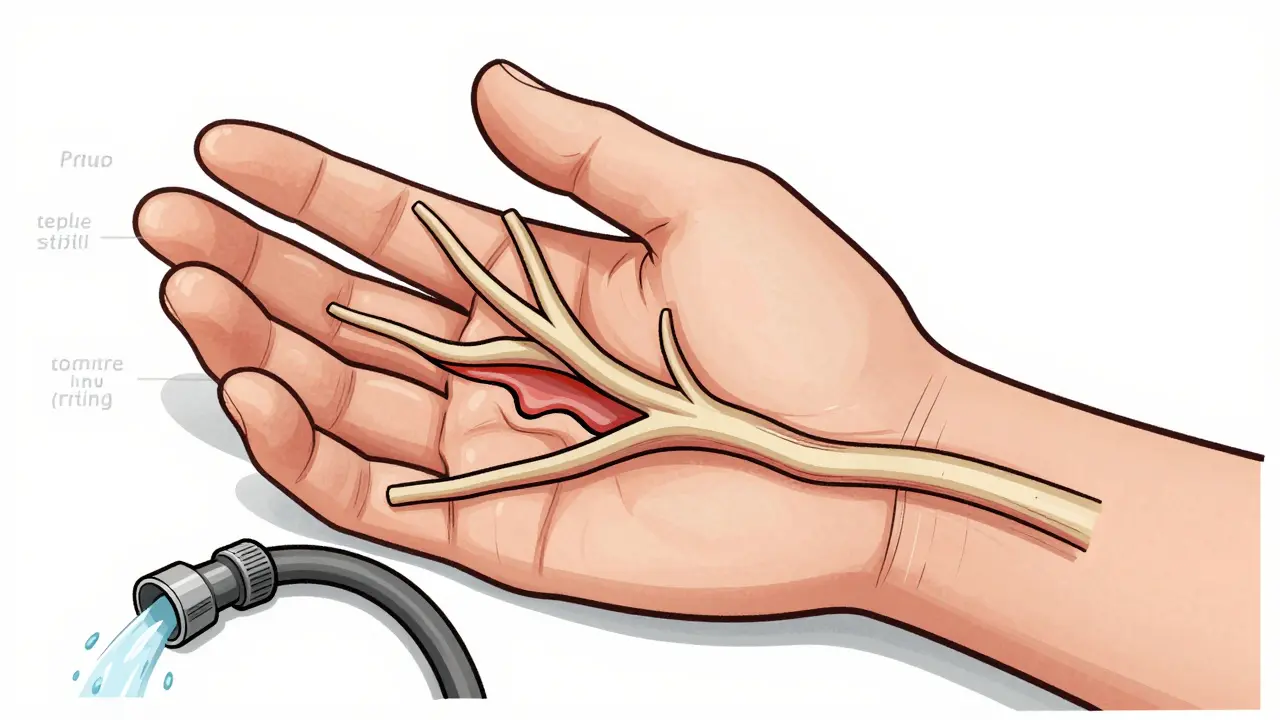
Carpal tunnel syndrome isn’t just "a sore wrist." It’s a specific nerve compression problem. Inside your wrist, there’s a narrow passage called the carpal tunnel, made of bones on the bottom and a tough ligament on top. Through this tunnel, nine tendons and the median nerve travel from your forearm into your hand. The median nerve controls sensation in your thumb, index, middle, and half of your ring finger. It also powers the small muscles at the base of your thumb. When that tunnel gets too crowded - from swelling, fluid retention, or repetitive motion - the nerve gets pinched. Think of it like stepping on a garden hose: the flow stops, and the part downstream starts to feel numb or tingly. In carpal tunnel, that’s your fingers. Normal pressure inside the tunnel is 2-10 mmHg. When it climbs above 30 mmHg, nerve damage starts to happen. That’s not guesswork - it’s measured in nerve conduction tests.Who Gets It and Why?
You might assume it’s office workers typing all day. But data from the CDC and NIOSH shows otherwise. While repetitive motion plays a role, the biggest risk factors are things you can’t always control:- Gender: Women are three times more likely to develop it than men.
- Age: Peak incidence is between 45 and 60.
- Obesity: A BMI over 30 increases risk by 2.3 times.
- Occupation: Meatpackers, assembly line workers, and dental hygienists have incidence rates up to 15%. Office workers? Around 2%.
- Pregnancy: Hormonal shifts cause fluid buildup - 70% of cases resolve on their own after birth.
- Diabetes: Poorly controlled blood sugar slows nerve healing.
What Does It Feel Like?
The symptoms are unmistakable once you’ve experienced them:- Numbness or tingling in the thumb, index, middle, and half of the ring finger - never the pinky. That’s the median nerve’s territory.
- Waking up at night with your hand "falling asleep." Eighty-nine percent of patients report nighttime symptoms.
- Shaking or flicking your hand to get feeling back - the classic "flick sign."
- Weak grip. You drop things. Opening jars becomes hard. You notice your thumb muscles are shrinking - that’s thenar atrophy, a sign of advanced nerve damage.
- Pain that radiates up the forearm, sometimes to the shoulder.
How Is It Diagnosed?
You can’t diagnose carpal tunnel with a quick glance. Doctors rely on two things: your symptoms and objective tests.- Nerve conduction studies are the gold standard. They measure how fast electrical signals travel through the median nerve. If the motor latency is over 4.2 milliseconds or sensory speed drops below 45 m/s, the diagnosis is confirmed.
- Physical exams like Phalen’s maneuver (bending wrists for 60 seconds) or Tinel’s sign (tapping over the nerve) can suggest CTS, but they’re not reliable alone.
- Ultrasound is increasingly used to visualize swelling in the nerve or thickening of the ligament - it’s faster and cheaper than nerve tests, though not yet standard everywhere.

Non-Surgical Treatments: What Actually Works?
For mild to moderate cases, especially if caught early, you don’t need surgery. Here’s what works - and what doesn’t:- Nocturnal wrist splinting: Wearing a splint at night to keep your wrist straight reduces pressure on the nerve. Studies show it helps 40-60% of patients with symptoms under 10 months. But compliance is low - only 52% wear it consistently. If you’re going to try it, wear it for at least 6-8 hours nightly for 6-8 weeks.
- Corticosteroid injections: These reduce inflammation around the nerve. About 60-70% of patients get relief lasting 3-6 months. But repeated injections may cause tissue scarring and make future surgery harder. Harvard researchers found a 18% increase in surgical complications after multiple shots.
- Activity modification: Avoid forceful gripping, repetitive wrist flexing, or vibrating tools. Use ergonomic tools. Keep your wrist neutral - no more than 15 degrees of extension.
- Ultrasound-guided injections: Newer technique. More accurate than blind injections. Shows 20% higher success in targeting the nerve.
Surgery: When and How?
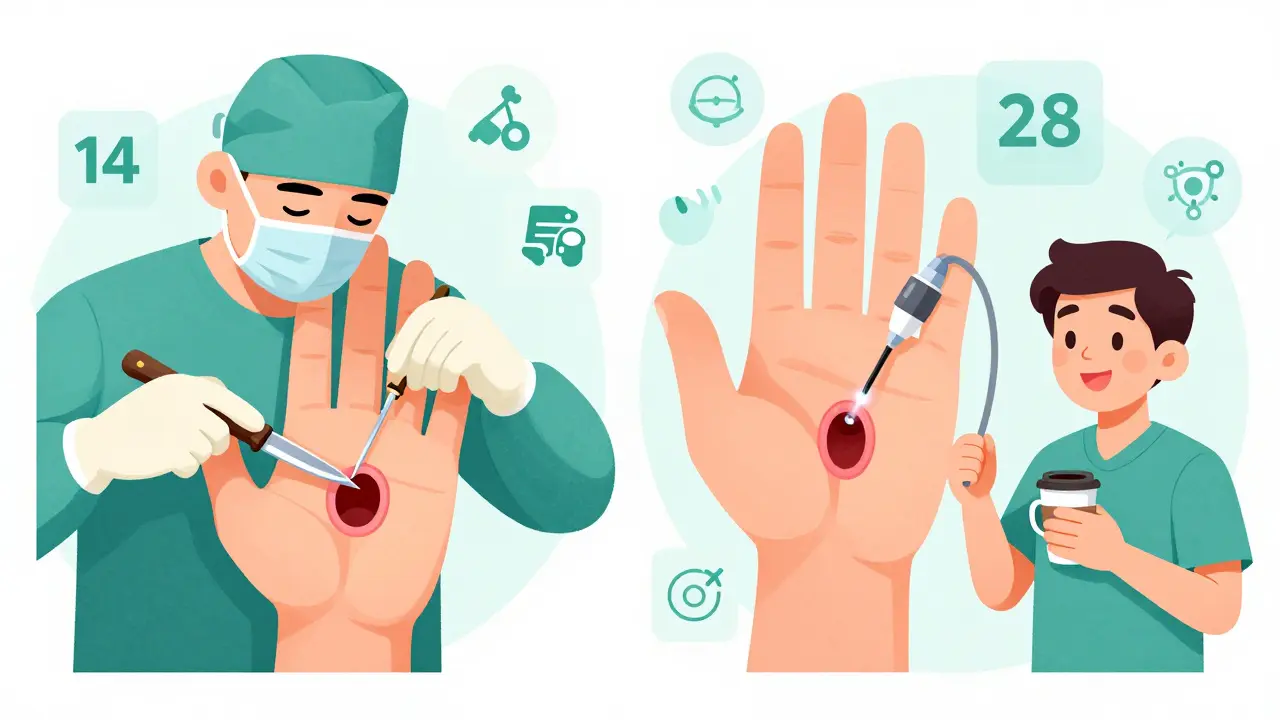
If you have constant numbness, muscle wasting, or symptoms lasting over a year, surgery is the best option. Success rates? 75-90%. There are two main types:- Open carpal tunnel release: The surgeon makes a 2-3 inch cut in the palm, cuts the ligament, and relieves pressure. This is done in 90% of cases. Recovery takes 4-6 weeks for light work, 8-12 weeks for manual labor.
- Endoscopic carpal tunnel release: One or two small incisions, a camera inserted, and the ligament cut from inside. Recovery is faster - average 14 days versus 28 for open surgery. But it requires specialized training. Surgeons need to do at least 20 procedures to match open surgery’s safety profile.
What Happens After Surgery?
Recovery isn’t instant. Here’s what to expect:- Immediate: Finger movement starts the same day. No need to keep your hand immobilized.
- Days 1-10: Keep the dressing dry. Sutures removed at 10-14 days.
- Weeks 2-4: Light activities. Desk work is usually fine. Avoid lifting more than 5 lbs.
- Weeks 4-8: Gradual strengthening. Start gentle grip exercises. Physical therapy is rarely needed unless you’re a manual laborer.
- Months 2-3: Full grip strength returns. For manual workers, it takes 8-12 weeks. For office workers, often 2-4 weeks.
Real Patient Experiences
Patient reviews tell a mixed story. On Healthgrades, CTS surgery averages 3.8 out of 5 stars. 68% report major improvement. But 22% still deal with persistent palm pain. Reddit’s r/HandSurgery community is full of honest takes:- "I wore the splint for two weeks, then gave up. It felt like a cast I couldn’t take off."
- "I went back to my keyboard after 10 days. My hand felt fine - until I tried opening a pickle jar."
- "I’m a barista. I thought my wrist pain was just from pulling espresso shots. Turns out, it was CTS. Surgery fixed it in 3 weeks."
- "They didn’t warn me about the palm pain. I thought the surgery failed."
What’s New in 2026?
The field is evolving:- Thread carpal tunnel release: A minimally invasive technique used in Europe. A thin thread is threaded under the ligament and pulled to cut it. Early results show 85% success. Not yet FDA-approved in the U.S., but under review.
- Biomarkers: Researchers are looking for blood or fluid markers that can detect nerve stress before symptoms start. Early detection could prevent damage.
- Ergonomic redesign: Factories using adjustable workstations and anti-vibration tools have cut CTS rates by 40%. The future isn’t just surgery - it’s prevention.
When to See a Doctor
Don’t wait until your thumb looks like it’s shrinking. See a hand specialist if:- Symptoms last more than 2 weeks and don’t improve with rest or splinting.
- You wake up every night with numb hands.
- You’re dropping things or losing grip strength.
- You have diabetes, thyroid disease, or are pregnant and have persistent wrist pain.
Final Thoughts
Carpal tunnel syndrome isn’t a myth. It’s not "just carpal tunnel" - it’s a measurable nerve compression with clear diagnostic criteria and proven treatments. It’s not caused by typing. It’s caused by pressure. And pressure can be relieved - either by reducing swelling or by cutting the ligament that’s squeezing the nerve. If you’re in pain, don’t assume it’s just aging or overuse. Get it checked. The sooner you act, the less likely you are to need surgery - and the better your outcome will be if you do.Can carpal tunnel syndrome go away on its own?
Yes - but only in specific cases. Pregnancy-related carpal tunnel resolves on its own in about 70% of women within three months after giving birth. Mild cases caught early (under 3 months) may improve with splinting and activity changes. But if symptoms are constant, worsening, or include muscle weakness, it won’t fix itself. Nerve damage accumulates over time, and once it’s severe, it’s often permanent.
Is carpal tunnel caused by typing too much?
No. A 2023 review in the New England Journal of Medicine found no significant link between computer use and carpal tunnel syndrome. The odds ratio was 1.05 - essentially no risk increase. What does raise risk? Forceful gripping (over 20 kg), repetitive wrist flexion, and vibration. Jobs like meatpacking, assembly line work, or dental hygiene carry much higher risk than office work.
How long does it take to recover from carpal tunnel surgery?
Recovery varies by job and surgery type. Desk workers often return to work in 2-4 weeks. Manual laborers need 8-12 weeks. Endoscopic surgery has a faster recovery - about 14 days on average - compared to 28 days for open surgery. Full grip strength typically returns in 6-8 weeks. Nighttime symptoms usually disappear immediately after surgery, but healing of the nerve itself takes time.
Are steroid injections safe for carpal tunnel?
Yes - but only if used wisely. A single injection gives 3-6 months of relief for 60-70% of patients. It’s a good option for moderate cases or as a bridge to surgery. But repeated injections (more than two or three) can cause tissue scarring, which makes future surgery more difficult and increases complication risk by 18%. Don’t rely on them as a long-term solution.
What happens if I ignore carpal tunnel syndrome?
Ignoring it can lead to permanent damage. The median nerve can lose its ability to send signals, causing constant numbness and loss of sensation. The muscles at the base of your thumb can waste away - this is called thenar atrophy. Once that happens, even surgery can’t restore full strength or feeling. Early treatment prevents this. Waiting too long turns a treatable condition into a lifelong disability.
Can I prevent carpal tunnel syndrome?
You can reduce your risk. Avoid forceful gripping, especially over 20 kg. Take breaks from repetitive wrist motions. Keep your wrists neutral - don’t bend them up or down for long periods. Use ergonomic tools. Maintain a healthy weight. If you have diabetes, keep your blood sugar under control. For workers in high-risk jobs, workplace redesign (like adjustable workstations) can cut incidence by 40%.
Is carpal tunnel surgery worth it?
For moderate to severe cases, yes. Success rates are 75-90%. Most patients report immediate relief from nighttime numbness. Grip strength returns in 6-8 weeks. The biggest downside is pillar pain - tenderness on the sides of the palm - which affects 15-30% of people but usually fades over time. If you’ve tried splinting and injections without success, surgery is the most reliable way to stop the progression and restore function.
What’s the difference between open and endoscopic carpal tunnel surgery?
Open surgery uses a 2-3 inch incision in the palm to cut the ligament directly. Endoscopic uses one or two small cuts and a camera to cut the ligament from inside. Endoscopic has faster recovery (14 vs. 28 days) and less visible scarring. But it requires more surgeon training - a learning curve of 20 procedures to match open surgery’s safety. Long-term results are the same after 6 months. Open is still done in 90% of cases because it’s reliable and widely available.


9 Comments
I used to think carpal tunnel was just from typing too much until my mom, a dental hygienist, got diagnosed. She never even used a computer all day. The grip strength thing hit me hard - she couldn’t open jars anymore. Surgery fixed it, but the recovery was rougher than she expected. Just wanted to say: if you’re having persistent numbness, don’t wait. It’s not "just tired hands."
Oh wow, so typing isn’t the villain? Shocking. Next you’ll tell me eating sugar doesn’t cause diabetes. I’m sure the meatpacking industry is just really into ergonomic wrist stretches. 😏
As someone who’s been through this twice (pregnancy + repetitive lifting at my job), I can say splinting works - if you actually wear it. I didn’t at first, thought it was dumb. Then I woke up with my hand frozen. Now I sleep in it like a second skin. Also, don’t skip the nerve tests. I had a doctor who just poked me and said "yeah, that’s it." Turned out I had two different issues. Get the real data.
USA always lie about carpal tunnel. In Nigeria we work 14 hours with hammer and steel and never get this. You lazy Americans sit on chair and blame keyboard. Even your coffee pot too heavy for you? HAHAHA. You need to lift real weight, not type 1000 words. This is why your country weak. Surgery? No need. Just stop being soft.
70% of pregnancy cases resolve postpartum but 30% don't. Steroid injections have 18% higher surgical complications. Endoscopic recovery is 14 days vs 28 for open. 85-95% of surgical candidates show nerve damage on tests. You're welcome.
I’m a mechanic and thought my wrist pain was just from wrenches. Turns out I was gripping too tight and not taking breaks. Got a splint, changed how I hold tools, and it’s been 6 months with zero issues. You don’t need surgery right away. Sometimes small changes make a huge difference. Just listen to your body.
My sister had carpal tunnel after having twins. She was shaking her hand all night like a wet dog. We laughed at first. Then she couldn’t hold her coffee. We got her a splint and she wore it religiously. Two months later, she was back to normal. No surgery. Just patience and a little help. Don’t ignore it. It’s not just "aging."
Okay but like… the pillar pain?? I was SO mad after surgery. Thought I got scammed. My palm was tender for like 3 months?? And no one told me. Like, can we PLEASE have a pre-op checklist that says "you will hate your palm for a while"?? Also, I wore the splint for 10 days and then threw it out because it felt like a medieval torture device. But I still recommend it if you can handle it.
It is imperative to underscore the clinical significance of early intervention in carpal tunnel syndrome. The data presented herein, derived from peer-reviewed literature and institutional guidelines, unequivocally demonstrates that delayed surgical intervention correlates directly with irreversible neuromuscular degeneration. Furthermore, the efficacy of non-invasive modalities is contingent upon strict adherence to prescribed regimens, as evidenced by compliance rates of less than 55% in longitudinal studies. It is therefore not merely advisable, but medically obligatory, to pursue diagnostic confirmation via nerve conduction studies prior to therapeutic escalation. The assertion that typing is causative is not only empirically unsupported but constitutes a dangerous public misconception that undermines occupational health initiatives.