
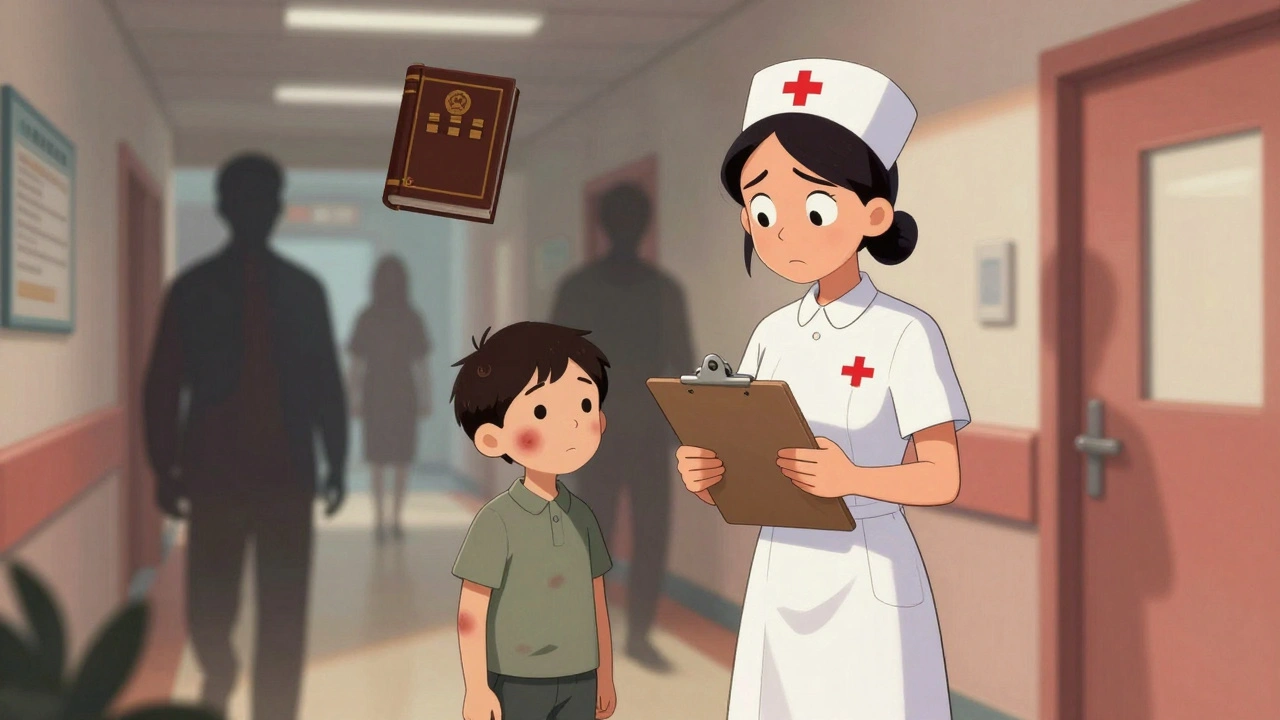
When a doctor sees signs of abuse on a child, or a nurse notices a colleague giving wrong doses, they don’t just have a moral duty to act-they have a legal one. In the U.S., healthcare providers are on the front lines of a system designed to protect the most vulnerable. But the rules aren’t simple. What you must report, when, and how varies wildly depending on your state, your job title, and even the type of facility you work in. This isn’t about paperwork. It’s about stopping harm before it kills.
What You’re Legally Required to Report
There are four main categories of mandatory reporting that apply to most doctors and nurses in the U.S. Each has its own rules, timelines, and consequences for getting it wrong.
- Child abuse and neglect: Required in all 50 states. You don’t need proof-just reasonable suspicion. That means a pattern of unexplained bruises, a child who flinches at touch, or a parent who can’t explain a broken bone. In states like California and Michigan, you must report within 24 to 48 hours. In Texas, it’s 48 hours. In Florida, it’s immediate.
- Elder and vulnerable adult abuse: 47 states require reporting of elder abuse, but only 14 states make it mandatory for every healthcare worker. In others, only staff in nursing homes or hospitals are required to report. Signs include unexplained weight loss, bedsores, or a resident who’s suddenly terrified of a caregiver.
- Public health threats: This includes infectious diseases like tuberculosis, measles, and syphilis. The CDC tracks 57 nationally notifiable conditions. Some, like anthrax, require a call within one hour. Others, like Lyme disease, give you up to seven days. Most hospitals now use automated systems that send alerts directly to health departments, cutting reporting time from 30 minutes to under five.
- Professional misconduct: If you see a nurse stealing meds, a doctor practicing while impaired, or a provider falsifying records, you’re often legally required to report it. Minnesota and Nebraska require institutional leaders to report nurse misconduct within 30 days. In Utah, you’re protected from retaliation by law-even if your report turns out to be wrong.
What’s not required? Reporting domestic violence in most states. Only New York and a handful of others mandate it. Mental health crises? Only if the patient threatens to harm themselves or others. Even then, rules differ. In California, you can break confidentiality to warn someone at risk. In other states, you can’t.
When “Reasonable Suspicion” Isn’t Clear
The biggest headache for providers isn’t the law-it’s interpreting it. What counts as “reasonable suspicion”? The answer changes by state.
In California, it’s any observation that makes you think abuse might be happening. In Texas, you need more-something that would make a reasonable person suspect abuse. In Minnesota, it’s “a reasonable basis to believe.” That’s not the same thing. One nurse in Ohio reported a child with a bruise on the thigh. The state said no, it didn’t meet the threshold. Two weeks later, the child was found dead with 47 bruises.
Doctors and nurses often hesitate because they fear: breaking trust, getting sued, or being wrong. But the data shows something else. A 2019 JAMA study found that states with mandatory reporting identified 37% more child abuse cases than states where reporting was optional. In Michigan, a nurse’s report in 2020 led to the rescue of a 4-year-old who had been locked in a closet for weeks. That report saved a life.
Still, 68% of physicians surveyed by the American Medical Association say mandatory reporting makes patients less likely to be honest. One pediatrician in Colorado told a Reddit forum: “I had a teen come in for birth control. She told me her dad hits her. I reported it. She never came back.” That’s the cost of the system. You’re forced to choose between confidentiality and safety.
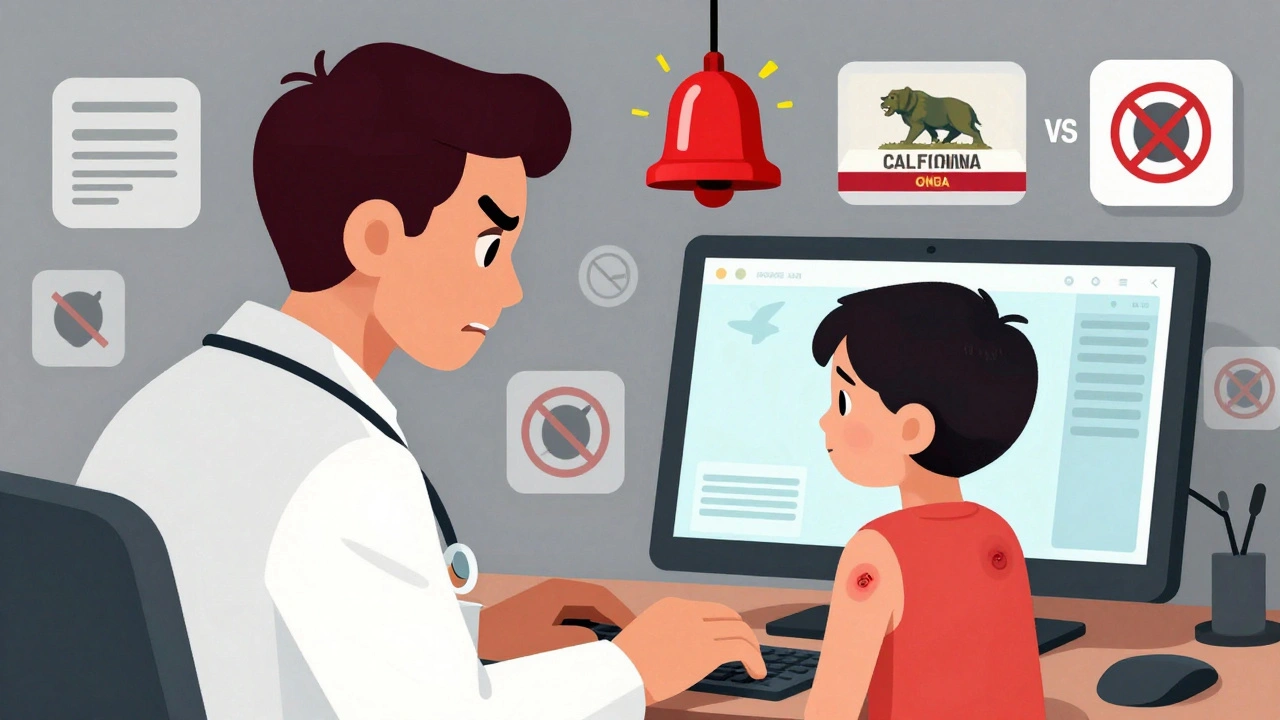
How Reporting Works in Practice
Here’s how it actually plays out on the ground.
Child abuse: You call your state’s child protective services hotline. In California, it’s 1-800-4-A-CHILD. You give the child’s name, age, address, description of injuries, and who you suspect. You then file a written report within 36 hours. Hospitals often have templates. You don’t need to interview the family. You don’t need to prove it. You just need to report.
Elder abuse: In states that require it, you call Adult Protective Services. You need the victim’s name, location, type of abuse, and your contact info. In New York, you must also report to the Office of the Aging. In Texas, you’re not required to report unless you work in a nursing home.
Public health: Most hospitals now use electronic reporting systems. When a lab confirms a case of syphilis, the system auto-files with the state. No human action needed. But if you’re in a small clinic without eCR, you still have to call or fax. Missing the deadline can mean fines-or worse.
Professional misconduct: You report to your state’s nursing or medical board. In Minnesota, the Chief Nursing Officer must file within 30 days. In Utah, any provider can file anonymously. But if you’re wrong? You’re protected. If you’re right? You might get thanked-or demoted. A nurse in Utah reported unsafe staffing. Two weeks later, she was moved to night shifts and denied overtime. She sued. The court ruled in her favor under Utah Code 26B-8-232.
Where the System Falls Apart
Despite good intentions, the system is broken in places.
- Telehealth chaos: A doctor in Pennsylvania sees a patient in Arizona. The child has signs of abuse. Pennsylvania law says report. Arizona law says only if the child is in state. Which law applies? The doctor reported under PA law. Arizona officials said it didn’t count. The child was later abused again. No one was held accountable.
- Training gaps: Only 28 states offer comprehensive online reporting guides. Most new nurses get a one-hour training during orientation. That’s not enough. A 2023 study found 41% of nurses couldn’t correctly identify when to report elder abuse.
- Retaliation: Even with laws protecting reporters, 8% of nurses who reported misconduct faced demotion, harassment, or termination. One nurse in Texas said she reported a doctor for drunk driving. She was labeled “difficult” and lost her shift preferences.
- Administrative burden: On average, each report takes 2.7 hours of a provider’s time. That’s paperwork, calls, forms, follow-ups. In high-volume ERs, that’s a lot of patient care time lost.

What You Can Do to Get It Right
You don’t have to guess. Here’s how to stay protected:
- Know your state’s laws. Go to your state’s Department of Health website. Look for “mandatory reporter” or “abuse reporting.” Bookmark it.
- Use your hospital’s protocol. Most hospitals have reporting checklists, hotlines, and templates. Use them. They’re your legal shield.
- Document everything. Write down what you saw, when, where, and who was present. Don’t rely on memory. Your notes could be your only defense if you’re accused of failing to report.
- Ask for help. If you’re unsure, call your hospital’s compliance officer or legal department. In Washington State, there’s a 24/7 hotline: 1-800-252-0230. Use it.
- Report anyway if you’re unsure. It’s better to file a report that turns out to be false than to miss one that could save a life. Most states give you legal immunity if you report in good faith.
There’s no perfect system. But the alternative-staying silent-is worse. Every report you make is a chance to stop abuse before it escalates. Every call you make could mean the difference between a child going home safe-or not going home at all.
What’s Changing in 2025
The system is slowly fixing itself.
In 2023, the U.S. Department of Health and Human Services launched a nationwide push to standardize public health reporting through electronic systems. By 2025, every state will use the same platform for disease reporting. That’s a big win.
More states are adding human trafficking as a reportable condition. California, Illinois, and Florida now require it. More will follow.
AI tools are being tested in hospitals like Massachusetts General. These tools scan patient charts for red flags-unexplained injuries, repeated ER visits, inconsistent stories-and flag them for review. In a 2023 study, they cut reporting errors by 38%.
But the biggest change? A growing recognition that reporting isn’t just about compliance. It’s about culture. Hospitals that train staff regularly, support reporters, and celebrate successful interventions see higher reporting rates-and better patient outcomes.
Do I have to report if I’m not 100% sure?
Yes. You only need reasonable suspicion-not proof. If something feels off, and you’re a trained professional, that’s enough. Most states give you legal protection if you report in good faith. It’s better to report and be wrong than to stay silent and miss a life-threatening situation.
Can I be sued for reporting?
Almost never. All 50 states offer immunity from civil or criminal liability if you report in good faith. The only risk is if you report with malice-like trying to get someone fired out of anger. That’s rare. Most lawsuits against reporters come from people who failed to report, not those who did.
What if I work in telehealth across state lines?
You must follow the laws of the state where the patient is physically located-not where you are. If you’re licensed in Texas but treating a child in California, you must follow California’s reporting rules. Many telehealth platforms now have built-in state-specific reporting checklists. If yours doesn’t, contact your employer’s compliance team.
Can I report anonymously?
For child and elder abuse, you usually must provide your name and contact info. But for professional misconduct, some states like Utah allow anonymous reports. Check your state’s rules. Even if you give your name, your identity is protected by law in most cases.
What happens after I report?
Child and elder abuse reports go to state protective services. They investigate and decide whether to open a case. Public health reports go to the state health department-they track outbreaks and contact patients. Misconduct reports go to the medical or nursing board-they may suspend licenses or require retraining. You won’t always get updates, but your report starts the process.
Are there tools to help me report faster?
Yes. Most hospitals use digital reporting systems. For public health, the National Electronic Disease Surveillance System (NEDSS) automates reporting. For abuse, some states offer online portals like California’s Child Abuse Reporting System. If your workplace doesn’t have one, ask for it. These tools cut reporting time from hours to minutes.
If you’re reading this, you’re already thinking about your responsibility. That matters. The system isn’t flawless, but it only works if people like you do their part. Don’t wait for someone else to act. If you see something, report it. It’s not just your job. It’s your duty.

9 Comments
Just saw a nurse report a kid with a bruise on the thigh and got shut down by CPS. Two weeks later, that kid was found dead with 47 bruises. We don't need more rules-we need people who actually listen when someone says something’s wrong.
Stop overthinking 'reasonable suspicion.' If it feels off, report it. Your paperwork might save a life.
One cannot help but observe that the moral imperative underlying mandatory reporting is not merely a legal construct, but an ontological duty arising from the physician’s Hippocratic covenant with society.
When one observes suffering-whether physical, psychological, or systemic-one is not merely a witness, but a moral agent bound by the categorical imperative to intervene.
Statistical compliance metrics are reductive; the true measure lies in the quiet courage of those who choose to speak when silence would be complicity.
It is not enough to follow protocol; one must embody the ethical weight of the role.
Our profession is not a job-it is a sacred trust, and to dilute its moral gravity with bureaucratic hedging is to betray the very essence of healing.
Those who hesitate do not fear liability-they fear the burden of moral clarity.
And yet, it is precisely this burden that distinguishes the healer from the technician.
Let us not confuse legal immunity with moral cowardice.
Every report is a small act of resistance against the normalization of suffering.
Let us honor those who report-not with praise, but with the solemn recognition that they carry the weight of humanity’s fragile hope.
May we all strive to be such people.
Okay but have you ever wondered if all these reports are just feeding into a surveillance state disguised as child protection?
Every time you report a bruise, you’re handing data to a system that’s already overburdened, underfunded, and full of bureaucrats who don’t care if they separate a kid from their mom over a hiccup.
And don’t even get me started on how telehealth reporting is being weaponized-now they’re tracking your IP address to see which state you’re ‘really’ in.
AI tools flagging ‘inconsistent stories’? That’s just coded bias against poor families and non-native English speakers.
They say ‘report if you’re unsure’-but what if you’re unsure because the system’s designed to make you doubt yourself?
I’ve seen moms get dragged into CPS for letting their kid play outside unsupervised.
And now we’re automating it?
They’re not saving children-they’re criminalizing poverty, trauma, and nonconformity.
And you’re all just clicking ‘submit’ like it’s a TikTok like.
Wake up. This isn’t protection. It’s control dressed in scrubs.
I’ve been a nurse for 12 years. I’ve made 17 reports.
Three of them saved lives.
Twelve of them led to nothing but paperwork and a parent crying in the waiting room.
One kid came back a year later and hugged me because the system finally worked for them.
It’s messy. It’s heavy.
But I’d rather be the one who reported and felt guilty than the one who stayed quiet and carried the weight of a death I could’ve stopped.
You don’t need to be perfect. You just need to show up.
It’s fascinating how we’ve reduced the profound ethical weight of witnessing harm to a checkbox in an EHR.
One must wonder: if a nurse reports abuse and no one is there to witness the emotional labor behind it, does it still count as moral action?
Or is it merely performative compliance wrapped in the soothing language of ‘protocols’ and ‘immunity’?
It’s not about the law-it’s about the soul of the profession, and we’re losing it to spreadsheets.
And yet, the fact that we even have this conversation suggests that somewhere, someone still cares enough to feel the burden.
That’s something, I suppose.
LOL at people who think ‘reasonable suspicion’ is hard 😂
Bro, if a kid has a bruise and says ‘my dad did it’ and then looks away? That’s not suspicion. That’s a neon sign.
And if you don’t report that? You’re literally choosing to let a child suffer so you don’t have to deal with a 10-minute phone call.
Also, I’ve seen nurses who ‘forgot’ to report because they were ‘too busy’-and then the kid dies.
Y’all are lucky you don’t get sued for malpractice for this.
Just report. End of story. 🙄🙏
As a UK-based clinician, the US mandatory reporting framework is both admirable and terrifying.
Our ‘duty to report’ is more about risk assessment than legal obligation, and the threshold is far higher.
But I’ve seen cases where UK social services ignored red flags because ‘no direct evidence’-and kids died.
Maybe the US system, flawed as it is, at least forces action.
Still, the administrative burden is insane. I’ve seen nurses spend 3 hours on one report.
That’s 3 hours of direct care lost.
And we’re not even talking about the trauma it inflicts on the reporter.
It’s a systemic failure disguised as a moral win.
Needs better tech, better training, less guilt-tripping.
What if the real problem isn’t that we don’t report enough-but that we report the wrong things?
Like, yeah, report the kid with the broken arm.
But what about the kid whose mom is working three jobs and can’t afford to buy diapers?
That’s neglect too, but nobody reports that because it’s ‘poverty,’ not ‘abuse.’
And what about the nurse who’s being sexually harassed by a doctor but can’t report it because the board only cares about ‘medication errors’?
We’ve turned reporting into a narrow, performative checklist.
Real harm? The kind that doesn’t leave bruises? It’s invisible.
And we’re proud of ourselves for checking a box while ignoring the whole damn room.
Just got back from a 12-hour shift. Made two reports today.
One was a kid with unexplained burns. The other was a nurse who was clearly high during meds pass.
Both got processed in under 20 minutes thanks to our new eCR system.
Wish I could say I felt good about it.
But honestly? I just feel tired.
Not because I did the right thing.
But because I know tomorrow, I’ll have to do it again.
And the system won’t change.
And neither will I.
Just keep showing up.
That’s all we can do.