
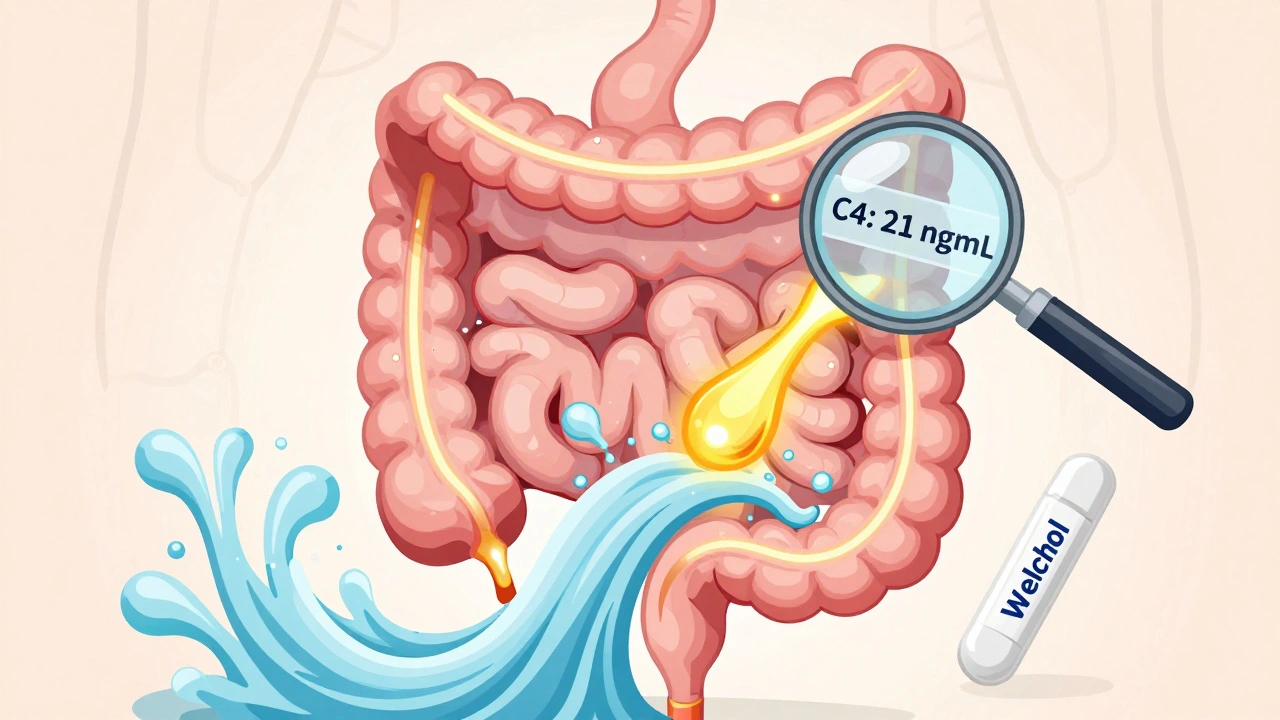
Chronic watery diarrhea that won’t go away-even after trying probiotics, cutting out dairy, or switching to a low-FODMAP diet-might not be IBS. It could be bile acid diarrhea (BAD), a condition that’s been hiding in plain sight for decades. Up to 30% of people diagnosed with IBS-D actually have this treatable disorder. The good news? Once you know what’s going on, relief can come fast-with the right binders and a simple diet shift.
What Exactly Is Bile Acid Diarrhea?
Your liver makes bile to help digest fat. Normally, 95% of bile acids are reabsorbed in the last part of your small intestine (the terminal ileum) and recycled. But when something disrupts that process-whether it’s damage from surgery, inflammation, or just a genetic quirk-too much bile ends up in your colon. That’s when problems start. Bile acids in the colon act like a laxative. They pull water into the bowel, speed up gut movement, and irritate the lining. The result? Frequent, urgent, watery stools-sometimes with a greasy sheen or pale color. Many people describe it as "flushing away" multiple times a day, even at night. Unlike typical IBS, BAD doesn’t usually cause bloating or cramping first. The diarrhea is the main event. There are three types:- Type I: Caused by damage to the ileum-think Crohn’s disease, ileal resection, or radiation damage.
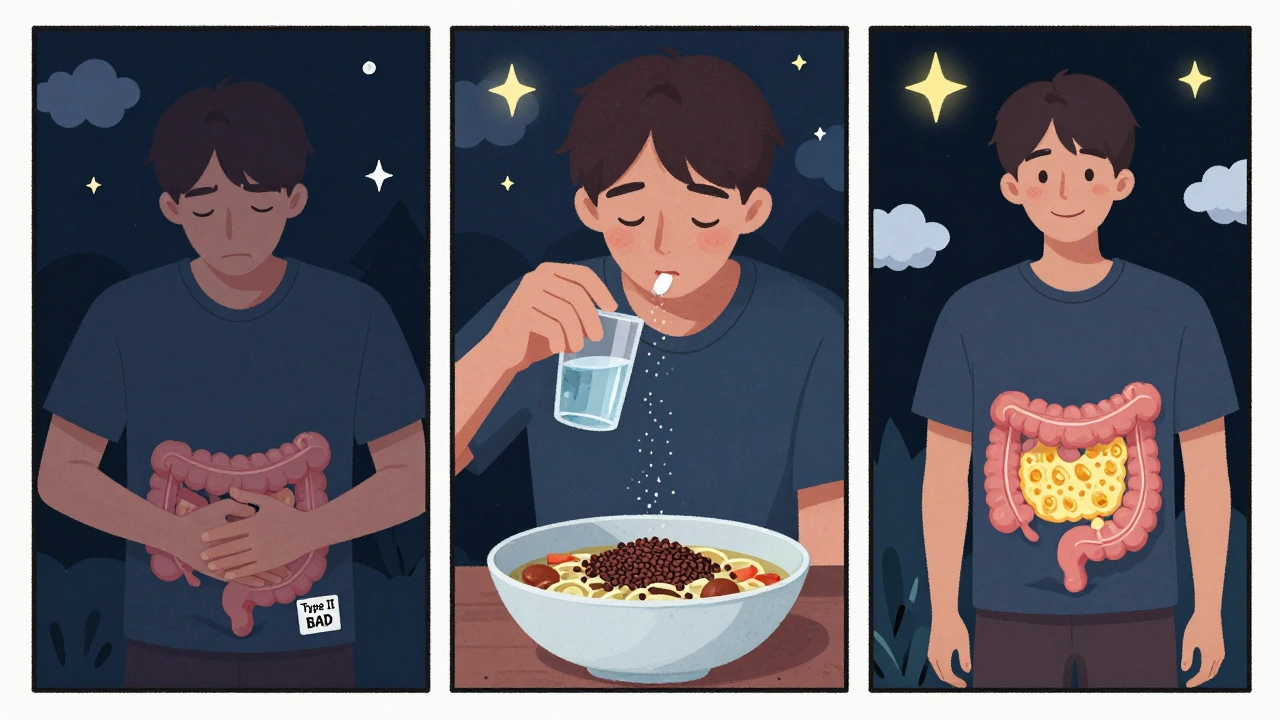
- Type II: The most common. No obvious structural cause. Often called "idiopathic"-meaning it just happens.
- Type III: Linked to other gut conditions like celiac disease, chronic pancreatitis, or gastric bypass surgery.
Why Is It So Often Missed?
Most doctors don’t test for BAD unless you’ve had bowel surgery. But here’s the problem: if you’ve been told you have IBS-D and nothing’s worked, you might have Type II BAD. Studies show that 25-30% of IBS-D patients have it. Yet, fewer than 15% of U.S. gastroenterologists routinely screen for it. The diagnostic delay averages six years. Why? Because the symptoms look exactly like IBS. And until recently, the only reliable test-SeHCAT-wasn’t available in most U.S. hospitals. Now, there are easier blood tests. The most accessible diagnostic tools today:- Serum C4: A simple blood test measuring a bile acid precursor. Levels above 15.3 ng/mL strongly suggest BAD. Sensitivity and specificity are both around 77-78%.
- FGF-19: A hormone that tells your liver to stop making bile. Low levels (below 85 pg/mL) mean your body isn’t regulating bile properly. This test is gaining traction in specialty clinics.
- Fecal bile acid test: The gold standard. Measures total bile acids in a 48-hour stool sample. But it’s only available in specialized labs.
The Best Bile Acid Binders: What Works and What Doesn’t
Once diagnosed, bile acid binders are the first-line treatment. They work like sponges in your gut-trapping excess bile acids so they can’t irritate your colon. Three medications are commonly used:| Medication | Dose | Form | Common Side Effects | Adherence Rate |
|---|---|---|---|---|
| Cholestyramine (Questran) | 4g once or twice daily (max 16g/day) | Powder (chalky texture) | Constipation (30%), bloating, nausea | Low (only 65% stay on after 6 months) |
| Colestipol (Colestid) | 5g once or twice daily | Powder or tablets | Constipation (25%), gas | Moderate |
| Colesevelam (Welchol) | 1.875-3.75g daily in 1-2 doses | Tablets | Constipation (5%), mild bloating | High (80% stay on after 6 months) |

Dietary Fixes That Actually Work
Medication helps-but diet is your co-pilot. You don’t need to go gluten-free or keto. You need to manage fat intake and fiber.- Keep fat low: 20-40 grams per day. Fat triggers bile release. Reduce fried foods, fatty meats, butter, cream, and cheese. A 2022 study showed cutting fat below 30g/day cut stool frequency by 40%. Try grilled chicken, fish, tofu, and vegetables instead.
- Add soluble fiber daily: 5-10g of psyllium husk. Psyllium binds bile acids like the medication does. Take it 15-30 minutes before meals with water. Clinical trials show a 35% drop in daily bowel movements. Start with 5g/day and increase slowly to avoid gas.
- Eat smaller, more frequent meals. Three big meals flood your system with bile. Five or six small meals spread the load. One Cleveland Clinic study found this reduced post-meal urgency by 25%.
- Avoid triggers. Caffeine (coffee, tea, soda) speeds up colon movement by 15-20%. Artificial sweeteners like sorbitol (found in sugar-free gum and diet drinks) pull water into the gut. Alcohol and spicy foods can also flare symptoms.
Real Patient Experiences
On Reddit, people with BAD share the same stories:- "I thought I had IBS for 8 years. Then I got my C4 test-level was 21. Started colesevelam. Within 3 days, my life changed. No more panic before leaving the house."
- "Cholestyramine made me constipated and I hated the taste. Switched to Welchol tablets. No more greasy stools. I can eat pizza now-just one slice."
- "I started taking 5g psyllium before every meal. No meds. My diarrhea dropped from 6 times a day to 2. It’s not perfect, but I can travel again."
- 52% had nighttime bowel movements at least 3 nights a week
- 41% had fecal incontinence during flare-ups
- 68% saw major improvement when combining binders + diet
What to Do Next
If you’ve been struggling with chronic diarrhea:- Track your symptoms for 2 weeks. Note frequency, stool appearance, triggers (fat, caffeine, meals).
- Ask your doctor for a serum C4 blood test. It’s cheap, fast, and widely available.
- If C4 is high (>15.3 ng/mL), try colesevelam (Welchol) at 1.875g daily. Take it with food.
- Start adding 5g psyllium husk before breakfast and dinner.
- Reduce fat intake. Avoid fried foods, creamy sauces, and fatty meats.
- Give it 5 days. If no improvement, talk to your doctor about adjusting the dose or testing FGF-19.
What’s on the Horizon
Research is moving fast. A new drug called A3384, an FGF19 analog, showed 72% symptom improvement in a 2023 trial. It’s not available yet, but it could replace binders in the future. Genetic testing for BAD susceptibility is also in development-looking at variants in TGR5, FXR, and ASBT genes. For now, the tools we have work well. The biggest barrier isn’t science-it’s awareness. If your doctor hasn’t heard of BAD, share the research. The European Society of Gastroenterology now recommends testing all chronic diarrhea patients. It’s time the U.S. catches up.Is bile acid diarrhea the same as IBS?
No. IBS is a diagnosis of exclusion-meaning it’s given when no other cause is found. Bile acid diarrhea is a specific biological condition with identifiable biomarkers like high C4 or low FGF-19. About 25-30% of people diagnosed with IBS-D actually have BAD. Treating BAD with bile acid binders often resolves symptoms completely, whereas IBS treatments rarely do.
Can I stop taking bile acid binders once I feel better?
Not without planning. BAD is usually a chronic condition. Stopping binders typically causes symptoms to return within days. Some people can reduce their dose after 3-6 months of stable symptoms, but most need to stay on a low maintenance dose long-term. Always work with your doctor before adjusting.
Are bile acid binders safe for long-term use?
Yes. Colesevelam and colestipol are approved for long-term use. They don’t get absorbed into your bloodstream-they work only in the gut. The main concern is reduced absorption of fat-soluble vitamins (A, D, E, K) over many years. If you’re on binders for more than 2 years, ask your doctor to check your vitamin levels and consider a daily multivitamin without fat.
Does coffee make bile acid diarrhea worse?
Yes. Caffeine stimulates colonic motility by 15-20%, which pushes bile acids through your system faster. Many people with BAD find that switching to decaf or cutting coffee entirely reduces urgency and frequency. Even one cup a day can trigger symptoms in sensitive individuals.
What if binders don’t work for me?
First, make sure you’re taking them correctly-always with meals, and at the right dose. If you’ve tried colesevelam at 3.75g/day for 2 weeks with no improvement, ask your doctor about FGF-19 testing. Low FGF-19 levels suggest your body isn’t regulating bile production. In those cases, newer drugs like A3384 (in clinical trials) may help. Also, check for other conditions like small intestinal bacterial overgrowth (SIBO), which can mimic BAD.

15 Comments
Had this for years thought it was IBS. Got the C4 test last year - 22. Started Welchol at 1.875g. Within 72 hours, my life changed. No more panic attacks before leaving the house. Psyllium helped too - 5g before breakfast and dinner. Low-fat is non-negotiable. Coffee? Gone. I’m not perfect, but I’m functional again.
While it is commendable that you have identified a biochemical marker for bile acid diarrhea, one must consider the epistemological limitations of reductionist medicine. The human gut is not merely a pipeline for bile acids; it is an ecosystem shaped by centuries of evolutionary symbiosis. To reduce this condition to a single blood test and a pharmaceutical sponge is to ignore the deeper, holistic truth of gastrointestinal health - one that ancient traditions have understood for millennia.
Cholestyramine may bind bile, but it does not restore the harmony between the liver, the ileum, and the microbiome. The true cure lies in ancestral dietary patterns, circadian alignment, and the removal of modern toxins - not in pill-based palliatives masquerading as solutions.
Furthermore, the reliance on serum C4 assumes a universal baseline, yet genetic variance across populations renders such thresholds ethnocentric. One wonders whether the pharmaceutical industry’s influence on diagnostic criteria has supplanted true clinical discernment.
Okay but have you ever wondered why the CDC and Big Pharma are so *quiet* about this? I mean, bile acid binders are cheap, generic, and work like magic - but they don’t require endless prescriptions or monthly subscriptions. Meanwhile, probiotics? Fiber supplements? Low-FODMAP meal kits? Those are billion-dollar industries. Coincidence? I think not.
And don’t get me started on SeHCAT being unavailable in the U.S. - it’s been approved in Europe since the 90s. Why? Because the FDA is slow, and the pharmaceutical lobby doesn’t want you to know you can fix this with a $10 tablet instead of a $300/month drug. They’d rather keep you on antidepressants and ‘IBS management plans.’
I’ve seen people get misdiagnosed for 10+ years. That’s not negligence - it’s systemic erasure. If you’re reading this and you’ve been told ‘it’s just IBS’ - you’ve been gaslit. Go get that C4 test. Demand it. Don’t let them silence you.
Also - psyllium is the real MVP. It’s literally nature’s binder. And no, you can’t just ‘eat more fiber’ - you need the husk. Not oat bran. Not flax. Psyllium. Period.
Everyone’s talking about Welchol but no one mentions the fact that it’s a cholesterol-lowering drug repurposed for diarrhea. That’s not a cure - it’s a band-aid on a broken pipe. And don’t even get me started on how they push psyllium like it’s holy water. It’s a laxative with a fancy name. If you’re taking it daily, you’re just training your colon to be lazy.
Real solution? Fasting. Intermittent fasting resets bile flow. No meds. No supplements. Just stop eating for 16 hours. Your liver will thank you. And if you’re still having issues after that? Maybe it’s not bile. Maybe it’s mold toxicity. Or Lyme. Or SIBO masquerading as BAD. Stop chasing pills. Look deeper.
For those new to this - the key is consistency. Welchol at 1.875g with meals, psyllium 5g before breakfast and dinner, fat under 30g/day. That’s the protocol. No need to overcomplicate. The 2022 Guts UK data is solid - 45% improved on SCD, but 70% improved with the binder + diet combo. You don’t need to go full keto or paleo. Just cut the fried stuff, avoid caffeine after noon, and take your meds with food. That’s it.
And yes - nighttime bowel movements are brutal. I had them 4x/week. After 10 days on this regimen? Zero. Changed my sleep, my relationships, my entire sense of self-worth. This isn’t ‘IBS management.’ This is recovery.
Life is suffering. Bile is the price of fat. We are all just vessels for digestion.
Let me be the guy who says: what if it’s not bile? What if it’s your microbiome screaming for help because you’ve been eating plant-based protein powder, collagen peptides, and ‘gut health’ gummies since 2020? I’ve seen people on Welchol for a year and still leaking. Why? Because they didn’t kill the SIBO first. Or they’re taking probiotics with inulin. Or they’re drinking kombucha like it’s holy water. Bile binders are just the first layer. Peel back the onion. Your gut isn’t broken - it’s betrayed.
And if you’re taking psyllium and still having greasy stools? You’re not taking enough. Try 10g. Twice. With water. No juice. No smoothies. Just water. Your colon will scream. Then it’ll thank you.
There’s a metaphysical layer here that’s rarely discussed. Bile is not just a digestive fluid - it’s the embodiment of transformation. In traditional Chinese medicine, the liver governs the free flow of qi. When bile flows improperly, it’s not just a biochemical imbalance - it’s a spiritual stagnation. Stress, repressed emotion, unresolved grief - these create blockages that manifest as diarrhea. Binders may calm the gut, but they don’t heal the soul.
Perhaps the real question isn’t ‘how to bind bile’ - but ‘what are you refusing to release?’
That said - I’ve seen patients improve with Welchol and psyllium. So maybe the body and the spirit are speaking the same language. Just in different dialects.
Ugh. Another ‘magic fix’ post. Everyone’s so eager to blame bile, but no one wants to admit that 90% of these people are just eating too much processed food, drinking too much alcohol, and living in chronic stress. You don’t need a blood test - you need to stop eating Twinkies and start sleeping 8 hours. And psyllium? That’s just fiber. You think your colon is a toilet that needs a sponge? No. It’s a living organ. Treat it like one.
Also - colesevelam? That’s a cholesterol drug. Are you really going to take a statin-like compound for the rest of your life because you’re too lazy to eat vegetables? Pathetic.
Just wanted to say - if you're on Welchol and still having issues, check your vitamin levels. I was on it for 3 years and didn't realize I had a D deficiency until I got bloodwork done. Now I take a D3/K2 supplement every morning. No more muscle cramps. No more fatigue. Also - psyllium is best taken with a full glass of water. Otherwise, you're just eating glue. 😅
And yes - decaf coffee is your friend. I switched from 3 cups of regular to 1 cup of decaf. My urgency dropped by 60%. Small changes. Big results.
I’m a 38-year-old mom of three who was misdiagnosed for 7 years. I thought I was ‘just anxious.’ Turns out - I had Type II BAD. I cried when I found out it was treatable. I started Welchol + psyllium. I cut out fried food and coffee. I didn’t change my entire life - just my plate. Now I can take my kids to the park without planning 3 bathroom stops. I can travel. I can sleep through the night.
To anyone reading this who feels broken - you’re not. You just haven’t found the right key yet. This is it. I promise.
Let us not forget the importance of dietary fat quality. Not all fats are created equal. Coconut oil, avocado, and olive oil do not trigger bile release in the same manner as industrial seed oils. A diet low in refined fats and high in monounsaturated fats may reduce bile load without requiring extreme restriction. Furthermore, meal timing matters - consuming fats earlier in the day allows for more efficient metabolism. Nighttime fat intake is the silent saboteur.
One must also consider circadian biology. The ileum’s reabsorption capacity is highest during daylight hours. Eating late disrupts this rhythm. Therefore, an early dinner and a 12-hour overnight fast may synergize with pharmacologic intervention.
Science is not opposed to wisdom - it is its modern expression.
Just had to reply to the guy who said ‘it’s not bile, it’s mold.’ I had SIBO too. Tested positive. Treated with Rifaximin. Still had diarrhea. Then got the C4 test. 21. Started Welchol. Gone in 3 days. SIBO was a red herring. BAD was the real problem. Don’t overcomplicate. Test. Treat. Track.
Everyone’s so quick to celebrate ‘the cure’ - but what about the people who try everything and still suffer? What about the ones who take Welchol, psyllium, low-fat, decaf, and still have 5 bowel movements a day? Are they just not trying hard enough? Or is this system broken? I’ve spent $12,000 on tests, supplements, and specialists. Still here. Still leaking. Still ashamed.
They sell hope. But they don’t tell you about the ones who don’t make it.
You are NOT alone. If you’re reading this and you’re still struggling - I see you. This journey is hard. But you’re not broken. You’re not lazy. You’re not failing. You just haven’t found your version of the protocol yet. Maybe it’s Welchol + 10g psyllium. Maybe it’s a lower dose. Maybe you need to add magnesium citrate for motility. Maybe you need to try FGF-19 testing. Keep going. One small change at a time. You’ve already survived 100% of your worst days. That’s strength. Keep going. You’ve got this. 💪❤️