

Metformin Safety Risk Calculator
Your Safety Assessment
This calculator assesses your risk of lactic acidosis while taking metformin based on your health factors. Lactic acidosis is extremely rare but potentially serious.
Your Safety Status
Your Risk Level
Based on your current health factors
Your risk of lactic acidosis is extremely low.
This is common for most patients taking metformin.
Important Recommendations
With your current health status:
- 1 Continue taking metformin as prescribed
- 2 Check kidney function every 6 months
- 3 Limit alcohol to 1-2 drinks per day
Metformin is the most commonly prescribed diabetes medication in the world. If you’ve been diagnosed with type 2 diabetes, chances are your doctor started you on it. It’s cheap, effective, and helps with weight loss. But for many people, the first few weeks on metformin feel like a battle with your stomach. Diarrhea. Nausea. Cramps. It’s so common, it’s almost expected. And then there’s the scary stuff - lactic acidosis. You hear the term, you panic. But here’s the truth: most people never experience it. Understanding what’s normal, what’s serious, and how to handle it makes all the difference.
Why Your Stomach Hates Metformin (And What to Do About It)
About 1 in 3 people who start metformin get gastrointestinal side effects. That’s not rare - it’s routine. Diarrhea hits the hardest, affecting more than half of those who have issues. Nausea, vomiting, stomach pain, and loss of appetite follow close behind. These aren’t mild discomforts. They can make you miss work, cancel plans, or even consider quitting the drug.
The good news? These problems usually don’t last. Around 85% of people find their symptoms fade within 2 to 4 weeks. The bad news? That first month feels endless. You’re trying to get your blood sugar under control, but your body feels like it’s rebelling.
The reason? Metformin stays in your gut longer than it should. It irritates the lining, changes how your gut bacteria behave, and speeds up how fast food moves through your system. It’s not an allergy. It’s a direct chemical reaction.
Here’s what actually works:
- Start low, go slow. Don’t jump to 1,000 mg on day one. Begin with 500 mg once a day, taken with your evening meal. After a week, if you’re not sick, bump it to 500 mg twice a day. Wait another week before going higher. This isn’t just advice - it’s backed by data from the UK Prospective Diabetes Study.
- Switch to extended-release (ER). Metformin-ER releases the drug slowly into your system. A 2023 FDA-approved version (Metformin-ER-XR) cut GI side effects by over 40% in clinical trials. Many patients who quit regular metformin because of diarrhea go back on it - just the ER version - and never look back.
- Take it with food. Never take metformin on an empty stomach. Even a small snack helps. A slice of toast, a handful of nuts, or half a banana is enough to blunt the shock to your gut.
- Give it time. Most people who stick with it for 30 days find their body adjusts. One Reddit user, u/DiabeticWarrior, said switching to 500 mg ER at dinner dropped his diarrhea from 4-5 times a day to occasional cramps in just 10 days.
If you’re still struggling after 4 weeks, talk to your doctor. Don’t just quit. There are other options - different formulations, timing changes, or even switching to another medication. But for most, patience and small tweaks make metformin tolerable.
Lactic Acidosis: The Scary Risk That’s Actually Rare
Metformin has a black box warning from the FDA. That’s the strongest warning they give. It’s for lactic acidosis - a life-threatening buildup of lactic acid in your blood. The word alone sounds like a death sentence.
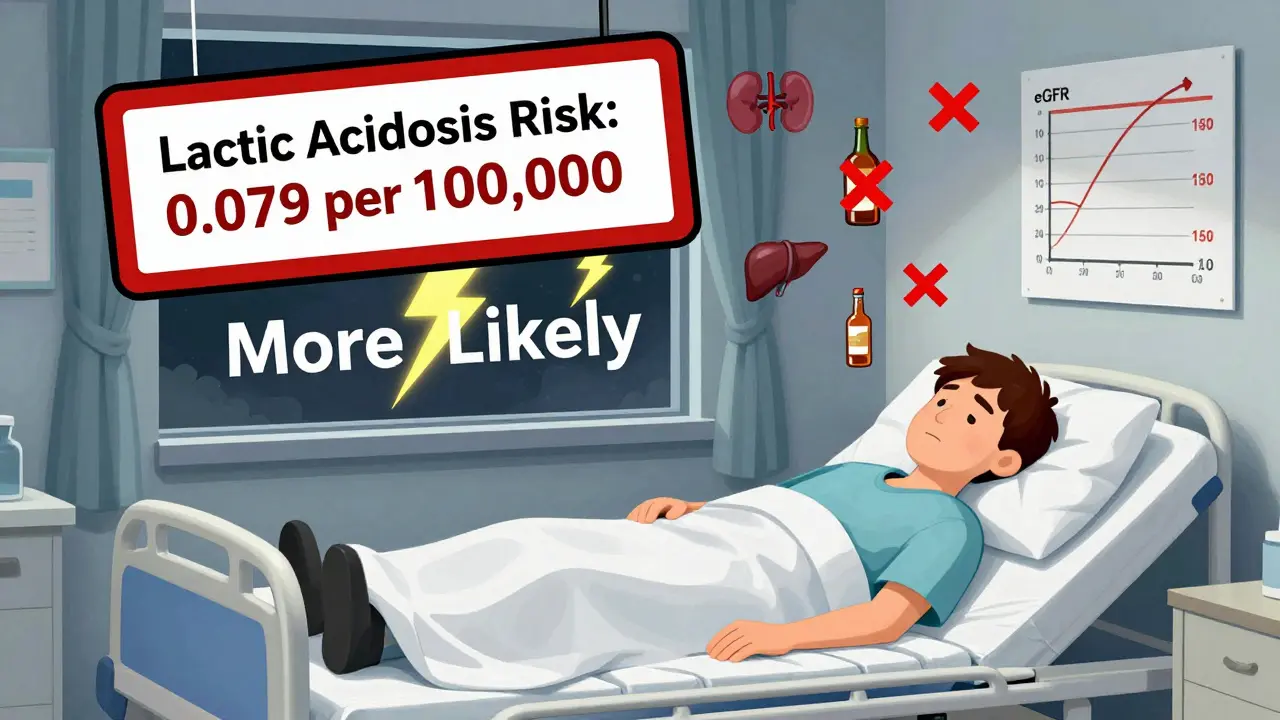
But here’s the reality: you’re far more likely to be struck by lightning than get lactic acidosis from metformin. Studies show it happens in just 1 to 9 cases per 100,000 people each year. In 2022, the FDA reviewed 15.2 million metformin users and found only 12 confirmed cases. That’s 0.079 per 100,000.
So why the warning? Because when it does happen, it’s deadly. Between 30% and 50% of people who develop metformin-associated lactic acidosis (MALA) die. The key word is develop. It doesn’t just appear out of nowhere. It happens in people who already have serious health problems.
Here’s who’s at real risk:
- Severe kidney disease - eGFR below 30. This increases risk by nearly 19 times.
- Acute kidney injury - from dehydration, infection, or heart failure. Risk jumps 24-fold.
- Severe liver disease - your liver helps clear lactate. If it’s failing, lactate builds up.
- Age over 80 - kidneys slow down naturally. Risk is nearly 5 times higher.
- Heavy alcohol use - 3 or more drinks a day raises risk by almost 7 times.
Most cases aren’t caused by metformin itself. They’re caused by the person being critically ill. Metformin doesn’t create lactic acidosis - it makes it worse in people who are already on the edge. As Dr. Kenneth Cusi from the University of Florida says, “The 50% mortality rate applies only to critically ill patients with multiple organ failures, not to stable outpatients on appropriate dosing.”
What are the warning signs? If you feel any of these, get help immediately:
- Extreme fatigue - you can’t get out of bed
- Rapid, shallow breathing - you feel like you can’t catch your breath
- Severe nausea or vomiting
- Stomach pain that doesn’t go away
- Muscle pain or weakness
- Feeling cold, even in a warm room
These aren’t side effects. They’re red flags. If you have them, stop metformin and go to the ER. Doctors will check your blood pH, lactate level, and anion gap. A pH below 7.35 and lactate above 5 mmol/L confirms it.
What You Should Actually Worry About (And What You Shouldn’t)
There’s a lot of misinformation out there. Let’s clear it up.
Myth: Metformin damages your kidneys.
Truth: It doesn’t. In fact, studies show it doesn’t increase kidney damage risk. If your kidneys are already bad, metformin can’t be used - but it didn’t cause the problem. A 10-year study found no link between metformin use and worsening kidney function.
Myth: Metformin causes dementia.
Truth: The opposite might be true. Some research suggests metformin could lower dementia risk. A 2021 study in Neurology found no increase - and even a slight decrease - in dementia cases among users.
Myth: Metformin permanently steals your vitamin B12.
Truth: It can lower B12 levels over time - about 7% of long-term users. But it’s reversible. The American Association of Clinical Endocrinologists now recommends checking B12 every year. If it’s low, a simple supplement fixes it. In 94% of cases, it goes back to normal.
Myth: You can’t take metformin if you have heart failure.
Truth: That used to be true. Now, it’s not. If your heart failure is stable and your kidneys are okay, metformin is safe - and may even help. The 2023 American Diabetes Association guidelines removed heart failure as a strict contraindication.
When to Stop Metformin - And When to Keep Going
You don’t need to stop metformin for every little upset stomach. But there are times when you must.
Stop immediately if:
- You have signs of lactic acidosis (fatigue, trouble breathing, vomiting, muscle pain)
- Your eGFR drops below 30
- You’re admitted to the hospital for a serious illness (infection, heart attack, stroke)
- You’re having a procedure with contrast dye (like a CT scan)
For contrast dye procedures, guidelines say: stop metformin 48 hours before and restart 48 hours after - only if your kidney function is stable. Don’t skip this. It’s not optional.
Keep taking it if:
- Your kidneys are okay (eGFR above 45)
- You’re not severely ill
- You’re not drinking heavily
- Your GI symptoms are improving
For people with mild kidney issues (eGFR 45-59), doctors should check kidney function every 3 to 6 months. If it drops below 45, check monthly. If it hits 30 or lower, stop metformin. That’s the rule.
What’s New in Metformin?
Metformin isn’t standing still. In May 2023, the FDA approved a new extended-release formula designed to reduce stomach upset. Early trials showed 42.7% fewer GI side effects. If you’ve struggled with diarrhea or nausea, ask your doctor if this version is right for you.
There’s also the TAME trial - a $72 million study looking at whether metformin can slow aging. It’s not for everyone. The American Federation for Aging Research warns: “Current evidence does not support off-label use for longevity.” Stick to using it for diabetes unless your doctor specifically recommends otherwise.
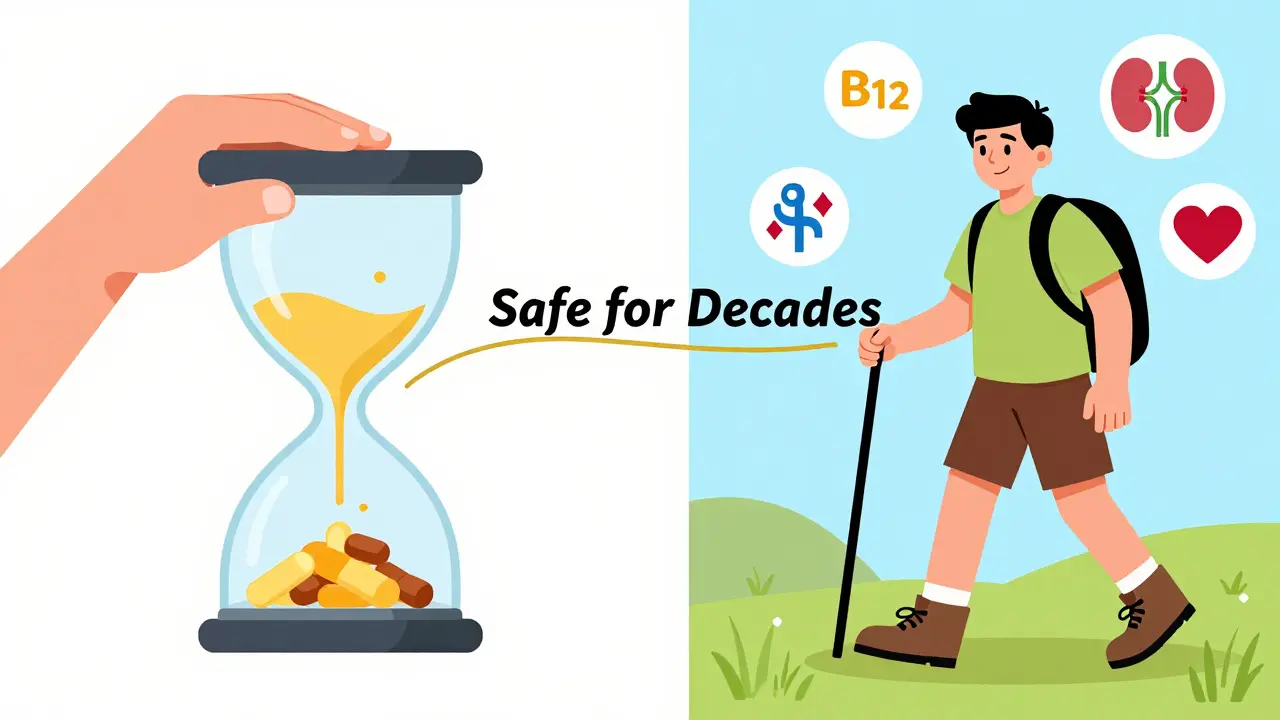
Metformin isn’t perfect. But for millions, it’s life-changing. The side effects are real - but manageable. The risks are real - but rare. The key is knowing the difference between what’s annoying and what’s dangerous. Most people can take metformin safely for decades. You just need to listen to your body, follow the rules, and talk to your doctor when things change.
Does metformin cause permanent kidney damage?
No. Metformin does not cause kidney damage. It’s cleared by the kidneys, so if your kidneys are already failing (eGFR below 30), the drug can build up and increase risk of lactic acidosis. But studies show no link between metformin use and worsening kidney function over time. A 10-year cohort study found a hazard ratio of 1.02 - meaning no increased risk.
Can I take metformin if I drink alcohol?
Occasional drinking is usually fine. But heavy alcohol use - 3 or more drinks per day - increases your risk of lactic acidosis by nearly 7 times. Alcohol affects your liver and kidneys, which are already handling metformin. If you drink regularly, talk to your doctor. They may suggest monitoring your kidney function more closely or adjusting your dose.
How long do metformin stomach side effects last?
For most people, GI side effects like diarrhea and nausea last 2 to 4 weeks. About 68% of people feel them in the first 30 days, but 85% see improvement within that time. Starting with a low dose and using extended-release metformin can cut the duration and severity. If symptoms persist beyond a month, talk to your doctor - you may need a different formulation or medication.
Is metformin safe for older adults?
Yes - if kidney function is normal. People over 80 have nearly 5 times higher risk of lactic acidosis, but that’s mostly because kidney function declines with age. The key is checking eGFR regularly. If it’s above 45, metformin is generally safe. Many older adults take it for years without issues. Don’t assume age alone means you can’t take it - test your kidney function instead.
Should I stop metformin before a CT scan with contrast dye?
Yes. Contrast dye can temporarily reduce kidney function. If your kidneys slow down while you’re on metformin, lactic acid can build up. The American College of Radiology recommends stopping metformin 48 hours before the scan and not restarting until 48 hours after - and only if your kidney function is normal. Always tell your radiology team you’re on metformin.
Does metformin cause vitamin B12 deficiency?
It can lower B12 levels in about 7% of long-term users, but it’s not permanent. The American Association of Clinical Endocrinologists recommends checking B12 levels every year. If levels are low, a simple oral or injectable B12 supplement reverses it in 94% of cases. Don’t panic - just get tested annually.
Can I take metformin if I have heart failure?
Yes - if it’s stable. Older guidelines said no, but new evidence shows metformin is safe and may even improve outcomes in stable heart failure patients, as long as kidney function is normal. The 2023 American Diabetes Association guidelines removed heart failure as a strict contraindication. Always check your eGFR and talk to your doctor before making changes.
Next Steps: What to Do Right Now
If you’re on metformin and feeling fine - keep going. Get your kidney function checked every 6 months if you’re over 65 or have other health issues. Ask your doctor about switching to extended-release if you still have stomach problems.
If you’re just starting - don’t quit because of nausea. Start with 500 mg once a day with dinner. Wait a week. Then go to 500 mg twice a day. If you’re still struggling after a month, ask about the new ER-XR version.
If you’re feeling extreme fatigue, trouble breathing, or severe stomach pain - stop metformin and go to the ER. Don’t wait. Lactic acidosis is rare, but it’s not something you can treat at home.
Metformin saved millions from diabetes complications. It’s not the perfect drug - but it’s the best we’ve got. You don’t need to fear it. You need to understand it.

12 Comments
You think this is bad? Try taking metformin in India without any doctor oversight. People just buy it from the pharmacy like candy. Then they wonder why they’re throwing up at 3am. You don’t get a medal for surviving side effects-you get a warning label.
The FDA’s black box warning is not a suggestion. It’s a legal requirement because people die. You can’t just shrug off lactic acidosis as 'rare.' Rare doesn’t mean impossible. And if you’re telling people to 'give it time,' you’re gambling with their lives.
They don’t want you to know the truth. Metformin was designed by Big Pharma to keep you dependent. The GI issues? That’s the drug killing your gut flora so you’ll need probiotics. And the B12 thing? That’s just the first step before they sell you the 'cure' for the cure.
I was terrified when I started metformin, but following the slow-start advice changed everything. I went from three diarrhea episodes a day to none in 21 days. It’s not perfect, but it’s manageable. You’re not alone in this.
I’ve been on metformin for 8 years. Started with 500mg at dinner. Took 3 weeks to adjust. Now I take ER and barely notice it. If you’re struggling, don’t give up-just tweak the dose. You got this.
In India, we call metformin 'the silent guardian'-cheap, effective, and the only thing standing between you and insulin shots. But yes, your gut will hate you for a month. My uncle took it with ginger tea and a banana. Said it felt like a hug for his stomach. Sometimes the old ways still work.
If you're still having GI issues after a month you're doing it wrong. Stop being weak. Start low go slow isn't a suggestion-it's the protocol. And if you can't handle a pill with food then maybe you shouldn't be managing your own diabetes
I switched to ER after two weeks of crying in the bathroom. Game changer. Also, taking it with a spoonful of peanut butter? Magic. Don’t overthink it. Just do the small things.
Oh, so now we’re glorifying metformin like it’s some holy grail? People die from lactic acidosis. You act like it’s just a stomach bug. Meanwhile, your cousin’s uncle’s neighbor’s dog died from it. You’re not helping.
The real issue isn’t metformin-it’s that doctors don’t test kidney function before prescribing. I’ve seen 70-year-olds on 1000mg with eGFR 38. That’s not negligence-it’s negligence with a diploma.
This country is falling apart because people take pills without understanding them. Metformin was never meant for lazy Americans who won’t diet. You want to live longer? Stop eating sugar. Not take more pills.
They’re hiding the truth. Metformin causes mitochondrial damage. That’s why you get tired. The B12 thing? That’s just cover-up. The real damage is inside your cells. They don’t want you to know.