

When you pick up a prescription, the label looks simple: a few lines of text, some numbers, maybe a symbol or two. But what do those words really mean? If your label says "take twice daily," do you take it at 8 AM and 8 PM? Or just whenever you remember? What if it says "take with food"-does that mean right after a meal, or just during? These aren’t just small details. Getting them wrong can mean your medicine doesn’t work, or worse, it harms you.
What "Twice Daily" Actually Means
Many people assume "twice daily" means morning and night. But that’s not always safe. The FDA now recommends avoiding vague terms like "twice daily" entirely. Instead, labels should say: "Take 1 tablet with breakfast and 1 tablet with dinner." Why? Because timing matters. Take blood pressure medicine, for example. If you take it only at night, your blood pressure might spike in the morning-when heart attacks are most common. If you take it only in the morning, it might wear off by evening. The same goes for antibiotics. If you space doses too far apart, the drug doesn’t stay at effective levels in your body, and bacteria can start to grow again. A 2021 study at Massachusetts General Hospital found patients who got labels with exact timing instructions were 34.7% more likely to take their meds correctly than those who just saw "twice daily." That’s not a small difference. It’s the difference between healing and getting sicker.Why "As Needed" Is Risky
"Take as needed for pain" sounds flexible. But without a maximum daily limit, it’s dangerous. Many people don’t realize that over-the-counter painkillers like acetaminophen (Tylenol) can cause liver failure if taken too often-even if each dose feels fine. A 2023 Consumer Reports survey found that 67.8% of people didn’t know the safe daily limit for pain meds labeled "as needed." Some took 3 or 4 pills a day, thinking it was fine because they weren’t in constant pain. But those pills add up. The FDA warns that acetaminophen overdose is the leading cause of acute liver failure in the U.S. The fix? Labels should say: "Take 1 tablet every 6 hours as needed for pain. Do not exceed 4 tablets in 24 hours." Clear limits save lives.Milliliters, Not Teaspoons
If you’re taking liquid medicine-like antibiotics for a child or syrup for a cough-the unit of measure matters. For decades, prescriptions used "teaspoon" or "tablespoon." But household spoons vary wildly. A teaspoon from your kitchen might hold 4 mL, or it might hold 7 mL. That’s a 75% difference. The FDA and U.S. Pharmacopeia now require all liquid prescriptions to use milliliters (mL). So your label should say "5 mL," not "1 teaspoon." And you should use the measuring cup or syringe that comes with the medicine-not a kitchen spoon. A 2022 NIH study found that 27.4% of patients made dosing errors when using household spoons. That’s nearly 1 in 3 people. Even a small mistake can be dangerous for kids or elderly patients.Timing and Food: What "With Food" Really Means
"Take with food" isn’t just a suggestion. For some drugs, food changes how your body absorbs them. Take levothyroxine, used for thyroid problems. If you take it with coffee, calcium, or a big breakfast, your body absorbs less of it-sometimes up to 50% less. That means your thyroid levels stay low, and you feel tired, gain weight, or get depressed-even if you’re taking the right dose. The correct way? Take it on an empty stomach, at least 30 to 60 minutes before eating. But many labels still just say "take in the morning." That’s not enough. The best labels say: "Take 1 tablet 30 minutes before breakfast, with a full glass of water. Do not take with coffee, calcium, or iron supplements." The same applies to antibiotics like doxycycline. If you take it right after a meal, especially dairy, it won’t work as well. The label should say: "Take on an empty stomach, 1 hour before or 2 hours after meals."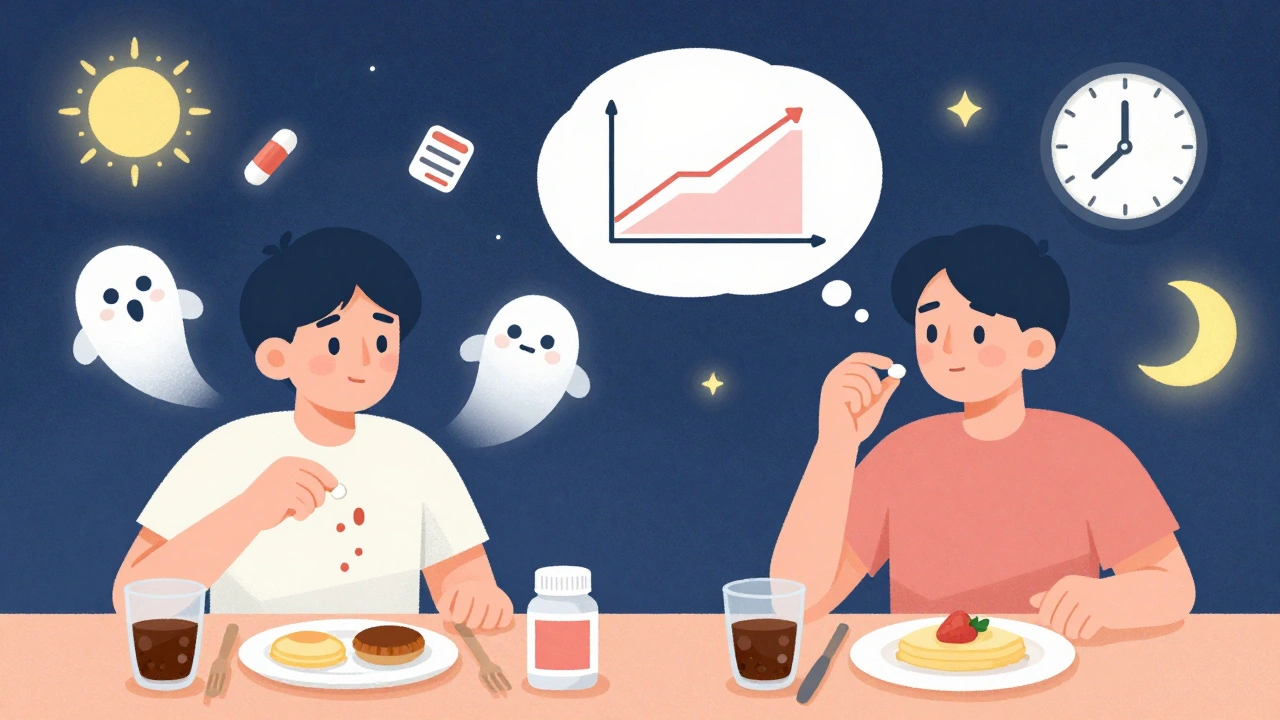
What About "Once Daily"?
"Once daily" sounds easy. But it’s not always simple. Some drugs need to be taken at the same time every day to keep steady levels in your blood. For example, warfarin (a blood thinner) needs consistent timing. If you take it at 8 AM one day and 10 PM the next, your blood clotting levels swing wildly. That raises your risk of stroke or dangerous bleeding. The best labels say: "Take 1 tablet at 8:00 AM every day, even on weekends." This helps patients build a habit. It also makes it easier for pharmacists and doctors to track if the dose is working.Why Abbreviations Like "B.I.D." Are Dangerous
You might see "b.i.d." or "t.i.d." on old-style labels. These are Latin abbreviations for "twice daily" and "three times daily." But most patients don’t know what they mean. The American Medical Association tested this in 2021. Only 37.4% of adults correctly understood what "b.i.d." meant. That’s less than 4 in 10 people. Even some nurses and doctors mix them up. The fix? Never use abbreviations. Always spell it out: "Take two times a day." Clear language saves lives.Shift Workers and Odd Schedules
What if you work nights? Or your schedule changes every few days? "Take with breakfast" doesn’t work if you eat dinner at 6 AM. A 2022 study found that 22.3% of night-shift workers misinterpreted "morning" and "evening" instructions. They took their medicine when they woke up-even if it was 3 PM. The solution? Labels should offer flexibility. Instead of "take in the morning," try: "Take one dose approximately every 12 hours." Or: "Take one dose when you wake up, and one dose 12 hours later." This lets patients adapt to their lives without breaking the rules.
What’s Changing in 2025
The FDA isn’t done. Starting January 1, 2027, all new prescription labels in the U.S. must include a "Medication Schedule Grid." That’s a simple chart showing exactly when to take each dose-Monday through Sunday-with icons for meals, sleep, or activity. Some pharmacies are already testing this. In California, Senate Bill 1333 (effective 2024) requires pictograms: a sun for morning, a moon for night, a plate for with food. These visuals help people who struggle with reading. Pharmacies are also rolling out QR codes. Scan the code with your phone, and you’ll get a short video showing how and when to take the medicine. A 2023 FDA pilot found this cut timing errors by over 50%.What You Can Do Right Now
You don’t have to wait for better labels. Here’s what to do every time you get a new prescription:- Ask the pharmacist: "Can you explain exactly when and how to take this?" Don’t be shy. Pharmacists are trained to help.
- Check the unit: Is it in mL? If it says "teaspoon," ask for a measuring cup.
- Clarify "as needed": "What’s the most I can take in a day?" Write it down.
- Ask about food: "Should I take this before, with, or after meals?"
- Use a pill organizer: Fill it once a week. It helps you see if you missed a dose.
- Set phone alarms: Label them clearly: "Morning med-take with breakfast."
When Something Doesn’t Feel Right
If you feel worse after starting a new medicine, or if you’re unsure about the timing, don’t guess. Call your doctor or pharmacist. Don’t stop taking it unless they tell you to. Many people avoid asking questions because they don’t want to seem "stupid." But medication errors are one of the top causes of hospital visits in the U.S. The problem isn’t you. It’s the system. You have the right to understand your medicine. And the more you ask, the better the system gets-for everyone.What does "twice daily" really mean on a prescription label?
"Twice daily" should mean two doses spaced about 12 hours apart, but it’s often misunderstood. The FDA now recommends avoiding this term entirely. Instead, labels should say exactly when to take each dose-for example, "Take 1 tablet with breakfast and 1 tablet with dinner." This reduces confusion and improves adherence by up to 35%.
Why should liquid medications use mL instead of teaspoons?
Household teaspoons vary in size-some hold 4 mL, others 7 mL. This leads to dangerous overdoses or underdoses. The FDA and U.S. Pharmacopeia require milliliters (mL) on all liquid medication labels because they’re precise. Always use the measuring syringe or cup that comes with the medicine, never a kitchen spoon.
Can I take my medicine "as needed" whenever I want?
No. "As needed" always comes with a maximum daily limit. For example, acetaminophen should never exceed 4,000 mg per day (usually 4 tablets). Without knowing this limit, people risk liver damage. Always ask your pharmacist: "What’s the most I can take in 24 hours?" Write it down.
What does "take with food" actually mean?
It means take the medicine during or right after eating. But for some drugs, like levothyroxine or doxycycline, food blocks absorption. The label should specify: "Take 30 minutes before breakfast" or "Take 1 hour before or 2 hours after meals." If it doesn’t, ask your pharmacist for clarification.
Why should I avoid abbreviations like b.i.d. or t.i.d.?
Abbreviations like b.i.d. (twice daily) and t.i.d. (three times daily) are Latin terms that most patients don’t understand. A 2021 AMA survey found only 37.4% of adults knew what they meant. Always ask for plain language: "Take two times a day" or "Take three times a day." Clear words prevent mistakes.
What should I do if my work schedule makes it hard to take medicine at the same time every day?
If you work nights or have irregular hours, tell your pharmacist. Instead of "take in the morning," ask for: "Take one dose when you wake up, and one dose 12 hours later." This keeps the timing consistent with your body’s rhythm, not a clock. Some newer labels now include flexible instructions for shift workers.


11 Comments
so the government finally figured out people can't read
took them long enough. next they'll ban the word 'daily' and make us all use emojis for medicine times 🌞💊🌙
This is why your meds don't work. The system is designed to keep you confused. They want you dependent. They don't care if you live or die as long as you keep buying pills.
YESSSS this is so important!! 🙌 I always tell my grandma to use the little syringe - not the spoon! She used to say 'it's just a teaspoon, it's fine' 😅 Now she's got a whole pill organizer and alarms set. Life changed!
you think this is bad? wait till you find out the pharma companies pay the FDA to approve these labels. they WANT you to mess up so you come back for more. and don't get me started on the QR codes - that's how they track you. 😈
Honestly? This post is a gift. So many people are just winging it with meds and it's terrifying. If you're reading this and you've ever guessed at a dose - stop. Call your pharmacist. Right now. Seriously. You're worth the 2-minute call.
they're putting QR codes on pills now? next they'll implant microchips in the capsules. you think this is about safety? its about control. they dont want you thinking for yourself
i never knew about the mL thing!! i used spoons for my kid's antibiotics for YEARS. i feel so stupid. but thanks for this - i'm going to the pharmacy tomorrow to ask for a syringe. i dont care if they think i'm annoying
The real problem? People don't read. They see 'twice daily' and think 'I'll take it when I remember.' That's not laziness - that's intellectual surrender. You're not too busy to live - you're too lazy to care.
I cried reading this. My mom died because she took her blood thinner at different times every day. No one ever explained it clearly. I wish someone had shown her this. Please - if you're taking meds, ask. Ask again. And again. You're not being a burden. You're saving your life.
You're all missing the point. The real issue is that doctors prescribe these drugs without knowing how patients live. Why should a night shift worker take 'with breakfast'? That's not medicine - that's colonial thinking disguised as healthcare.
This is why Western medicine is failing. You treat symptoms, not systems. You give people pills and tell them to follow instructions they can't understand. Meanwhile, the real solution is fasting, sunlight, and ancestral wisdom. But no - we'll keep printing tiny labels and calling it progress.