

HIV is no longer a death sentence
Thirty years ago, an HIV diagnosis meant a short life expectancy. Today, someone diagnosed with HIV at age 25 can expect to live a full, healthy life-just like anyone else. This shift didn’t happen by accident. It came from decades of research, better drugs, and a fundamental change in how we treat the virus. The key? HIV treatment isn’t about fighting the virus every day anymore. It’s about controlling it so completely that it can’t harm the body or spread to others.
How modern HIV treatment works
Modern HIV treatment uses a combination of drugs that attack the virus at different stages of its life cycle. These are called antiretroviral drugs, and they fall into seven main classes: NRTIs, NNRTIs, PIs, INSTIs, fusion inhibitors, CCR5 antagonists, and capsid inhibitors. The most common and effective regimens today combine three or more drugs into one pill, taken once daily.
One of the most widely used is Biktarvy. It contains bictegravir, emtricitabine, and tenofovir alafenamide-all in a single tablet smaller than a dime. It’s effective, simple, and has fewer side effects than older drugs. Another option is DELSTRIGO, which is often chosen for people with kidney issues because it’s gentler on the body.
But the biggest leap forward isn’t a pill-it’s an injection. In 2022, lenacapavir (Sunlenca) became the first capsid inhibitor approved for HIV treatment. It works by blocking the virus’s outer shell, called the capsid, which protects its genetic material. What makes it revolutionary? One injection lasts six months.
The breakthrough: Twice-yearly HIV treatment
In early 2025, a new combination therapy called LTZ-made up of lenacapavir, teropavimab, and zinlirvimab-showed results that stunned the medical world. In clinical trials, 98.7% of people who received LTZ injections every six months maintained undetectable viral loads. That’s higher than daily pills. And the side effects? Only 12% had mild pain at the injection site. Compare that to monthly injections, which require 12 visits a year. LTZ needs just two.
This isn’t just a minor upgrade. It’s a complete rethinking of HIV care. The FDA gave it Breakthrough Therapy Designation. Science Magazine named lenacapavir the 2024 Breakthrough of the Year. The World Health Organization endorsed it as a prevention tool in July 2025, calling it “the next best thing to an HIV vaccine.”
For prevention, the same drug is now sold as Yeztugo. It’s approved for people at high risk of HIV infection. In trials, it prevented nearly all infections. That’s not just effective-it’s life-changing.
Quality of life: More than just survival
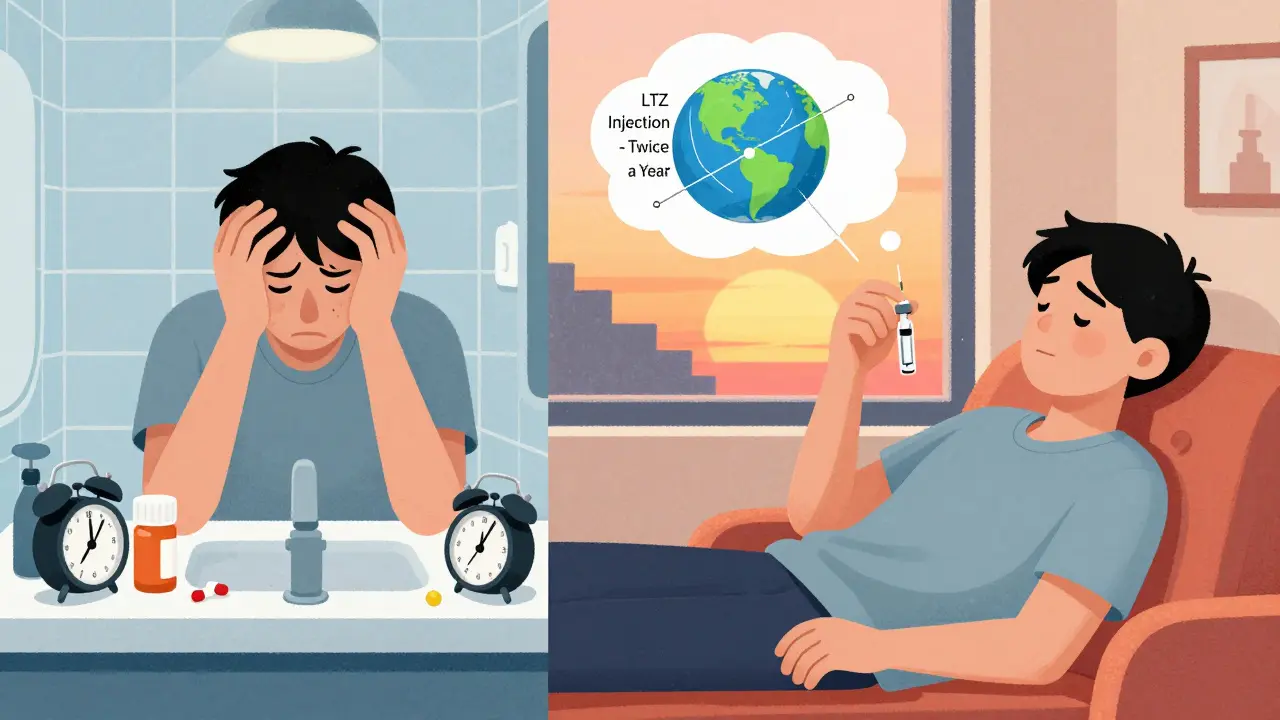
People with HIV used to live with constant fear: fear of missing a pill, fear of side effects, fear of stigma. Daily pills meant reminders everywhere-on the bathroom counter, in the work bag, on the phone alarm. For many, that daily routine became a symbol of shame.
Now, with long-acting therapies, that burden is gone. A Reddit user wrote in March 2025: “After 12 years of daily pills, the twice-yearly injection has eliminated my treatment-related anxiety completely.” That sentiment echoes across patient forums. The Positive Peers app, used by over 150,000 people with HIV, found that 92% of those on long-acting regimens rated their satisfaction as 8 or higher out of 10. Only 76% of those on daily pills felt the same.
It’s not just about convenience. It’s about mental health. When you don’t have to think about your HIV every day, you can start living again. People report better sleep, less depression, and more confidence in relationships. One study showed 89% of LTZ users felt “excellent” confidence in their adherence-compared to 63% on daily pills.
Cost, access, and the global divide
Here’s the hard truth: these breakthroughs come with a price tag. In the U.S., Biktarvy costs about $69,000 a year. Yeztugo, the prevention version, is $45,000. That’s more than most people make in a year.
But there’s hope. According to UNAIDS and the European AIDS Treatment Group, generic versions could be produced for as little as $25 per person per year. That’s one-thousandth of the current list price. If that happens, we could see universal access-not just in wealthy countries, but in sub-Saharan Africa, Southeast Asia, and Latin America.
Right now, only 17% of U.S. clinics could offer Sunlenca in early 2025 because it needed to be stored at -20°C. That’s a freezer most doctors’ offices don’t have. After the Yeztugo approval, a more stable version became available, and clinic access jumped to 43%. But in low-income countries, less than 2% of people with HIV are on long-acting therapies. The WHO is pushing hard to fix this. Their July 2025 guidelines say community health workers-local nurses, village volunteers-should be trained to give the injections. That’s how we make this work globally.

What’s next? The future of HIV care
By 2030, experts predict that 75% of people with HIV in high-income countries will be on long-acting treatments. In lower-income countries, that number could hit 40%-if pricing drops as projected. Gilead Sciences, the company behind lenacapavir, made $13.2 billion from HIV drugs in 2024. That’s a lot of money. But it’s also a signal: the market is ready for change.
Other companies are racing to catch up. ViiV Healthcare has two new candidates in trials-VH-184 and VH-499-that work like lenacapavir but don’t yet offer twice-yearly dosing. Merck’s DOR/ISL is a once-daily two-drug pill that’s easier on the heart, but it still requires daily commitment.
And then there’s the bigger question: can we cure HIV? A trial in 2025 tested a combination of antibodies and drugs meant to flush out hidden virus. Three out of 25 participants stayed virus-free after stopping treatment. It’s not a cure yet. But it’s a start.
Switching to long-acting therapy: What to expect
If you’re on daily pills and want to switch, it’s not as simple as stopping your current meds. You need a transition plan. Most providers recommend a four-week overlap-taking your oral pills while starting the first injection. This ensures the virus stays suppressed without interruption.
Side effects? Mild pain or swelling at the injection site is common. It usually lasts two to three days. Ice packs and over-the-counter painkillers like ibuprofen help in 92% of cases. No one has reported serious reactions.
Getting started requires coordination. You’ll need an HIV specialist, a pharmacist who knows how to handle the drug, and a system to remind you of your next appointment. Programs that use text reminders saw 96.4% of patients show up on time. Without them, it was just 82.7%.
Why this matters beyond HIV
This isn’t just about HIV. It’s about what medicine can do when science, funding, and compassion align. If we can turn a once-deadly virus into a manageable condition with two shots a year, why can’t we do the same for hepatitis C, tuberculosis, or even some cancers?
The lesson here is simple: treatment doesn’t have to be daily. It doesn’t have to be painful. It doesn’t have to carry shame. We’ve proven that.
The next step? Making sure everyone gets it. Not just the wealthy. Not just the lucky. Everyone.
Can HIV be cured with current treatments?
No, current treatments cannot cure HIV. They suppress the virus to undetectable levels, meaning it can’t be transmitted and won’t damage the immune system. But the virus remains hidden in reservoirs in the body. If treatment stops, the virus rebounds. Researchers are testing cure strategies, like combining broadly neutralizing antibodies with drugs that activate hidden virus, but these are still experimental. Only a handful of people have achieved long-term remission after stopping treatment, and none are considered fully cured.
How often do you need injections for the new long-acting HIV treatment?
The new LTZ regimen-lenacapavir combined with two broadly neutralizing antibodies-is designed for twice-yearly dosing. That means two injections per year, six months apart. This is a major improvement over monthly injections like cabotegravir (Apretude), which require 12 visits annually. The goal is to reduce the burden of care and improve adherence.
Is long-acting HIV treatment better than daily pills?
For many people, yes. Long-acting treatments like LTZ match or exceed daily pills in viral suppression-98.7% vs. 97.2%. But the real advantage is in quality of life. People report less anxiety, better mental health, and higher confidence in staying on track. Daily pills require strict routines, which can be hard to maintain. Injections every six months remove that daily pressure. However, they require clinic visits and trained staff, which can be a barrier in some areas.
Can you use long-acting therapy for HIV prevention?
Yes. Lenacapavir is approved for prevention under the brand name Yeztugo. It’s recommended by the WHO for people at high risk of HIV, such as those in serodiscordant relationships or in areas with high infection rates. In trials, it prevented nearly all infections. It’s given as a subcutaneous injection every six months. This makes it far easier to use than daily PrEP pills, especially for people who struggle with adherence.
Why is HIV treatment so expensive in the U.S.?
Drug pricing in the U.S. is driven by patent protections, lack of price negotiation, and market monopolies. Companies like Gilead set prices based on what the market will bear, not production cost. The list price for Biktarvy is $69,000 a year, and Yeztugo is $45,000. But manufacturing costs are far lower. Experts estimate generic versions could be made for under $25 per person per year. The high cost isn’t about science-it’s about policy and profit. Global health advocates are pushing for compulsory licensing and bulk purchasing to bring prices down.
Are there side effects with long-acting HIV injections?
The most common side effect is mild to moderate pain, swelling, or redness at the injection site. In trials, about 12% of people experienced this with the LTZ regimen, and it lasted only two to three days. Most cases were managed with ice packs and over-the-counter pain relievers like ibuprofen. Serious reactions are rare. Some people report fatigue or headaches, but these are uncommon. Overall, most users say the discomfort is far better than taking a daily pill.
Can you switch from daily pills to long-acting injections?
Yes, but it must be done carefully. You’ll need to continue your daily pills for about four weeks after your first injection. This ensures there’s no gap in viral suppression while the long-acting drug builds up in your system. Your doctor will monitor your viral load during this transition. Switching is safe and effective when guided by an HIV specialist. Many people report feeling more in control of their health after making the switch.
Where can you get long-acting HIV treatment?
In the U.S., long-acting treatments are available at specialized HIV clinics, major hospitals, and some community health centers. As of mid-2025, about 43% of U.S. clinics can offer lenacapavir-based therapies, up from 17% in early 2025. Access is still limited in rural areas and low-income regions due to storage requirements and lack of trained staff. Outside the U.S., availability is much lower-under 2% in sub-Saharan Africa. The WHO is working with governments to train community health workers to deliver injections, which could dramatically expand access in the coming years.



15 Comments
This is life-changing. Two shots a year? I can actually imagine living without the daily reminder. Finally, HIV care feels human.
I’ve been on Biktarvy for 7 years. The idea of switching to injections makes me want to cry. Not because I’m sad-because I’m finally free.
The stigma hasn’t disappeared, but the burden? Gone. When you don’t have to explain why you’re taking pills at lunch, you start to breathe again.
I work in a clinic in rural Ohio. We don’t even have a freezer that goes to -20°C. This tech is amazing… but it’s not for us. Not yet.
You people act like this is some miracle. Let’s be real-this is just pharma selling the same drug under a new brand and charging $45k for it. They’re not heroes. They’re capitalists.
OMG, I can’t believe people are still taking daily pills?? Like, what are you even doing?? This is 2025. You’re literally choosing suffering. I mean… really??
I’m so glad we’re finally talking about this! 😊 I switched to Sunlenca last year and my anxiety dropped 90%. I even started dating again. Who knew two shots a year could give you your life back? 🥹
The 98.7% viral suppression rate is statistically significant, but the real metric is adherence. Daily pills have ~85% adherence in real-world settings. Long-acting injectables push that to 96%. That’s not just efficacy-it’s behavioral pharmacology.
It is, however, profoundly concerning that the cost of these therapies remains astronomically disproportionate to their marginal production cost. The market failure here is not merely economic-it is moral.
I just got my first injection last week. The nurse said it felt like a bee sting. I cried. Not from pain-from relief. I haven’t felt this… normal… in 14 years.
So… we’re celebrating a $45k injection as a win… while people in Kenya still can’t get tenofovir? We’re not heroes. We’re just better at marketing.
In India, we’re waiting for generics. I’ve seen friends die because they couldn’t afford one pill a day. This breakthrough means nothing if it doesn’t reach them. Please don’t forget us.
I’m from Nigeria. We don’t have clinics with freezers. We have community health workers with coolers and ice packs. If WHO trains them to give these shots? We could see real change. Not in 10 years. In 2.
I used to hide my meds in my toothbrush cup. Now I just set a calendar alert for next June. Feels like magic. Or maybe… just dignity.
We’ve been conditioned to believe that medicine must be daily, painful, and inconvenient to be valid. This isn’t progress-it’s a rebuke of our entire paradigm of care. If we can do this for HIV, why are we still forcing cancer patients to endure daily chemo infusions? The answer isn’t science. It’s power.