
Drug Causality Estimator
Assess Drug-Side Effect Causality
This tool helps estimate the likelihood that a medication caused a side effect based on clinical evidence from dechallenge and rechallenge observations.
What this means:
This tool uses WHO-UMC causality assessment principles. A positive dechallenge increases likelihood from "unlikely" to "probable." Successful rechallenge confirms "definite" causality but is rarely performed for serious reactions.
When a patient develops an unexpected reaction after taking a medication, doctors don’t just guess what caused it. They use real-world clues-like what happens when the drug is stopped, and what happens when it’s given again. These are called dechallenge and rechallenge. They’re not fancy lab tests. They’re simple, powerful clinical observations that help figure out if a drug is truly responsible for a side effect.
What Is Dechallenge?
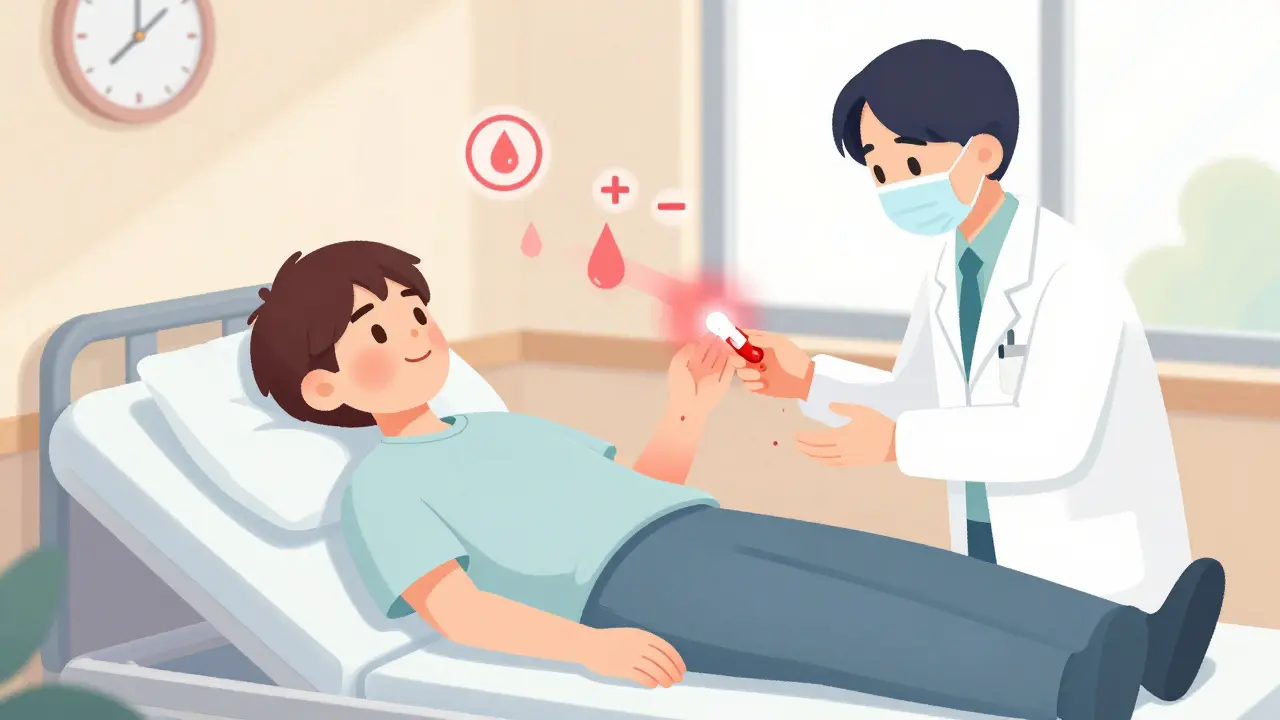
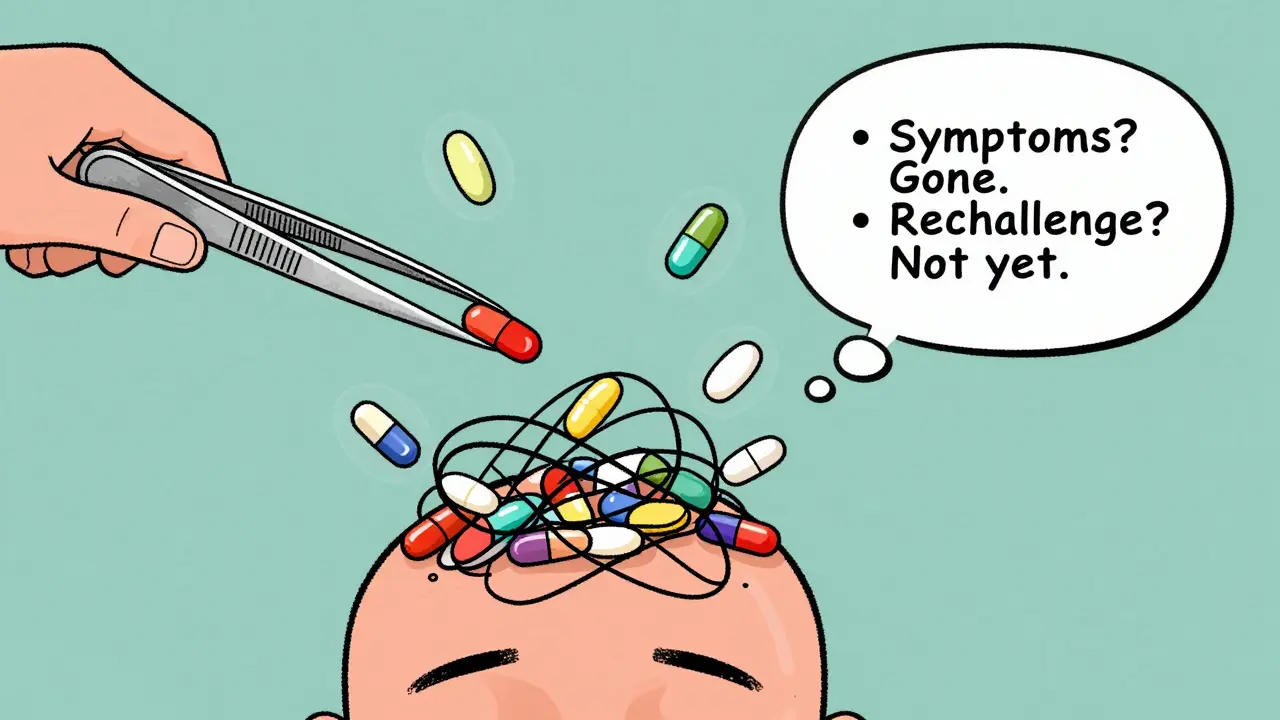
Dechallenge means stopping the drug to see if the side effect goes away. It’s the first step in figuring out if a medication is the culprit. If symptoms improve or vanish after the drug is pulled, that’s a positive dechallenge. It doesn’t prove the drug caused the problem-but it’s strong evidence.Take someone who develops a rash after starting a new antibiotic. The doctor says, "Stop the medicine." Two days later, the redness fades. By day five, it’s mostly gone. That’s a positive dechallenge. The timing matches the drug’s half-life. The rash didn’t just disappear on its own-it cleared after the trigger was removed.
But not all reactions vanish quickly. Some, like liver damage or nerve problems, can linger even after stopping the drug. That’s a negative dechallenge. It doesn’t mean the drug is innocent-it could mean the damage is permanent, or the body took longer to recover. A negative result just means you can’t rule out the drug yet.
Dechallenge works best when the drug is stopped under medical supervision. If a patient quits the medicine on their own, or switches to another drug without telling their doctor, the results get muddy. That’s why proper documentation matters. Did the patient stop the drug on a specific date? Did symptoms start exactly after starting it? Was anything else changed at the same time? These details turn a guess into a clue.
What Is Rechallenge?
Rechallenge is when the drug is given back-on purpose-to see if the side effect returns. If the same reaction happens again, it’s strong proof the drug caused it. This is the gold standard in causality assessment.There’s a famous case in dermatology: a patient developed a fixed drug reaction-a dark, recurring patch on the same spot of skin-after taking metronidazole. After stopping the drug, the patch faded over weeks. Then, months later, the doctor gave the patient the same drug again, under strict supervision. Within 48 hours, the exact same patch reappeared in the same spot. That’s rechallenge in action. No algorithm, no lab test, no statistical model could prove causality like that.
But here’s the catch: rechallenge is risky. If the side effect was severe-like Stevens-Johnson Syndrome, liver failure, or anaphylaxis-re-exposing the patient could kill them. That’s why it’s rarely done. In fact, only about 0.3% of serious adverse reaction cases even consider rechallenge, and only under tight ethical oversight with emergency plans ready.
Rechallenge is mostly used in two situations: mild reactions (like a minor rash or nausea) and research settings. Dermatologists use it more than other specialists because skin reactions are often localized and less life-threatening. In psychiatry, it’s almost never done-stopping antidepressants can trigger suicidal thoughts, and restarting them could make things worse.
Why These Tests Matter
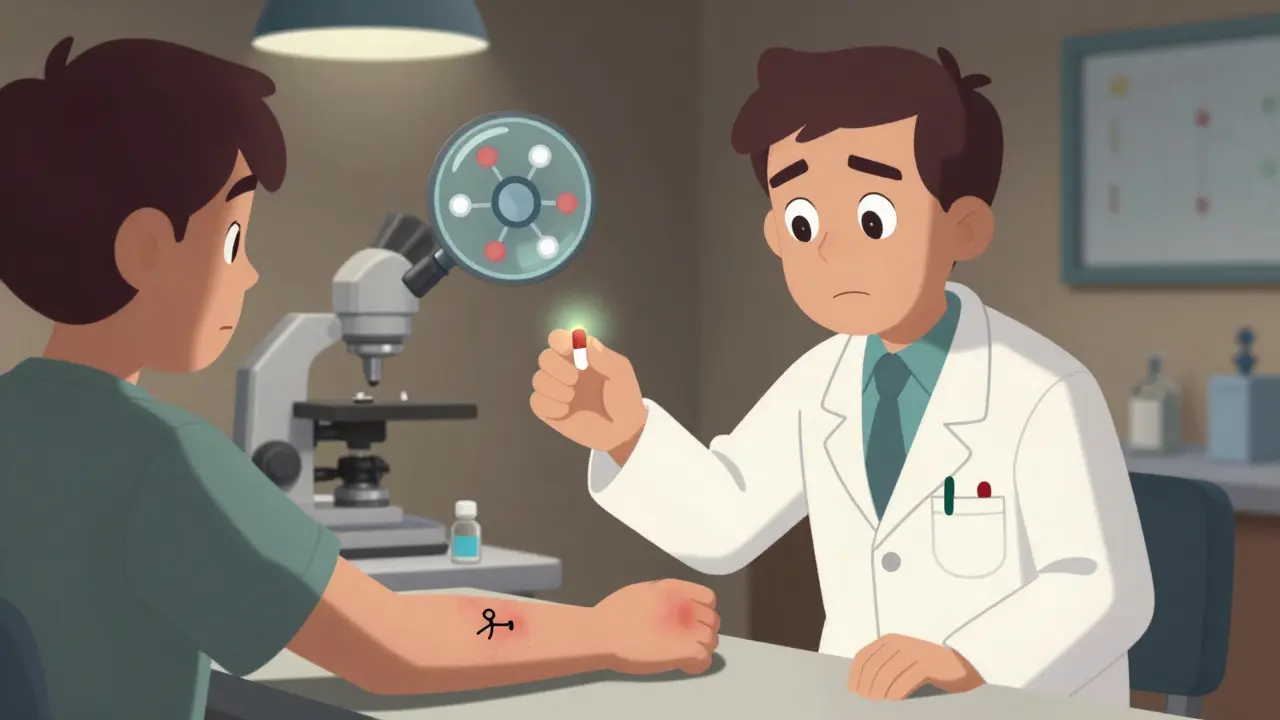
Without dechallenge and rechallenge, we’d be stuck guessing. Many side effects look like other illnesses. A headache after a new blood pressure pill? Could be stress. A fatigue after starting a statin? Maybe it’s aging. But if stopping the drug makes the fatigue vanish-and bringing it back makes it return-then you’ve got something real.Regulators like the FDA and EMA require this kind of evidence in safety reports. Pharmaceutical companies must document dechallenge outcomes in post-marketing studies. If a drug is linked to a rare liver injury, they need to show whether stopping the drug reversed the damage. That’s how drugs get warnings added to labels-or pulled from the market.
Pharmacovigilance systems around the world rely on these two steps to turn suspicion into certainty. The WHO-UMC system rates drug-reaction causality from "unlikely" to "definite." A positive dechallenge gets you to "probable." A successful rechallenge pushes it to "definite." That’s the highest level of confidence you can get without a controlled trial.
When Dechallenge and Rechallenge Don’t Work
These tools aren’t magic. They fail in real-world messiness.First, polypharmacy. If a patient is on ten medications and one causes a reaction, stopping them all at once makes it impossible to know which one was the culprit. That’s why doctors try to stop one drug at a time-when possible.
Second, delayed reporting. If a patient doesn’t tell their doctor about a rash until three weeks after it started, and they’ve already switched drugs, rechallenge isn’t an option anymore. The window closes.
Third, patient fear. Many people refuse to take a drug again-even if it helped them before-because they’re scared of the side effect. That’s understandable. But it means rechallenge data is often missing, even when it’s safe to do.
And sometimes, the reaction just doesn’t come back. That doesn’t mean the drug was safe-it could mean the immune system changed, or the dose was different, or the patient’s body reacted differently under new conditions.
What’s Changing in the Field
Technology is helping-but not replacing-these classic methods.Wearable sensors now track heart rate, skin temperature, and inflammation markers during dechallenge. Instead of relying on a patient saying, "I feel better," doctors can see objective data: inflammation markers dropped 40% in 72 hours after stopping the drug. That’s more reliable than memory.
Lab tests are also emerging. Some research labs can now test a patient’s white blood cells in a dish to see if they react to a specific drug. If the cells die or release inflammatory signals when exposed to, say, amoxicillin, it suggests the patient is likely to have a reaction if given the drug again. These tests are about 89% accurate in early studies. But they’re still expensive and not widely available.
Machine learning models are being trained to predict whether a side effect will resolve after stopping a drug-based on thousands of past cases. These tools help prioritize which reactions to investigate deeper. But experts agree: no algorithm can replace the real-world observation of a patient getting better after a drug is stopped.
As one WHO scientist put it: "No algorithm can substitute for the clinical reality of symptom resolution after drug discontinuation."
What You Should Know
If you’ve had a side effect from a medication:- Don’t assume it’s "just a side effect"-ask your doctor if it could be linked to the drug.
- If you stop the drug, tell your doctor exactly when you stopped it and what changed.
- If the reaction went away, that’s useful information. Document it.
- If you’re offered a rechallenge, ask why it’s being considered, what the risks are, and what alternatives exist.
- Never restart a drug that caused a serious reaction without medical supervision.
Doctors and pharmacists aren’t just treating symptoms. They’re solving puzzles. Dechallenge and rechallenge are two of the most reliable clues they have. They’re not perfect-but in a world full of noise, they’re the quiet signals that cut through.
What does a positive dechallenge mean?
A positive dechallenge means the side effect improved or disappeared after the drug was stopped. This suggests the drug was likely the cause, but it doesn’t prove it. It’s a strong clue, especially when the timing matches the drug’s known behavior in the body.
Is rechallenge safe?
Rechallenge is only considered safe for mild reactions, like a minor rash or stomach upset. For serious reactions-like liver damage, severe skin reactions, or anaphylaxis-it’s too risky and almost never done. When it is done, it’s under strict medical supervision with emergency plans ready.
Can dechallenge and rechallenge be used for any drug?
Technically yes-but practically, no. They’re most useful for drugs with clear timing between use and reaction, and where stopping the drug won’t cause more harm. They’re commonly used in dermatology and for antibiotics, but rarely in psychiatry or for life-saving drugs like chemotherapy.
Why don’t doctors always do rechallenge?
Because it’s dangerous. If a drug caused a life-threatening reaction once, giving it again could kill the patient. Ethical review boards and regulators limit rechallenge to cases where the risk is low and the benefit of knowing the cause is high. In most cases, dechallenge alone is enough to guide treatment.
How accurate are dechallenge and rechallenge?
Dechallenge alone gives "probable" causality in most cases. A successful rechallenge pushes it to "definite"-the highest level of certainty in pharmacovigilance. Studies show that when rechallenge works, it confirms drug causality in 97% of cases. But it’s only used in a tiny fraction of reactions because of safety concerns.

12 Comments
Dechallenge is basically the medical version of "did I forget to turn off the stove?" You stop the drug, wait, and see if the fire goes out. If it does, congrats-you found your culprit. If not, well, maybe it was the cat.
But seriously, this is how real medicine works-not algorithms, not big data, just watching a human body react. It’s beautiful in its simplicity.
While dechallenge provides a clinically robust signal-to-noise ratio in pharmacovigilance, rechallenge remains the definitive criterion for establishing causal attribution per the WHO-UMC algorithm-particularly when temporal association, biological plausibility, and dose-response relationships are congruent. That said, the ethical risk-benefit calculus for rechallenge is non-trivial, especially in polypharmacy contexts where confounding variables proliferate exponentially.
Moreover, the emergence of in vitro immune cell assays (e.g., lymphocyte toxicity testing) may soon augment-but not supplant-these phenomenological observations.
so like… if i got a rash from amoxicillin and then it went away after i stopped it… and then i took it again and the rash came back… that’s basically proof right??
why dont they just do this all the time then??
It’s kind of amazing how such a simple, low-tech method can be the most reliable way to prove causation in medicine. We’ve got AI predicting disease, robots doing surgery, and yet the gold standard is still: stop the drug, wait, see what happens.
It’s humbling. And honestly? I love that.
lol they’re not telling you the whole story. Big Pharma HATES rechallenge because if they admit a drug causes a reaction, they get sued. So they push the "it’s probably stress" line. Dechallenge? Sure, fine. Rechallenge? Nope. Too dangerous… unless you’re a guinea pig in a Phase IV trial 😈
Also, why do you think they never test drugs on people who’ve had side effects before? They don’t want to know the truth. 🤫
Interesting. In India, many patients stop antibiotics on their own after feeling better. Then they get sick again. Doctors assume it’s resistance. But maybe it’s just that the original reaction never fully resolved because the drug was stopped too early. Dechallenge becomes messy when patients are their own pharmacists.
So you’re telling me I could’ve avoided 3 years of chronic fatigue if I’d just stopped that statin sooner? And now they won’t let me try it again because I might die? Cool. Thanks for the clarity.
Also, why is my doctor so weird about this? Like I’m asking to jump off a bridge.
Let’s be honest-dechallenge and rechallenge are glorified anecdotes. They’re not statistically valid. They’re not blinded. They’re not controlled. They’re observational noise dressed up as science. The fact that regulators still treat them as "definite" evidence is a testament to how little real pharmacovigilance infrastructure exists.
Meanwhile, the FDA approves drugs based on trials with 300 people, then monitors millions for side effects using this? Pathetic.
Yeah, but what if the rash was caused by the new laundry detergent? Or the stress from your divorce? Or the fact you started eating gluten again? You stop the drug, the rash goes away-but so did the detergent, the stress, and the bread. That’s not dechallenge, that’s coincidence.
Doctors need to stop pretending this is precise science. It’s guesswork with a lab coat.
Western medicine is built on arrogance. You think stopping a drug and watching a rash disappear proves causation? What about karma? What about your ancestors’ sins? What about the moon phase? In India, we know illness is not just chemical-it’s spiritual. You cut the drug, the body heals, but the soul remembers. Rechallenge? You don’t rechallenge karma. You apologize to the medicine.
And don’t even get me started on how American doctors ignore Ayurvedic detox protocols. You think your liver just needs to "clear" the drug? No. It needs to be cleansed with neem, turmeric, and silence. But no, you want your algorithm.
There is a critical error in the original post: the term "positive dechallenge" is incorrectly defined. According to the WHO-UMC guidelines, a "positive dechallenge" refers to the resolution of the adverse event following drug withdrawal-not merely "improvement." The wording here is imprecise and potentially misleading for non-specialists. Furthermore, the use of "definite" as a causality rating is only valid when both dechallenge and rechallenge are documented, with clear temporal relationships and exclusion of confounders. This article, while well-intentioned, lacks academic rigor and should be revised.
So you're telling me that the same system that gave us Vioxx and fen-phen is now telling us this "guesswork" is the gold standard? That's not reassuring. That's terrifying.
And yeah, I'm not restarting anything that once made me feel like I was melting from the inside. No rechallenge for me. Ever.