
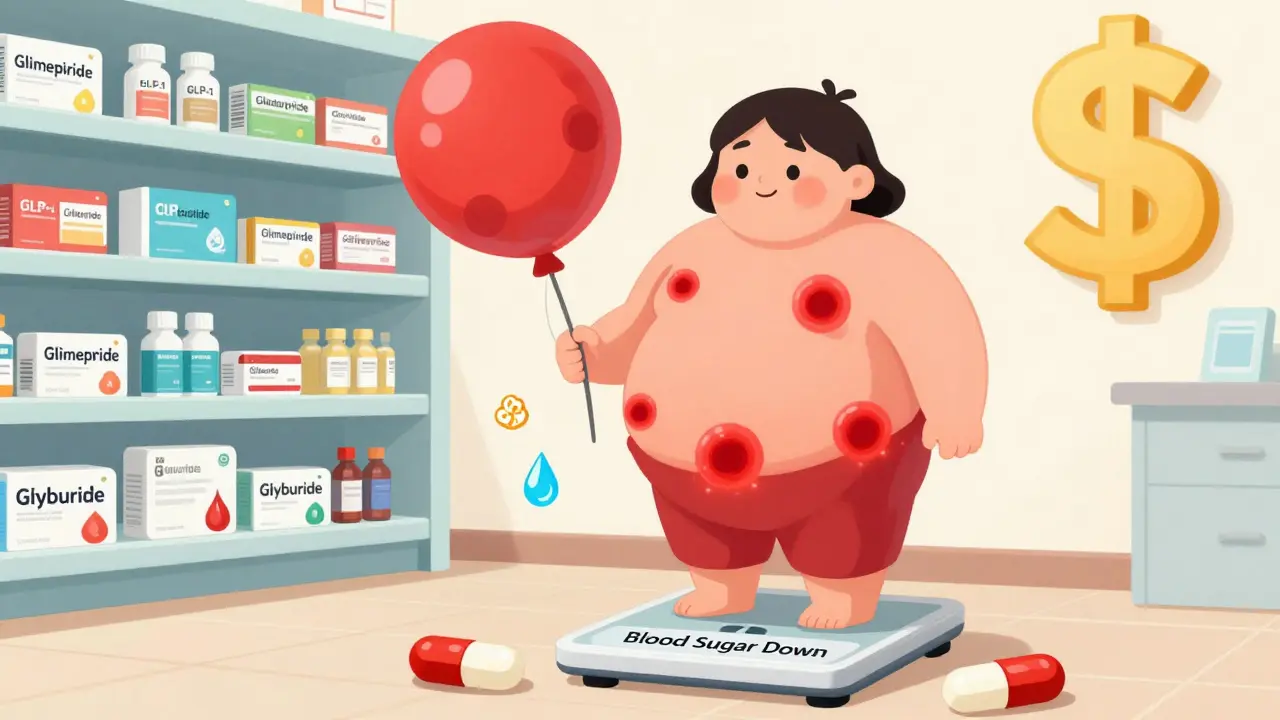
Sulfonylurea Weight Gain Estimator
Weight Gain Calculator
What This Means
Enter your information to see your expected weight gain.
Alternative Options
No recommendation yet
When you’re managing type 2 diabetes, getting your blood sugar under control is only half the battle. The other half? Keeping your weight in check - and that’s where sulfonylureas start to raise red flags. These older oral diabetes drugs have been used for decades because they work well and cost very little. But for many people, the trade-off isn’t worth it: sulfonylureas consistently cause weight gain, and that gain isn’t just cosmetic - it can make diabetes harder to manage over time.
How Sulfonylureas Work - and Why They Make You Gain Weight
Sulfonylureas like glipizide, glyburide, and glimepiride force your pancreas to pump out more insulin, no matter how much glucose is in your blood. That lowers blood sugar quickly. But insulin doesn’t just help your cells take in sugar - it also tells your body to store fat. Every time your insulin levels spike because of a sulfonylurea, your fat cells get the signal: hold onto everything.
Studies show this isn’t just a minor side effect. A 2016 study in the Farmacia Journal tracked 51 patients on sulfonylureas and found that over half of them gained noticeable weight - 2 to 5 kilograms on average. That’s about 4 to 11 pounds. The mechanism is direct: sulfonylureas bind to receptors on fat cells, increasing calcium flow inside them. That triggers fat production. It’s not about eating more - it’s about how your body handles calories when insulin is constantly high.
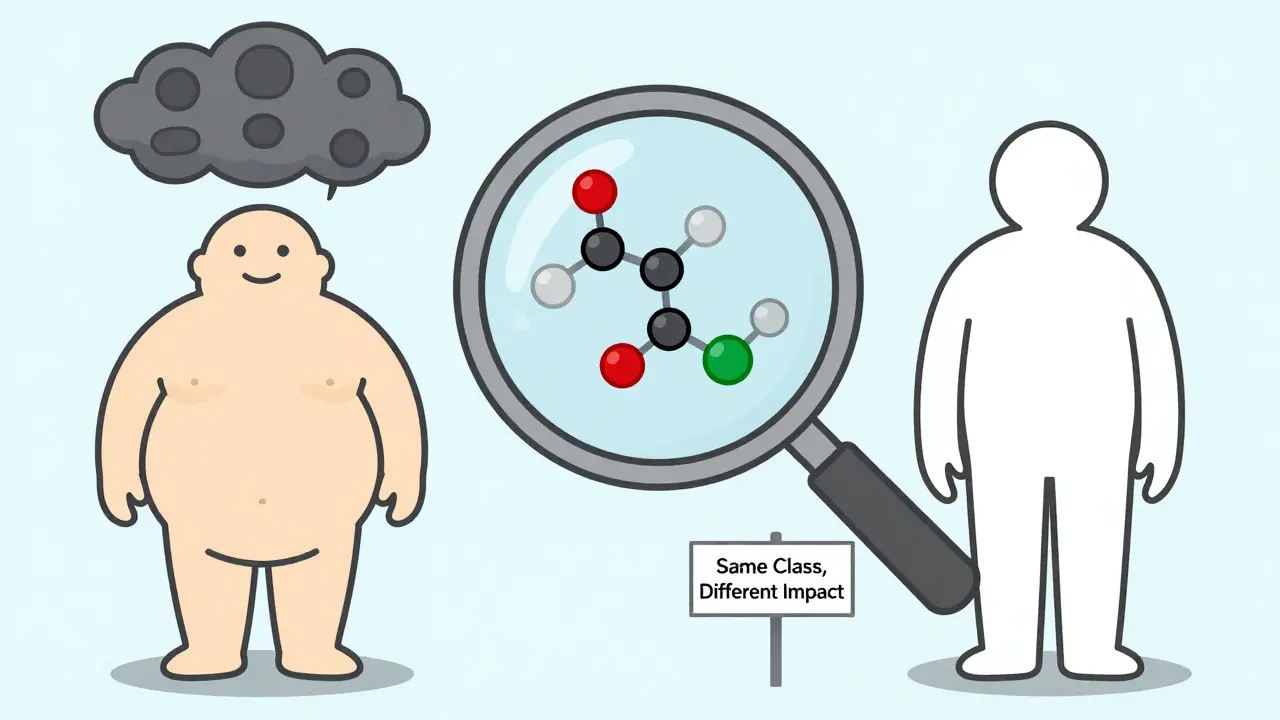
Not All Sulfonylureas Are the Same
Here’s the twist: not every drug in this class affects weight the same way. Glimepiride and glyburide are the worst offenders. The same 2016 study found that 62.7% of weight gain cases happened in people taking glimepiride. Meanwhile, gliclazide - another sulfonylurea - showed almost no weight gain. In fact, a 1988 study published in PubMed found that gliclazide actually led to a small but significant drop in body weight over three years.
Why the difference? It comes down to how tightly each drug binds to fat cell receptors. Glimepiride has a stronger affinity, which means it overstimulates fat storage more than gliclazide does. This isn’t just academic - it changes real-world choices. If you’re starting a sulfonylurea, choosing gliclazide over glimepiride could mean the difference between gaining 10 pounds or staying about the same.
How Weight Gain Compares to Other Diabetes Drugs
When you stack sulfonylureas against newer diabetes medications, the gap gets wider. Metformin? It’s weight-neutral or even helps you lose a little. GLP-1 agonists like semaglutide? They cause 5 to 7 kilograms of weight loss on average. SGLT2 inhibitors like empagliflozin? Same thing - you lose weight because you’re peeing out sugar.
Compare that to sulfonylureas: they make you gain. A 2021 NEJM review found that 60-80% of patients on GLP-1 drugs lost weight. For sulfonylureas? About 25% gain weight - and many gain more than 5 kg. The numbers don’t lie: if weight is a concern, sulfonylureas are one of the least favorable options.
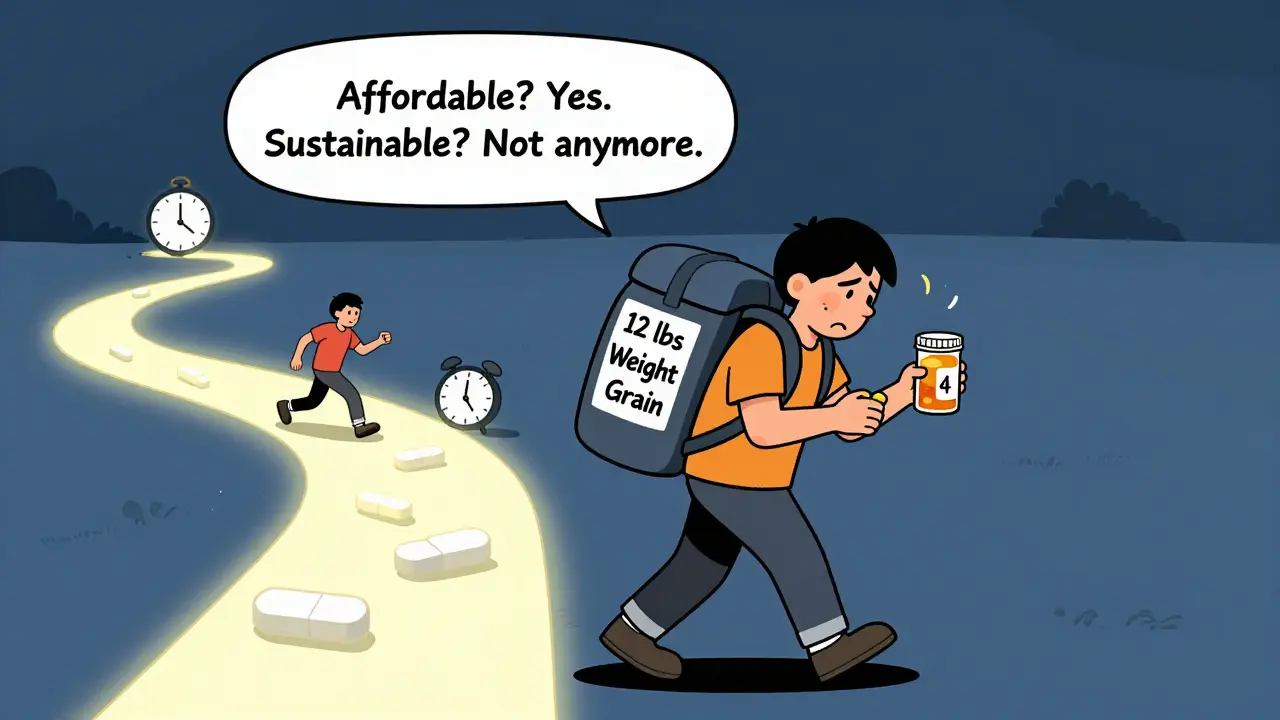
And yet, they’re still prescribed. Why? Cost. Glimepiride can cost as little as $4 a month. Semaglutide? Over $600. For someone on a tight budget, that choice isn’t easy. But here’s the hidden cost: weight gain increases insulin resistance, raises blood pressure, and increases heart disease risk. That’s not just a number on the scale - it’s a ticking clock for complications.
Real People, Real Experiences
Online diabetes communities tell the same story over and over. On the American Diabetes Association forums, 68% of 1,243 users said weight gain was a major reason they stopped taking sulfonylureas. Reddit’s r/diabetes community saw 72% of comments about these drugs mention weight as the dealbreaker.
One user, 'Type2Warrior87', wrote: “After 9 months on glipizide, I gained 12 pounds despite unchanged diet and exercise. Switched to metformin - lost it all back in 6 months.”
But not everyone feels that way. 'DiabetesSurvivor' said: “At $8/month for glyburide, I accept the 5-pound gain. My glucose is stable. I can’t afford anything else.”
These stories reflect a real divide. For some, the financial relief outweighs the physical cost. For others, the weight gain is unbearable - and it makes diabetes harder to control.
What Doctors Recommend Today
The American Diabetes Association (2022) and the European Association for the Study of Diabetes (2023) both say: don’t start with sulfonylureas unless you have to. They’re no longer first-line after metformin. In fact, the ADA now recommends avoiding them in patients with a BMI over 35.
But if you’re already on one? Here’s what works:
- Switch to gliclazide. If you’re on glimepiride or glyburide, ask if you can switch. Gliclazide has the best weight profile in this class.
- Add metformin. Combining a sulfonylurea with metformin reduces weight gain by about 1.2 kg over a year. Metformin counteracts the fat-storage effect.
- Move more and eat less. A 2020 Veterans Affairs trial showed that 150 minutes of weekly exercise and a 500-calorie daily deficit cut sulfonylurea-related weight gain by 63%. Lifestyle changes aren’t optional - they’re essential.
- Monitor weight closely. If you gain more than 3% of your body weight in 6 months, it’s time to reconsider your meds.
The Bigger Picture: Why Sulfonylureas Are Still Around
Despite all the downsides, sulfonylureas still make up 18% of the global oral diabetes market. In the U.S., prescriptions dropped 34% between 2017 and 2022 - but that’s not because they’re obsolete. It’s because newer drugs are becoming more accessible.
For 85% of low-income patients worldwide, sulfonylureas are the only affordable option. That’s why experts like Dr. Matthew Riddle warn against abandoning them entirely. The goal isn’t to eliminate them - it’s to use them smarter. Fixed-dose combinations like glyburide-metformin XR are now available and show 1.8 kg less weight gain than glyburide alone. Time-restricted eating (eating only within an 8-hour window) cut weight gain by 78% in a 2024 study.
The future isn’t about removing sulfonylureas. It’s about pairing them with strategies that block their weight gain effect - and making sure people who need them can still get them.
When to Consider Switching
If you’re on a sulfonylurea and you’re seeing these signs, talk to your doctor:
- You’ve gained more than 5 pounds in 6 months
- Your waistline is increasing, even if the scale hasn’t changed much
- Your blood sugar is stable, but your energy is low and you’re hungrier than before
- You’re struggling to stick to a diet because you feel constantly full or sluggish
There’s no shame in switching. It’s not a failure - it’s a course correction. Many people do better on metformin, GLP-1 agonists, or SGLT2 inhibitors - even if they cost more upfront. The long-term savings? Fewer complications, better mobility, and less risk for heart disease.
Final Thought: It’s Not Just About Blood Sugar
Diabetes isn’t just a sugar problem. It’s a metabolic problem. And weight gain from sulfonylureas doesn’t just add pounds - it adds stress to your heart, liver, and pancreas. You might get your A1C down, but if your body is storing more fat, you’re not getting healthier.
That’s why the best treatment isn’t just the one that lowers blood sugar. It’s the one that helps you live better - longer - without making you feel like you’re losing control of your own body.



9 Comments
Really appreciate this breakdown. I’ve been on glimepiride for 3 years and didn’t realize the fat-cell mechanism behind the weight gain. It’s not just ‘eating too much’ - it’s biology being hijacked. Switching to gliclazide changed everything for me. Lost 8 lbs in 4 months without changing diet. Doctors need to stop treating this like a ‘lifestyle issue’ and start treating it like a pharmacological side effect. Seriously.
Also, love that you mentioned the VA trial. Exercise + calorie deficit isn’t just ‘good advice’ - it’s a direct countermeasure. Why isn’t this standard protocol?
Why are we even talking about this? If you can’t afford $600/month meds, maybe you shouldn’t be on insulin at all. My uncle was on sulfonylureas for 15 years, never gained weight, and still hikes the Grand Canyon at 72. This whole ‘weight gain crisis’ is just woke medicine pushing people away from cheap, proven drugs. Stop overcomplicating everything.
Also, gliclazide? Never heard of it. Probably some European junk. Stick to what works.
lol so sulfonylureas make you fat? shocker. i been on glyburide for 5 years and i look like a football player now. no joke. my wife says i got a beer belly from the medicine, not the beer. guess i shoulda known. but hey, at least my sugars are chill. i dont care if i look like a bball player. $4 a month is free money. why would i switch?
also metformin made me puke. so nope. not doing that. gliclazide? sounds like a drug from the future. i want my $4 pill.
Yasss queen 🙌 finally someone says it. I gained 14 lbs on glipizide and felt like my body was betraying me. Switched to gliclazide + metformin and now I’m back to my wedding weight. Also, I do 8-hour eating window. No fasting, just stop eating at 7pm. Game changer. DM me if u wanna know how I did it 💪🫶
Also why is everyone so scared of spending money? I’d rather pay $500/month than be diabetic and obese. Life’s too short to be tired all the time.
Wow. A 1500-word essay on how a $4 pill makes you fat. Groundbreaking. Next you’ll tell us oxygen causes weight gain. I’m sure the 37 people who read this are now running to their doctors to demand gliclazide. Meanwhile, the rest of us are just trying to pay rent and not die from low blood sugar. Thanks for the novel, but maybe just… don’t eat so much?
Appreciate the nuance here. The cost-accessibility tension is real, and it’s not just about individual choice - it’s systemic. I work with low-income patients daily. Many are choosing between insulin, food, or rent. Sulfonylureas aren’t ‘bad’ - they’re the only tool left in the box for millions.
But the real win is combo approaches: gliclazide + metformin + time-restricted eating. It’s not about replacing one drug with another. It’s about layering smart, affordable strategies. We need policy changes too - not just individual swaps.
Weight gain? Yeah whatever. My A1C was 11. Now it’s 6.5. I gained 10 lbs. Big deal. You think your body’s a temple? It’s a machine. It works. Stop overthinking. Also gliclazide? Sounds like a vitamin. Probably doesn’t even exist. Stick to glyburide. It’s been around since dinosaurs. That’s why it works.
Hey, I just want to say this post gave me hope. I was on glimepiride and felt hopeless. I gained 15 lbs and my energy was trash. Then I switched to gliclazide and added walking 30 min a day. Lost 12 lbs in 5 months. I’m not ‘cured’ but I feel like me again. You’re not alone. It’s not your fault. Your body isn’t broken. Your meds were. Change the meds, not yourself. 💙
THEY’RE HIDING THE TRUTH. Sulfonylureas are part of the Big Pharma-Pharmaceutical Complex. The weight gain? It’s not a side effect - it’s a feature. Fat people need more meds. More meds = more profits. Gliclazide? It’s not ‘better’ - it’s a distraction. The real solution is removing insulin dependence entirely. Fasting. Ketosis. Raw foods. Why won’t the FDA let us try? Because they’re owned by the same companies that sell the pills. Wake up.