
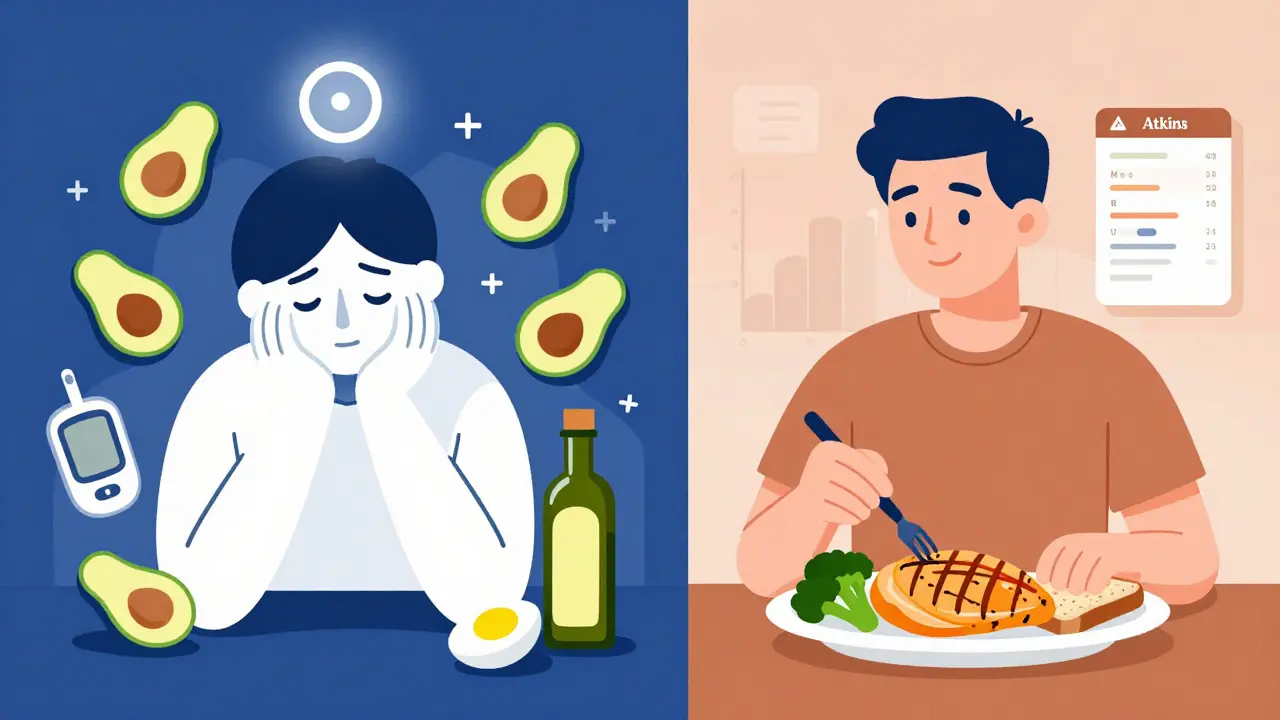
What’s the real difference between keto and Atkins for losing weight?
If you’ve ever scrolled through social media and seen someone bragging about losing 20 pounds in a month on keto, or heard a friend swear by Atkins because they could finally eat cheese again without guilt, you’re not alone. Both diets promise quick results, but they’re not the same. One locks you into a strict fat-burning state. The other gives you a roadmap out of restriction. So which one actually works better for keeping the weight off?
Keto is a metabolic switch. Atkins is a phased journey.
The ketogenic diet was never meant for weight loss. It was developed in the 1920s at the Mayo Clinic to control seizures in kids with epilepsy. Doctors found that starving the body of carbs forced it to burn fat for fuel, producing ketones. That same mechanism is what makes keto work for weight loss today. To stay in ketosis, you need to eat about 75-90% of your calories from fat, 15-20% from protein, and only 5-10% from carbs - usually under 50 grams a day. That’s less than one banana.
Atkins, on the other hand, was built as a weight loss plan from day one. Dr. Robert Atkins released his book in 1972, and it became a phenomenon because it didn’t ask people to give up meat or butter. Instead, it gave them stages. Phase 1 (Induction) is the most restrictive: just 20-25 grams of net carbs per day for two weeks. Then you slowly add back carbs - 5 grams at a time - until you find the level where you stop losing weight but don’t gain it back. That’s Phase 4: Lifetime Maintenance. At that point, you could be eating up to 100 grams of carbs daily. That’s a lot more than keto allows.
Protein matters more than you think.
Here’s a key difference most people miss: keto limits protein. Too much, and your body turns it into glucose through a process called gluconeogenesis. That can kick you out of ketosis. So on keto, you’re not just counting carbs - you’re watching your chicken breast and eggs like a hawk. Eat too much, and your fat-burning engine stalls.
Atkins doesn’t care as much. Protein is your friend. You can eat lean meats, fish, eggs, and dairy without worrying about hitting a limit. That’s why many people find Atkins easier to stick with. You’re not constantly fighting hunger or feeling deprived. You’re just cutting out bread, sugar, and pasta - not your steak.
Processed food? Keto says no. Atkins says maybe.
On a strict keto diet, you’re supposed to eat whole, unprocessed foods: avocados, eggs, leafy greens, nuts, fatty fish, olive oil. No bars. No shakes. No “keto-friendly” cookies. The idea is to reset your metabolism with real food.
Atkins? It built a whole product line around it. Atkins bars, shakes, frozen meals, even keto bread - all sold in supermarkets. The brand even has its own carb counter app. For someone who’s busy, works long hours, or doesn’t like cooking, that’s a huge advantage. But it comes with a trade-off. Those processed foods are often high in artificial sweeteners, preservatives, and sodium. Some people feel better on whole-food keto. Others feel better just losing weight, no matter the source.
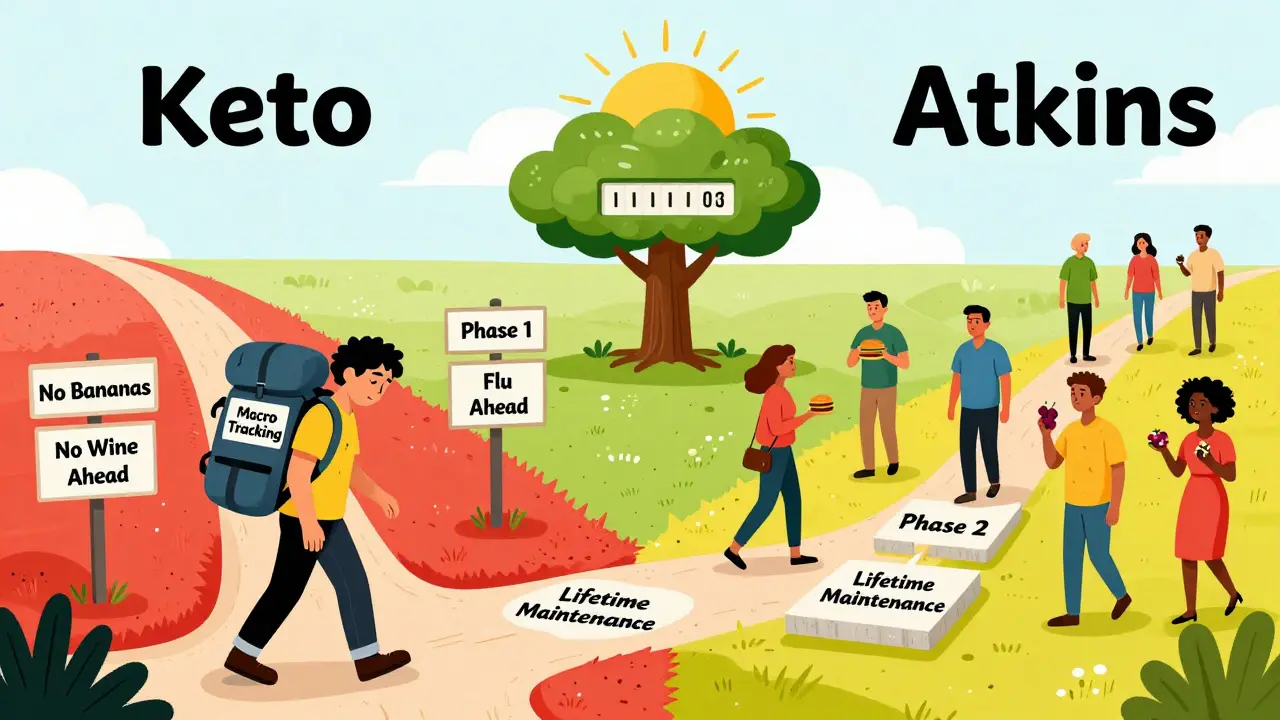
Short-term results? Both work. Long-term? It gets messy.
Studies show both diets deliver fast results. In a 2014 study, people on a low-calorie keto diet lost an average of 44 pounds in a year. That’s serious. In a 2013 study, people on Atkins lost weight, lowered their blood sugar, and needed less diabetes medication. So yes - both work in the first 6 months.
But here’s the catch: after a year, the difference disappears. A 2022 study in the American Journal of Clinical Nutrition found that keto lost 12.1 pounds at 6 months. Atkins lost 6.2. But by 24 months? Keto lost 7.8 pounds. Atkins lost 6.1. Almost the same. The same thing happens with other diets - low-fat, Mediterranean, calorie counting. Over time, adherence matters more than the plan.
That’s why long-term success isn’t about which diet is “better.” It’s about which one you can live with. Keto demands perfection. One slice of pizza, one glass of wine, and you’re out of ketosis. Atkins lets you adjust. You learn your personal carb tolerance. You find your balance. That’s sustainable.
The keto flu is real. Atkins has plateaus.
When you first start keto, your body goes through withdrawal. You lose water weight fast - that’s the initial drop. But then, for many, the “keto flu” hits: headaches, fatigue, brain fog, irritability. It lasts 1-2 weeks. About 70-80% of new keto dieters experience it. You need to replace electrolytes - sodium, potassium, magnesium - or you’ll feel awful.
Atkins doesn’t have that crash. But it has its own problem: plateaus. In Phase 3, when you’re adding back carbs, weight loss slows. People get frustrated. They think they’re doing something wrong. But it’s normal. Your body is adjusting. The trick is to slow down carb increases. Go back to the previous phase for a week. Track your portions. Don’t assume more carbs = more weight loss.
Who succeeds on each diet?
People who thrive on keto tend to be detail-oriented. They like numbers. They check labels. They use apps like Carb Manager or KetoDiet. They’re often younger - between 18 and 34 - and motivated by rapid results. They want to feel the burn. They’re okay with sacrifice.
People who do well on Atkins are usually older - 35 to 54 - and want structure without rigidity. They like having a plan with milestones. They appreciate the ability to eat out, travel, and still make progress. They don’t want to be on a diet forever. They want to learn how to eat for life.
One Reddit user, u/KetoSuccess2022, lost 50 pounds in 6 months on keto. But they also said, “I had to quit after a year because I missed fruit too much.” Another user, u/AtkinsLover2023, said: “Atkins 40 worked better than keto because I could gradually add carbs and still lose weight. I’ve kept it off for three years.”
Cost, tools, and support
Keto requires more tools. Blood ketone meters cost $40-60 a month. Urine strips are cheaper but less accurate. You need to track macros daily. There’s no room for guesswork.
Atkins gives you a built-in system: phase guides, carb counters, branded products, and a community. The Atkins app helps you track your net carbs as you move through phases. You don’t need a blood test. You just need to know your daily carb limit.
Support is different, too. Keto has a huge online community - over a million people on Reddit. But it’s full of purists who judge if you eat a single almond too many. Atkins has a more forgiving vibe. People share recipes, restaurant hacks, and how they handled holidays. It feels more like a lifestyle shift than a cult.
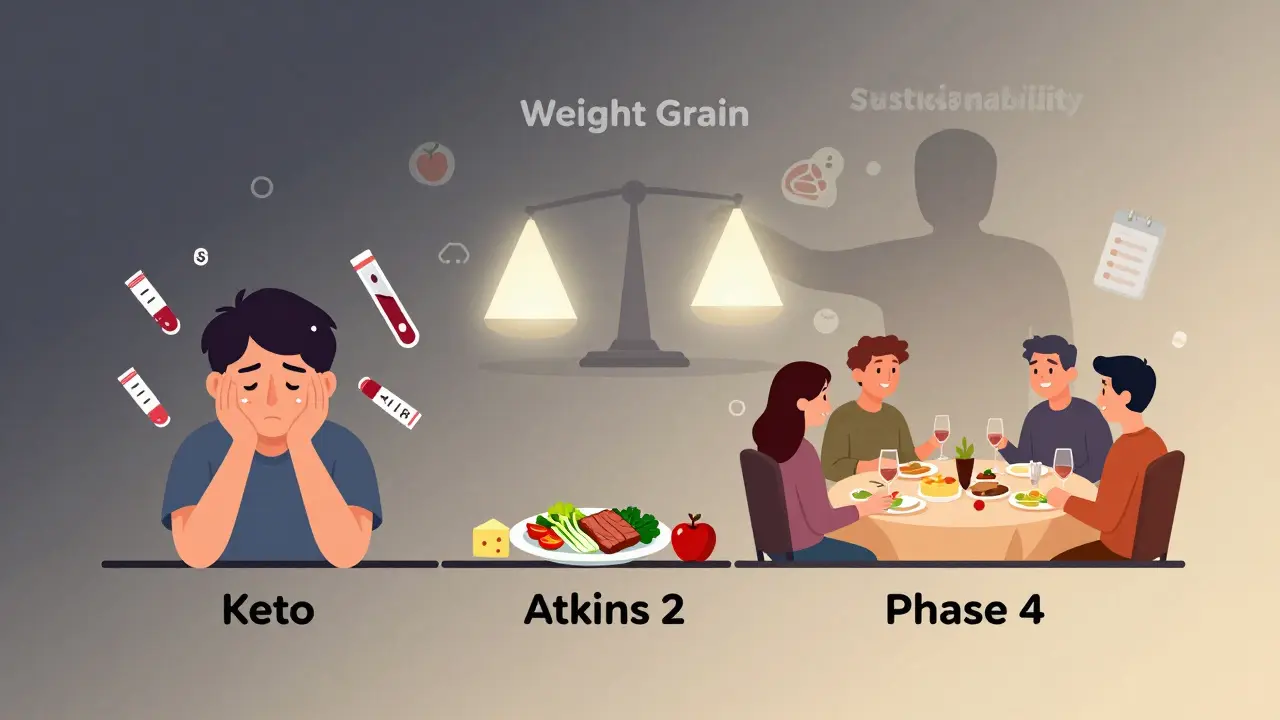
What do experts really say?
Dr. David Ludwig from Harvard says keto can produce “impressive short-term weight loss,” but the extreme restriction makes it hard for most people to stick with. Dr. Walter Willett, former head of nutrition at Harvard, says Atkins’ phased approach offers a “more practical path to sustainable weight management.”
The Mayo Clinic is blunt: “Over the long term, low-carb diets like Atkins are no more effective than standard weight-loss diets.” That doesn’t mean they don’t work. It means they don’t have a magic edge. The real advantage? They make you stop eating junk food. That’s where the weight loss comes from - not ketosis or phases. It’s cutting out sugar, bread, and processed snacks.
Bottom line: Pick based on your life, not your goals.
If you want fast results and don’t mind being strict for a while, keto can work. But be ready for the flu, the cost, and the feeling of missing out.
If you want to lose weight and keep it off without feeling like you’re on a diet forever, Atkins gives you a way out. It teaches you how to eat - not just how to starve.
Neither diet is perfect. Both can lead to nutrient gaps if you’re not careful. Both require planning. Neither is a magic bullet.
But here’s what no one tells you: the best diet is the one you can stick to. Not for 6 months. Not for a year. For life.
What happens after you lose the weight?
Most people don’t fail because they don’t lose weight. They fail because they gain it back. That’s where keto and Atkins really diverge.
Keto says: stay in ketosis forever. That’s hard. Most people can’t. And when they stop? Weight returns fast.
Atkins says: find your carb balance. That’s the goal. You’re not trying to stay in Phase 1 forever. You’re trying to figure out how many carbs your body can handle without gaining fat. That’s not a diet. That’s nutrition.
One study followed 89 obese adults for a year. They did 6 months of keto, then switched to a Mediterranean diet. They lost 10% of their body weight - and kept it off. That’s the real secret: flexibility beats restriction.
Final thought: You don’t need to choose one forever.
Some people start with keto to jumpstart weight loss. Then they move to Atkins 40. Others use keto for 3 months, then switch to a lower-carb version of the Mediterranean diet. There’s no rule that says you have to pick one and stick with it for life.
The goal isn’t to be on a diet. The goal is to feel better, have more energy, and keep the weight off without obsessing over every bite.
So ask yourself: Do you want to be on a diet… or do you want to learn how to eat?


14 Comments
I tried keto for 3 months and hated every second of it. The keto flu felt like a hangover that never ended. Then I switched to Atkins and suddenly I could eat out with my family again. No more sneaking snacks. No more guilt. I’ve kept 40 pounds off for 2 years now. It’s not perfect, but it’s livable.
Also, no one talks about how expensive ketone strips are. Like, $40 a month just to check if your pee is blue? No thanks.
You're conflating nutritional science with marketing. Keto isn't a 'diet'-it's a metabolic state. Atkins is a branded, corporate-funded program designed to sell protein bars and apps. The fact that you're praising processed 'Atkins-friendly' products reveals a fundamental misunderstanding of low-carb physiology. Ketosis is not a trend. It's biochemistry.
I’ve done both. Keto was brutal but worked for my PCOS. Atkins felt like a lifeline. I started with induction, then slowly added back sweet potatoes and berries. Now I eat 70g net carbs a day and still lose weight. The key isn’t the diet-it’s the mindset shift. You’re not restricting. You’re recalibrating.
Also, if you’re eating keto bread, you’re not doing keto. You’re doing carb-washing.
Just started keto last week and already lost 4 lbs! 💪 No carbs = no cravings. I’m not looking back. Keto is the only way. 🚀
i just wanna say... if you're struggling, you're not alone. i tried keto and cried over a banana. then i tried atkins and ate a whole pizza on phase 3 and didn't gain weight. it's not about being perfect. it's about finding what doesn't make you hate your life.
So let me get this straight-keto is for people who think ‘carbs’ is a four-letter word and Atkins is for people who want to eat cheeseburgers and call it ‘nutrition’? Sounds like one’s a cult and the other’s a grocery store.
You people are so naive. Keto and Atkins are both controlled by Big Pharma and the sugar industry to keep you dependent on processed foods. They want you to think it’s about carbs or ketones. It’s not. It’s about control. The real solution is fasting, raw food, and avoiding all packaged stuff-even the 'keto' ones. You think you’re healthy? You’re just another lab rat with a blood ketone meter. The government knows this. They fund the studies. They own the apps. Wake up.
I used to be Team Keto until I realized I was eating 200g of butter a day just to hit my macros. That’s not healthy. That’s a butter addiction with a fancy name. Atkins let me eat protein, veggies, and occasional rice. I lost weight without feeling like I was on a spaceship. Also, my wife liked me again.
Atkins 40 changed my life. No more midnight cravings. No more sugar crashes. I eat rice now and still lose weight. Keto made me tired. Atkins made me human.
The notion that 'adherence' is the only variable in long-term weight loss is a gross oversimplification. One must consider hormonal regulation, insulin sensitivity, and the thermic effect of food. The 2022 study you referenced fails to account for baseline metabolic health, sample size limitations, and the confounding variable of caloric intake. The data is statistically insignificant when properly contextualized.
Honestly, why are we even debating this? Both diets are just modern-day fads dressed up as science. The real issue is that we’ve been lied to about fat being bad. But the solution isn’t to replace sugar with stevia and eat 12 eggs a day. It’s to stop eating like a 1980s sitcom character and go back to whole, unprocessed food-period. No phases. No bars. No apps. Just meat, veggies, and silence.
They’re all lying. Ketosis isn’t real. It’s a placebo engineered by the pharmaceutical-industrial complex to sell expensive blood tests and supplements. Atkins? That’s just a front for the artificial sweetener lobby. Aspartame is in every ‘keto’ bar. The real weight loss comes from detoxing from MSG and corn syrup. But they don’t want you to know that. They’re afraid you’ll find out the truth: your body doesn’t need carbs at all. Not even from fruit. Not even from sweet potatoes. Your brain runs on ketones. Always has. They just don’t want you to remember.
I did keto for 6 months, lost 35 lbs, then switched to Atkins because I missed pasta. Now I eat a little rice once a week and still weigh less than I did in college. It’s not about perfection. It’s about balance. Also, I still drink wine. And I’m fine.
You're all missing the point. Neither diet is sustainable because neither addresses the root cause: insulin resistance caused by chronic stress and sleep deprivation. You can be in ketosis and still be metabolically obese. The real solution is circadian rhythm alignment, intermittent fasting, and reducing blue light exposure. The rest is just dietary theater.