
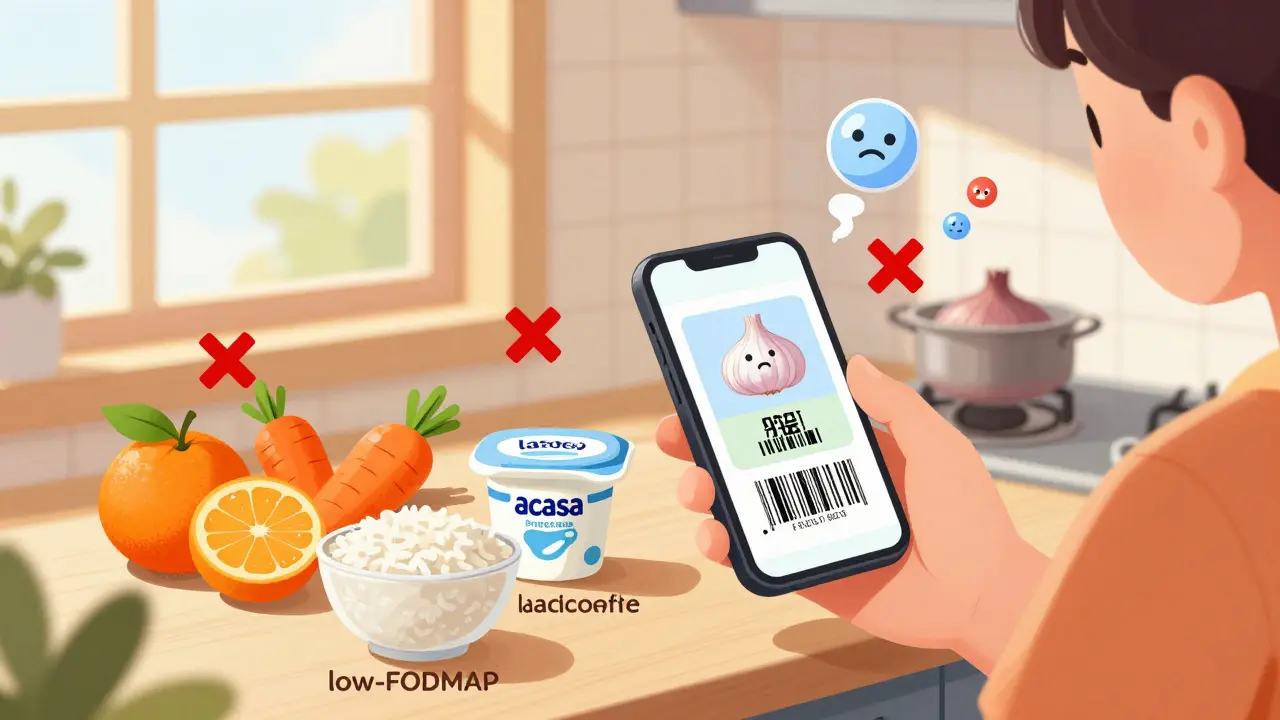
If you have irritable bowel syndrome (IBS), you’ve probably tried every diet under the sun. Gluten-free? Didn’t help. Dairy-free? Still bloated. You’re not alone. Millions of people struggle with IBS symptoms-abdominal pain, bloating, diarrhea, constipation-and most doctors will tell you the same thing: food plays a huge role. But not all diets are created equal. The low-FODMAP diet, low-residue diet, and elimination diets are three very different approaches, each with their own rules, science, and results. Knowing which one fits your body-and how to do it right-can mean the difference between constant discomfort and real relief.
What Is the Low-FODMAP Diet?
The low-FODMAP diet isn’t just another gluten-free or dairy-free trend. It’s a scientifically backed, three-phase plan developed by researchers at Monash University in Australia. FODMAP stands for Fermentable Oligosaccharides, Disaccharides, Monosaccharides, and Polyols-long words for types of carbs that some people’s guts can’t digest properly. These carbs pull water into the intestine and get fermented by gut bacteria, causing gas, bloating, and cramps.
The diet has three clear steps. First, you eliminate all high-FODMAP foods for 2 to 6 weeks. That means no garlic, onions, wheat, apples, honey, milk, beans, or artificial sweeteners like sorbitol. You eat only foods tested and labeled low-FODMAP by Monash’s lab. Portion size matters-eating a whole apple is high-FODMAP, but a small slice (1/2 apple) is okay. Many people see major improvements within days.
Then comes the reintroduction phase. This is where most people fail. You don’t stay on this strict diet forever. You slowly add back one FODMAP group at a time-like lactose or fructose-to see which ones trigger your symptoms. You test each group with a specific dose: 3 grams of fructans, 12 grams of lactose, 10 grams of polyols. It’s like a personal food experiment. Most people find they can tolerate some high-FODMAP foods again, just not all of them.
Finally, you personalize your diet. You keep the foods you tolerate and avoid only what causes problems. Studies show 75-80% of IBS patients get significant relief using this method. The Monash FODMAP app, with its barcode scanner and food database, is the gold standard tool for this. Over 28,500 users rate it 4.8 out of 5. But it’s not free-it costs $9.99 a month or $49.99 a year.
What Is a Low-Residue Diet?
A low-residue diet is older and simpler. It’s not designed for IBS specifically-it was originally used to rest the bowel before surgery or during flare-ups of Crohn’s disease or ulcerative colitis. The goal is to reduce the amount of undigested material (residue) in your stool. That means cutting fiber to just 10-15 grams a day (normal intake is 25-38 grams).
On this diet, you avoid:
- All raw fruits and vegetables
- Whole grains, bran, nuts, and seeds
- Legumes and beans
- High-fiber cereals
- Dairy if you’re lactose intolerant
You eat white bread, white rice, eggs, lean meats, canned fruits without skin, and low-fiber cereals. It’s easy to follow for a short time, and it can help reduce diarrhea quickly. One study showed 45% of IBS-D patients improved on this diet, compared to 75% on low-FODMAP.
But here’s the catch: it’s not sustainable. Cutting fiber this low for more than a few weeks can lead to nutrient gaps-folate drops by 35%, calcium by 25%. It’s also useless for constipation-predominant IBS. If you’re bloated and gassy, this diet won’t fix it. It only helps if your main problem is frequent, loose stools. And even then, it’s a temporary fix, not a long-term solution.
What Is a General Elimination Diet?
Elimination diets are the most common starting point for people with IBS. You remove common triggers-dairy, gluten, caffeine, fried foods, artificial sweeteners-for 2 to 4 weeks. Then you add them back one at a time to see what causes trouble.
It sounds simple, but it’s messy. Unlike the low-FODMAP diet, there’s no standard protocol. No defined doses. No lab-tested food lists. People often eliminate gluten thinking it’s the problem, only to find out it’s lactose or fructose. Studies show only 30% of people correctly identify their trigger foods without professional help.
The big advantage? It’s cheap and accessible. You don’t need an app or a dietitian. You just read labels and keep a food journal. But the downside is high failure rates. Without structure, you might cut out foods you don’t even react to, while missing your real trigger. And if you’re eliminating too many foods at once, you risk nutritional deficiencies or disordered eating patterns.
Which Diet Works Best for IBS?
Let’s compare them side by side:
| Feature | Low-FODMAP Diet | Low-Residue Diet | General Elimination Diet |
|---|---|---|---|
| Primary Goal | Identify fermentable carb triggers | Reduce stool volume | Find food sensitivities |
| Success Rate for IBS | 75-80% | 40-45% | 40-50% |
| Best For | Bloating, pain, IBS-D | Diarrhea-predominant IBS | General symptom relief |
| Worst For | Constipation-predominant IBS | Constipation, long-term use | People needing precision |
| Duration | 3-6 months | 2-4 weeks max | 2-4 weeks |
| Requires Tools | Yes (app, scale, journal) | No | No |
| Nutritional Risks | Moderate (if done wrong) | High (fiber, calcium, folate) | Moderate (if too many foods cut) |
The low-FODMAP diet wins for most people with IBS. It’s the only one backed by over 20 randomized trials and recommended by the American College of Gastroenterology as a first-line treatment. It’s not just about avoiding bad foods-it’s about finding which ones you can still eat. That’s the power of reintroduction.
Low-residue diets have a narrow use case: short-term relief for diarrhea. Don’t use it long-term. General elimination diets are a good starting point if you can’t access FODMAP resources, but they’re like shooting in the dark. You might hit the target, but you’ll waste a lot of bullets.
How to Start the Low-FODMAP Diet Right
If you’re going to try the low-FODMAP diet, don’t wing it. Here’s how to do it properly:
- Get the Monash FODMAP app. It’s the only app with lab-tested, up-to-date food data. Use it to scan barcodes and check portion sizes.
- Plan your first week. Buy low-FODMAP staples: rice, oats, eggs, chicken, spinach, carrots, lactose-free yogurt, strawberries, oranges.
- Keep a symptom journal. Note pain, bloating, bowel movements daily. Don’t rely on memory.
- Don’t cut out too much at once. Stick to the official low-FODMAP list. Avoid guessing.
- Work with a dietitian if you can. One session can save you months of confusion.
- After 2-6 weeks, start reintroducing one FODMAP group per week. Use the standard doses: 3g fructans, 12g lactose, etc.
- Wait 3 days between each challenge. If symptoms return, that group is a trigger.
- Once you know your triggers, build a personalized diet. You don’t have to avoid all high-FODMAP foods forever.
Common mistakes: skipping the reintroduction phase, not measuring portions, eating “healthy” foods that are secretly high-FODMAP (like granola bars with inulin or honey), or giving up too soon.
What to Expect During the Diet
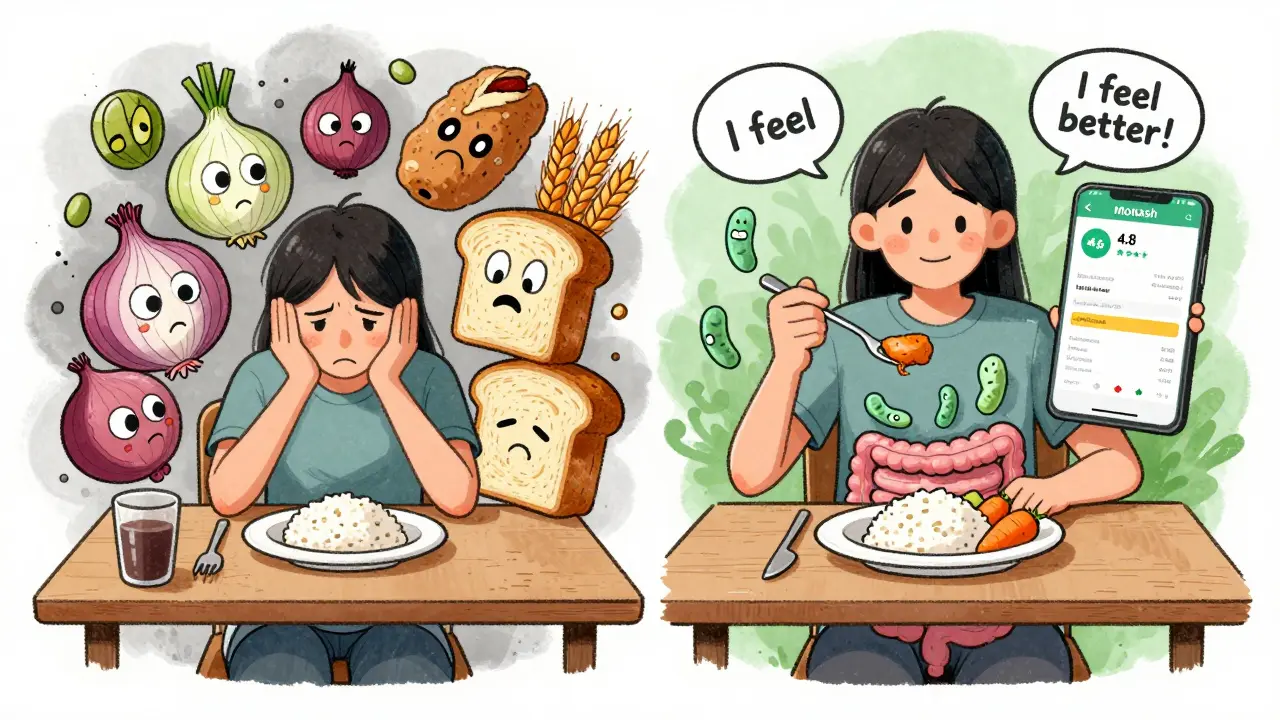
Some people feel better in days. Others feel worse at first-especially during reintroduction. That’s normal. Your gut is adjusting. You might get bloated again when you test lactose or fructose. That doesn’t mean the diet failed. It means you’re learning.
Many users report life-changing results. One person on Reddit said: “After 15 years of daily diarrhea, FODMAP cleared it up in 3 weeks.” Another said: “I thought I was allergic to everything. Turns out, I only react to onions and apples.”
But it’s not easy. Social situations are hard. Eating out? Bring your own food or use Monash’s restaurant cards. Traveling? Pack snacks. Cooking? Learn low-FODMAP spice blends-garlic-infused oil is okay, but raw garlic isn’t.
And yes, your gut bacteria change. Studies show Bifidobacterium drops by 40% during the elimination phase. That’s why reintroduction is so important-it helps restore balance.
Who Should Avoid These Diets?
Not everyone should try these diets. The low-FODMAP diet is not recommended for:
- People with eating disorders (it can trigger restrictive behaviors)
- Those with severe malnutrition
- Children under 12 without specialist supervision
- People with unexplained weight loss or blood in stool (see a doctor first)
Low-residue diets are dangerous long-term. They’re not for weight loss. They’re not for general “detox.” They’re a medical tool for specific situations.
And if you’re not sure what’s causing your symptoms, don’t self-diagnose. IBS is a diagnosis of exclusion. Other conditions like celiac disease, SIBO, or colon cancer can mimic IBS. Get tested first.
What’s Next for IBS Diets?
The field is evolving fast. Monash University released version 5.2 of their app in 2023 with 1,200 new foods and AI meal planning. Researchers are now testing blood and stool biomarkers to predict who will respond to low-FODMAP diets-before they even start. By 2026, most electronic health records will include FODMAP tracking tools.
The goal isn’t to make you eat bland food forever. It’s to give you back control. To help you eat without fear. To let you enjoy a meal with friends without dreading the consequences.
The science is clear: for most people with IBS, the low-FODMAP diet is the most effective tool we have. But only if you do it right.
Can I do the low-FODMAP diet without an app?
You can, but it’s much harder. The Monash FODMAP app is the only resource with lab-tested portion sizes and updated food data. Free lists online are outdated or inaccurate. Many foods labeled “healthy” contain hidden FODMAPs like inulin or honey. Without the app, you risk eliminating foods you can tolerate or eating too much of something that triggers you.
How long does the low-FODMAP diet take to work?
Most people notice improvement within 2 to 6 weeks during the elimination phase. But the full process-including reintroduction and personalization-takes 3 to 6 months. Rushing through the reintroduction phase leads to failure. This isn’t a quick fix. It’s a long-term strategy to understand your body.
Is the low-FODMAP diet a lifelong diet?
No. It’s designed to be temporary. The goal is to identify your personal triggers, then reintroduce as many foods as you can tolerate. Most people end up eating 50-80% of the foods they eliminated. You don’t have to avoid garlic and onions forever-you just need to know how much you can handle.
Can I lose weight on the low-FODMAP diet?
Some people do lose weight, but that’s not the goal. The diet focuses on symptom relief, not calorie restriction. If you’re losing weight unintentionally, you may be eating too few calories or cutting out too many food groups. Talk to a dietitian to make sure you’re getting enough nutrients.
What if the low-FODMAP diet doesn’t work for me?
About 20-25% of people don’t respond. That doesn’t mean you’re doing it wrong-it means your IBS might be triggered by something else: stress, gut bacteria imbalance, or another condition like SIBO. Talk to your doctor. You might need further testing or a different approach, like gut-directed hypnotherapy or medication.
Are there any side effects of the low-FODMAP diet?
Yes. During the elimination phase, your gut bacteria diversity drops, especially Bifidobacterium. That’s why reintroduction is critical-it helps restore balance. Also, cutting too many foods can lead to low calcium or fiber intake. Always work with a professional if possible, and don’t stay on the strict phase longer than 6 weeks.
Next Steps
If you’re ready to try the low-FODMAP diet:
- Download the Monash FODMAP app.
- Print a low-FODMAP food list from their website.
- Buy a small kitchen scale (accurate to 1 gram).
- Start a symptom journal in your phone or notebook.
- Consider booking a session with a registered dietitian trained in FODMAPs.
If you’re not ready for the full plan, start with a simple elimination: remove dairy, caffeine, and artificial sweeteners for 2 weeks. Track your symptoms. You might be surprised what you find.
IBS doesn’t have to control your life. With the right plan, you can eat well, feel better, and reclaim your confidence.



11 Comments
Man, this post saved my life. I’ve been bloated for years thinking it was gluten, but turns out it was onions and apples. Monash app is a game-changer - I even got my mom to use it and she’s now eating biryani without fear. 🙌
Wow. A diet that costs more than my rent just so I can eat without feeling like a balloon at a kid’s birthday party. Next they’ll charge me to breathe air that doesn’t contain fructans. Truly, the pinnacle of modern medicine.
How quaint. The low-FODMAP diet - a bourgeois solution to a problem created by industrialized food systems. Of course, the Monash app is the ‘gold standard’ - because nothing says ‘health’ like paying $50/year to know if your banana is ‘low’ or ‘high’ in oligosaccharides. We’ve turned nutrition into a luxury subscription service.
Really appreciate how you broke this down - especially the part about reintroduction. So many people quit after phase 1, but that’s when the real work begins. I started with just cutting garlic and honey, then slowly added back lactose. Took 4 months, but now I can eat pizza without panic. 🍕😊
75% success rate? That’s statistically meaningless if you’re in the 25% who still feel like shit. This whole FODMAP thing is just a placebo wrapped in pseudoscience and app subscriptions. You’re not ‘healing’ - you’re just avoiding food until you develop an eating disorder. Congrats.
My cousin in Lagos tried this and said it worked but was too expensive. He made his own list from free sites and stuck to rice, eggs, and chicken. No app. No stress. Just patience. Sometimes simple works better than fancy.
Okay so I tried the low fodmap diet for 6 weeks and lost 12lbs and my bloating went away but then I started getting constipated and my skin broke out and I realized I was eating nothing but white rice and chicken and I think maybe the diet is just making me unhealthy in a different way?? Like I didn’t know fiber was that important until I stopped eating it and now I feel like a zombie?? Also I think I’m addicted to lactose free yogurt???
Let’s be real - the low-FODMAP diet isn’t about IBS. It’s about control. It’s about the modern obsession with quantifying every bodily function until you become a walking spreadsheet. You’re not treating a syndrome - you’re performing a ritual of dietary purity. The app? It’s your new religion. The barcode scanner? Your holy relic. And the $50 subscription? Your monthly offering to the gods of gut orthodoxy.
The FODMAP protocol lacks longitudinal validation. The microbiome shifts observed during elimination are not causally linked to symptom resolution - merely correlative. Furthermore, the reliance on self-reported symptom journals introduces significant recall bias. The 75% efficacy rate is likely inflated by publication bias and selection effects in clinical cohorts. This is not medicine - it’s behavioral economics disguised as nutrition science.
Y’all are overthinking this. I did it with my sister - we cooked together, laughed about how weird it was to eat carrots instead of broccoli, and now we both eat what we want without guilt. It’s not perfect, but it’s better than crying in the bathroom at work. You got this. 💪❤️
As someone who’s been through this, the key is timing. Don’t start during a high-stress period. Don’t try to do it alone. And please - don’t skip the reintroduction. That’s where the magic happens. I went from avoiding 80% of food to enjoying 70% again. It’s not about restriction. It’s about reclamation.