
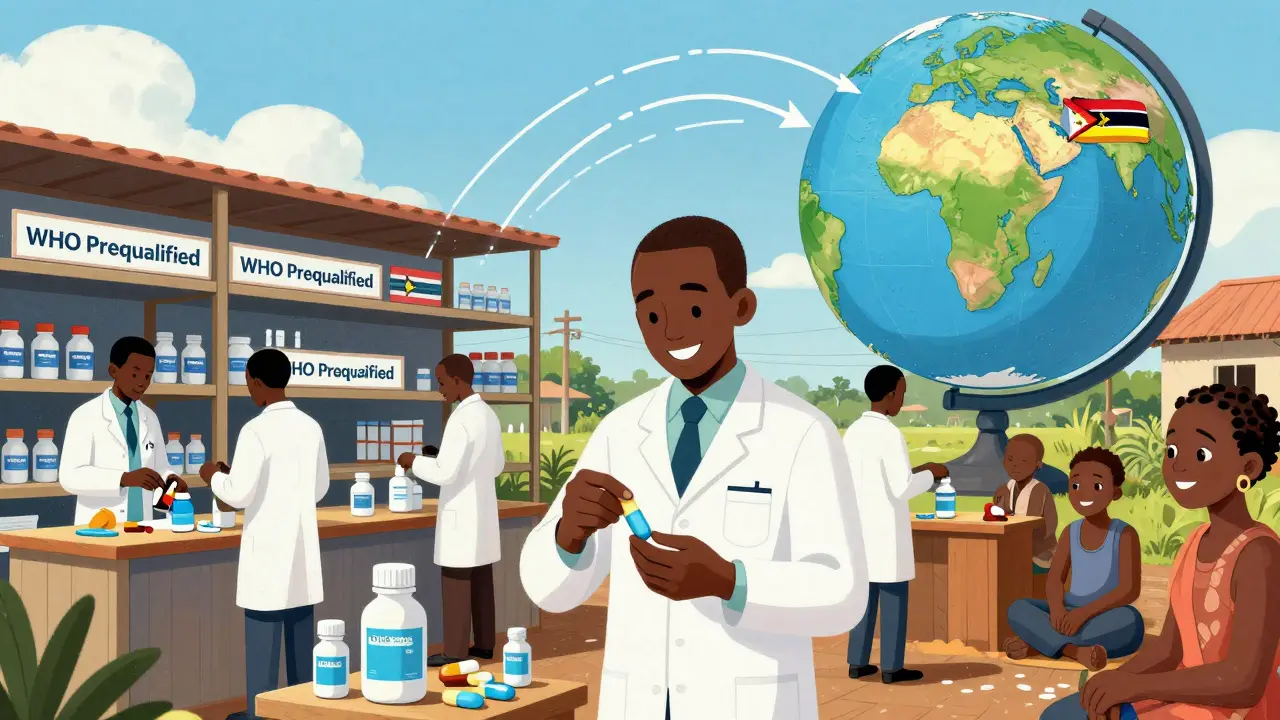
For decades, Africa relied on medicines made halfway across the world. When someone in rural Mozambique or rural Uganda needed HIV treatment, the pills often came from India, shipped across oceans, delayed by customs, and priced by distant corporations. That’s changing. On May 6, 2025, the Global Fund an international financing organization that mobilizes and invests in health programs against AIDS, tuberculosis, and malaria made history: it bought its first antiretroviral generics lower-cost versions of HIV drugs that meet international quality standards made in Africa. The medicine? TLD a fixed-dose combination of tenofovir, lamivudine, and dolutegravir, now the global standard for first-line HIV treatment. The maker? Universal Corporation Ltd a Kenyan pharmaceutical company that became the first African manufacturer to receive WHO prequalification for TLD in 2023. The impact? Enough pills to treat over 72,000 people every year - all produced on African soil.
Why Local Production Matters
Sub-Saharan Africa carries 65% of the world’s HIV cases. Yet, until recently, it imported over 80% of its medicines. That meant long delays, price spikes, and vulnerability to global shocks. During the COVID-19 pandemic, supply chains broke. Countries ran out of basic drugs. HIV patients missed doses. Viral loads rose. Resistance grew.
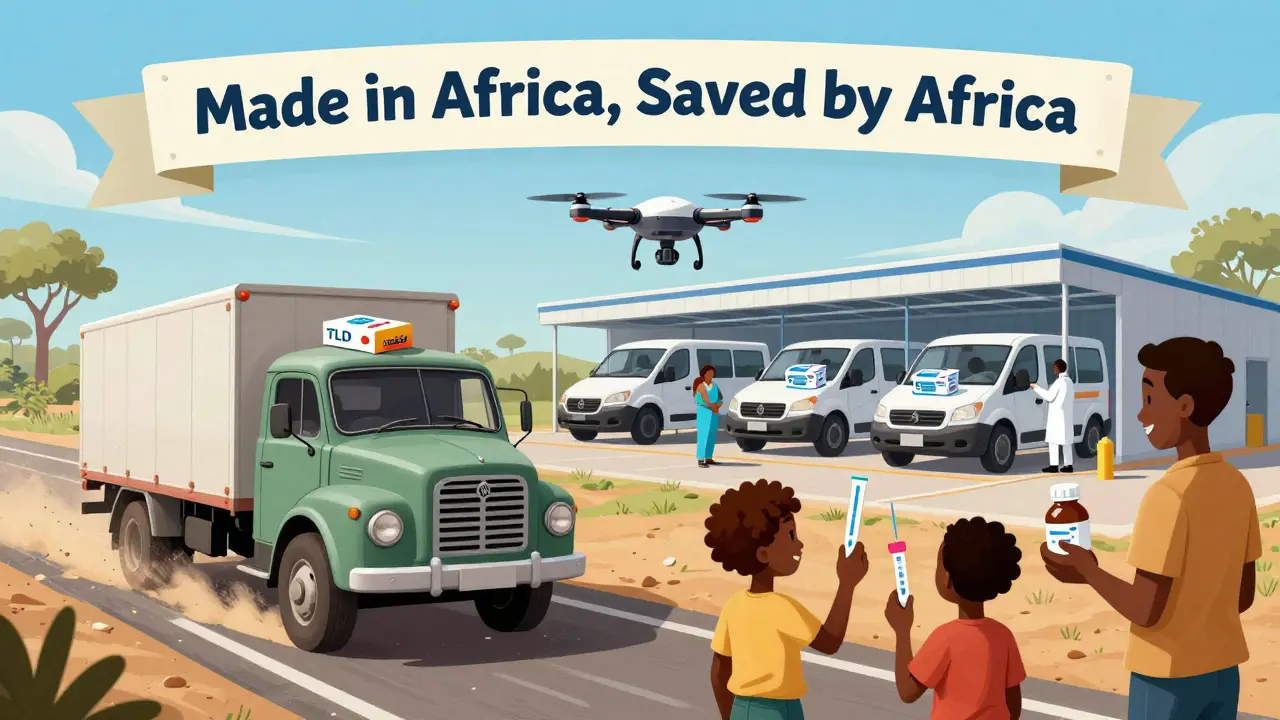
Local production changes that. When a factory in Nairobi makes TLD, it doesn’t need to cross oceans. It doesn’t need to wait for customs. It doesn’t need to compete with other countries for limited stock. It reaches clinics in weeks, not months. And because African manufacturers aren’t chasing global profit margins, prices stay low. The cost of a year’s supply of HIV treatment dropped from $10,000 in 2000 to under $100 by 2015 thanks to Indian generics. Now, African-made versions are pushing that number even lower - often 10-20% cheaper than imported generics.
This isn’t just about saving money. It’s about dignity. About control. About not having your life depend on someone else’s shipping schedule.
The TLD Breakthrough
TLD isn’t just any HIV drug. It’s the current gold standard. The combination of tenofovir, lamivudine, and dolutegravir works better than older regimens. It suppresses the virus more reliably. It’s harder for HIV to become resistant to. And it has fewer side effects - meaning fewer people stop taking it.
But getting TLD approved for production in Africa wasn’t easy. The World Health Organization the United Nations agency responsible for international public health has strict standards. WHO prequalification means a drug meets the same quality, safety, and effectiveness benchmarks as those from the U.S. FDA or the European Medicines Agency. Universal Corporation Ltd spent years building labs, training staff, and proving their processes. In 2023, they became the first African company to get that stamp of approval for TLD.
That’s when the Global Fund stepped in. Instead of buying from India again, they placed their first order with Universal. The delivery to Mozambique wasn’t just a shipment. It was a signal: African-made medicines are ready. And the world is ready to buy them.
More Than Just Pills
Building a local HIV response isn’t just about making drugs. It’s about making diagnostics, too. In Nigeria, Codix Bio a Nigerian diagnostics company that received a sublicense from SD Biosensor to manufacture HIV rapid diagnostic tests now produces HIV rapid tests using technology transferred through the Medicines Patent Pool an organization that facilitates voluntary licensing of medicines to increase access in low- and middle-income countries and WHO’s Health Technology Access Programme. These tests - the same ones used in clinics from rural Senegal to urban Kenya - are now made in Africa. No more waiting for shipments from South Korea or Germany.
This is part of a bigger shift: moving from silos to systems. HIV care used to live in its own bubble. Now, countries are starting to integrate it into primary health care. Testing, treatment, counseling, and follow-up all happen in the same clinic. That’s more efficient. More sustainable. And it means fewer people fall through the cracks.
What’s Next: Long-Acting Injectables
The future of HIV treatment isn’t pills at all. It’s injections. Twice a year. One shot keeps the virus suppressed. No daily routine. No stigma. No missed doses.
South Africa became the first African country to register the long-acting injectable cabotegravir a long-acting antiretroviral drug administered as an injection every two months in October 2025. That’s a huge deal. Regulatory approval moved fast - because African regulators are learning, adapting, and building capacity.
And here’s the real game-changer: Gilead Sciences has signed voluntary licensing agreements with six African manufacturers to produce generic versions of cabotegravir. Experts predict prices could drop 80-90% below the brand-name cost. That means, within two years, this life-changing treatment could be available across the continent at a price that clinics can afford.
Even more ambitious is lenacapavir a long-acting HIV drug used for both treatment and pre-exposure prophylaxis (PrEP). Gilead is supplying it at no profit to countries through PEPFAR and the Global Fund until generics arrive. By the end of 2025, they plan to submit regulatory applications in 18 high-burden African countries. The goal? Get it into the hands of up to two million people over three years.
The Bigger Picture: Health Sovereignty
This isn’t just about HIV. It’s about health sovereignty. Africa spent decades importing everything - from vaccines to antibiotics to cancer drugs. That made the continent vulnerable. The pandemic exposed that weakness. Now, leaders are saying: "We can do this ourselves."
The African Union Pharmaceutical Manufacturing Plan for Africa (PMPA) a continental strategy to increase local pharmaceutical production from 2-3% to 40% by 2040 aims to turn Africa into a self-reliant producer of medicines. Right now, the continent makes only 2-3% of what it consumes. The goal? 40% by 2040.
That won’t happen without investment. It needs better regulation across borders. It needs skilled technicians. It needs stable funding. And it needs markets - predictable demand from donors and governments. That’s what the Global Fund’s decision did: it created a market. Now manufacturers know: if we build it, they will buy it.
And it’s not just about drugs. It’s about jobs. Training. Innovation. African scientists are now leading clinical trials for new formulations. African engineers are designing supply chains. African policymakers are rewriting laws to support local production. This is how you build resilience.
Challenges Remain
Progress is real. But it’s not enough. Africa needs about 15 million person-years of first-line ARV treatment every year. The current African production capacity? Still a fraction of that. Only a handful of manufacturers have WHO prequalification. Most are small. Most are new.
Regulatory systems still vary widely. Some countries have strong agencies. Others still rely on foreign approvals. Harmonization is slow. And without sustained funding, manufacturers can’t scale.
That’s why initiatives like the NextGen market shaping approach a coordinated strategy to build sustainable African ARV markets through funding and technical support are so important. Funded by Unitaid, the Gates Foundation, and CIFF, it’s helping manufacturers get from pilot to full production.
There’s also the risk of complacency. If donors pull back, or if governments stop prioritizing this, progress could stall. The lesson from the past is clear: when funding drops, access drops. When attention fades, lives are lost.
What’s Working Now
Let’s look at the numbers:
- In 2010, 1.3 million people died from AIDS-related causes globally. In 2022, that number fell to 630,000 - a 52% drop, mostly thanks to expanded access to treatment.
- By 2023, Eastern and Southern Africa hit 93% of people living with HIV knowing their status, 83% on treatment, and 78% with suppressed virus.
- Western and Central Africa lagged: 81%-76%-70% - still progress, but a reminder that equity matters.
These numbers aren’t magic. They’re the result of relentless effort - testing campaigns, community health workers, mobile clinics, and now, local manufacturing.
The Global Fund is now preparing its Grant Cycle 7 (GC7), which will expand this model to more countries. The message is clear: African-made ARVs aren’t a side project. They’re central to the next phase of the HIV response.
The Road Ahead
By 2030, experts predict African-manufactured ARVs could supply 20-30% of the continent’s needs. That’s not the finish line - it’s the starting point.
The goal is simple: no one in Africa should have to wait for medicine because it was made in another country. No one should have to choose between food and a pill because the price was too high. No one should be left behind because the system didn’t adapt.
Local production isn’t just cheaper. It’s faster. It’s more reliable. It’s more just. And it’s proof that Africa doesn’t need to wait for help - it can lead the way.


15 Comments
yo so africa just made its own hiv pills and the whole world is like 'wow'?? bro we been waiting 20 years for this. i remember when my cousin in nairobi had to wait 6 months for meds because some indian factory had a power outage. now? local. fast. cheap. this is the shit.
Sure. And the next thing you know, they’ll be manufacturing rocket fuel and iPhones too.
This is bigger than pills. This is about dignity. I grew up in Lagos watching my uncle take three different pills at three different times because the supply chain kept breaking. Now, when my niece gets tested, she gets her meds the same day-made in Enugu, packed in Abuja, delivered by a guy on a motorbike who knows her name. That’s not healthcare. That’s homecoming.
I mean… this is the kind of shit that makes you wanna hug a stranger. Local production? African-led innovation? That’s not just progress-it’s poetry in motion. The way they’re stitching diagnostics, treatment, and care into one fabric? That’s genius. Someone’s finally listening to the rhythm of the continent instead of just slapping on a band-aid from Zurich.
The WHO prequalification for TLD was a watershed moment. Most people don’t realize how hard it is to get that stamp. It’s not just about chemistry-it’s about QA systems, documentation, audits, traceability. Universal Corp didn’t just make pills. They built a regulatory infrastructure from scratch. And now, other African manufacturers are using their playbook. This is how you scale.
I just hope this doesn’t get lost in the noise. We’ve seen this before-local production, then donor fatigue. Let’s keep the pressure on.
Wait… so you’re telling me… the Global Fund… bought African-made pills… and now… the WHO… is okay with it?? What’s next? A Chinese-made vaccine? A Russian-made insulin? This is the beginning of the end of Western medical dominance. I’m scared.
I must express my profound concern regarding the potential for regulatory arbitrage. The WHO prequalification, while nominally rigorous, lacks the institutional gravitas of the FDA or EMA. One must question the long-term pharmacovigilance capacity of nascent African manufacturing entities, particularly in the absence of robust post-market surveillance infrastructure.
I’ve been in this game 15 years. I’ve seen the same donors come in, fund a project, leave, and leave a graveyard of broken supply chains. This time? It’s different. The African Union PMPA isn’t a slogan-it’s a mandate. And the fact that Gilead licensed cabotegravir to six African firms? That’s not charity. That’s market logic. They see profit in scale. And Africa’s ready.
While the initiative is commendable, one must acknowledge the structural challenges inherent in scaling pharmaceutical manufacturing without adequate infrastructure investment in power, logistics, and human capital. The transition from pilot to sustainable production remains fraught with risk.
in india we made generics too but no one gave us a parade. now africa does it and suddenly its a revolution? chill. its just good business.
The real triumph here isn’t the pills-it’s the epistemological shift. For centuries, the Global South has been a consumer of knowledge produced elsewhere. Now, African scientists aren’t just implementing protocols-they’re generating them. The WHO prequalification isn’t a stamp of approval. It’s a validation of indigenous scientific authority. This is the quiet revolution of knowledge sovereignty.
I just imagine a kid in rural Zambia getting their first long-acting shot. No daily routine. No stigma. Just a nurse, a syringe, and a future. That’s not medicine. That’s magic. And it’s made in Africa.
I love how this isn’t just about HIV anymore. It’s about the whole health system. Testing, counseling, supply chains-all integrated. It’s like they’re building a healthcare ecosystem, not just a drug pipeline. That’s sustainable.
So… let me get this straight… we’re celebrating African-made HIV drugs… while the U.S. is still importing 80% of its antibiotics? This isn’t progress-it’s hypocrisy. We’re cheering for Africa to do what we refused to do. Pathetic.