
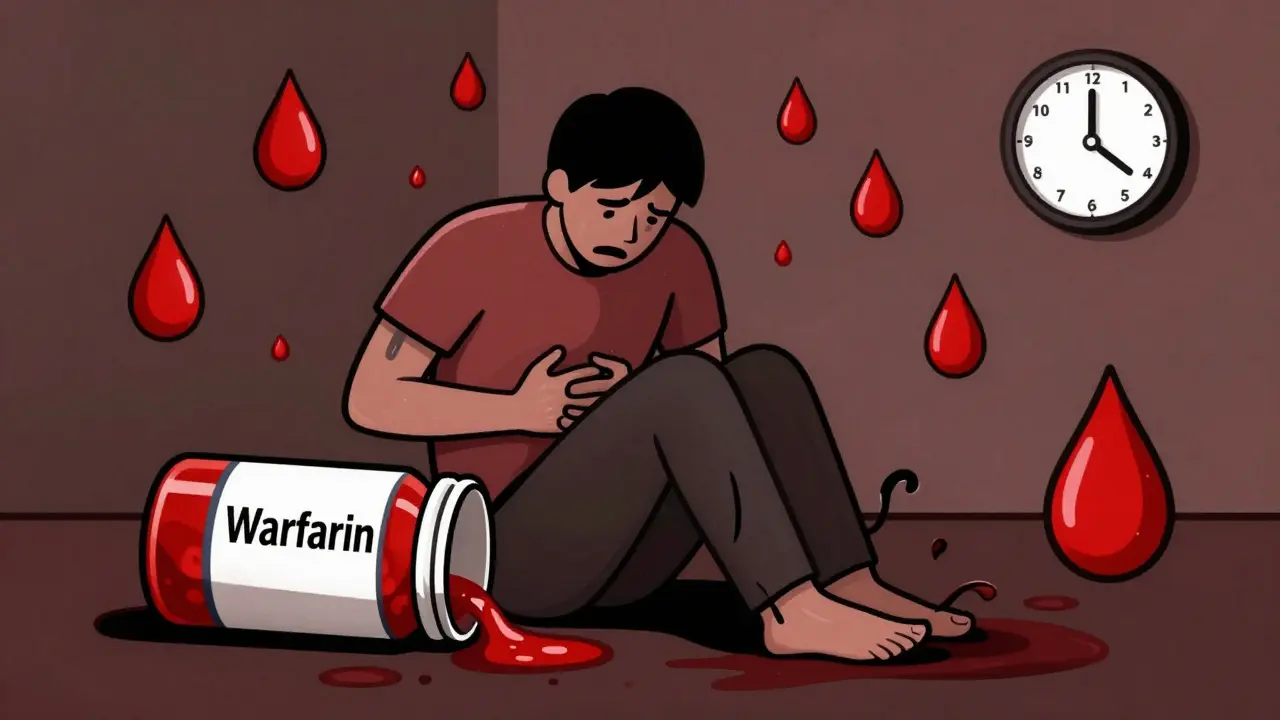
If you're taking a blood thinner like warfarin, apixaban, or rivaroxaban, you know it's meant to keep your blood from clotting dangerously. But what happens when you take too much? Or when you don’t realize you’ve taken a double dose? The risk isn't just a bruise or a nosebleed - it's internal bleeding, which can kill you before you even feel seriously sick.
Every year in the U.S., over 33,000 people end up in the emergency room because of blood thinner mistakes. About 1,100 of them die. Most of these cases aren’t suicide attempts. They’re accidents: someone forgets they already took their pill, mixes up their pills, or starts a new medication that interacts with their blood thinner. And here’s the scary part - by the time you feel weak, dizzy, or notice dark stools, it might already be too late to stop the bleeding inside you.
What Blood Thinners Do - and What Happens When You Overdose
Blood thinners don’t actually thin your blood. They slow down the clotting process. Warfarin (Coumadin) works by blocking vitamin K, which your body needs to make clotting proteins. Newer ones - called DOACs like Eliquis, Xarelto, and Pradaxa - block specific enzymes in the clotting chain. All of them do their job well… until they do too much.
An overdose means your blood can’t clot at all. Even a small bump can cause bleeding inside your body - in your brain, stomach, kidneys, or muscles. You might not see it. You might not feel it right away. But the blood is pooling, pressing on organs, dropping your oxygen levels, and silently draining your life.
For warfarin, the danger sign is an INR above 3.0 - or above 3.5 if you have a mechanical heart valve. INR is a blood test that measures how long it takes your blood to clot. Normal is around 1.0. A level of 8.0 or higher means you’re at extreme risk. One study showed that people with INR over 8 had a 40% chance of major bleeding within 72 hours - even if they felt fine.
Signs of Internal Bleeding You Can’t Ignore
Internal bleeding doesn’t always look like a gushing wound. Sometimes, it’s quiet. Here’s what to watch for:
- Bloody or black, tarry stools - this means bleeding in your stomach or intestines
- Pink, red, or dark brown urine - blood in your kidneys or bladder
- Vomiting material that looks like coffee grounds - digested blood from your stomach
- Coughing or spitting up blood - bleeding in your lungs or airways
- Unexplained bruising, especially large purple patches
- Small red dots under your skin (petechiae) - tiny bursts of bleeding
- Severe headache, blurred vision, confusion - possible brain bleed
- Sharp pain in your abdomen, back, or chest - internal bleeding pressing on organs
- Extreme fatigue, dizziness, fainting - your body is losing blood and can’t keep up
One Reddit user, u/WarfarinWarrior, thought his dark stools were from eating beets. By the time he went to the ER, his hemoglobin had dropped to 6.2 g/dL (normal is 12-16). He needed three units of blood and spent a week in the hospital.
Don’t wait. If you have even one of these symptoms and you’re on a blood thinner, call 911 or go to the ER immediately.
What to Do Right Now - Emergency Steps
Time is everything. Every hour you wait increases your risk of death. Here’s what to do:
- Call emergency services immediately. Don’t wait to see if it gets worse. Say clearly: “I’m on a blood thinner and I think I’m bleeding internally.”
- Do NOT take another dose. Even if you think you missed one, don’t double up. It will make things worse.
- Write down what you took. Name of the drug, dose, time you took it, and how much you think you took. This saves critical minutes at the hospital.
- Do NOT take aspirin, ibuprofen, naproxen, or any NSAID. These make bleeding worse. Even a single pill can push you into crisis.
- Lie down and elevate the bleeding area. If you’re bleeding from a cut, press hard with a clean cloth for at least 10 minutes. If you’re bleeding inside, lying flat helps reduce pressure on your organs.
- Bring your medication bottle. Emergency staff need to know exactly what you’re on. Don’t rely on memory.
Don’t try to “wait it out.” Don’t call your doctor’s office. Don’t text a friend. Call 911.

How Hospitals Treat Blood Thinner Overdose
What happens in the ER depends on what drug you took and how high your INR is.
For warfarin:
- If INR is 4.5-10 and no bleeding: Oral vitamin K (1-2.5 mg) is given. It takes hours to work.
- If INR is over 10 or you’re bleeding: 4-factor Prothrombin Complex Concentrate (PCC) is given IV - it reverses warfarin in minutes. Vitamin K is also given to prevent the effect from coming back.
- FFP (fresh frozen plasma) is used if PCC isn’t available, but it’s slower and risks fluid overload.
For DOACs (Eliquis, Xarelto, Pradaxa):
- For dabigatran (Pradaxa): Idarucizumab (Praxbind) - a specific antidote that reverses it in minutes.
- For apixaban or rivaroxaban: Andexanet alfa (Andexxa) - reverses factor Xa inhibitors quickly.
- Both cost $3,500-$10,000 per dose, but they save lives. Hospitals keep them on hand for emergencies.
Activated charcoal can help if you took the overdose within the last hour - but only if you’re awake and able to swallow. After that, it’s useless.
Some patients get tranexamic acid - a drug that helps stabilize clots - even if they’re not on warfarin. It’s not a reversal agent, but it buys time.
Why People Delay - And Why That’s Deadly
A 2022 survey found that 28% of people who ended up in the ER with a blood thinner overdose waited more than 12 hours after symptoms started. Why?
- “I thought it was just a stomach bug.”
- “I didn’t want to bother the doctor.”
- “I’ve had dark stools before - it’s probably nothing.”
Here’s the truth: If you’re on a blood thinner, any unusual bleeding is a red flag. The American Heart Association found that 62% of patients dismissed early signs as “minor.” By the time they acted, their blood loss was life-threatening.
Survival rates drop sharply with delay. If you get help within 2 hours of bleeding symptoms, your chance of survival is 97%. If you wait 6 hours or more, it drops to 76%. That’s a 21-point difference - and it’s all about timing.

How to Prevent This From Happening
Prevention isn’t just about taking your pill - it’s about managing the whole system.
- Use a pill organizer. Color-coded ones with AM/PM slots reduce mix-ups.
- Set phone alarms. Two alarms: one for when to take it, one as a double-check.
- Know your INR range. Most people need 2.0-3.0. If you have a mechanical valve, it’s 2.5-3.5. Write it on your fridge.
- Test regularly. If you’re on warfarin, get your INR checked weekly at first, then monthly if stable. Home INR monitors (around $250) are now recommended for high-risk patients - they cut major bleeding by 34%.
- Check all medications. Antibiotics, antifungals, even some herbal supplements (like ginkgo, garlic, or ginger) can interact with blood thinners. Always tell your pharmacist you’re on anticoagulants.
- Wear a medical ID. A bracelet or necklace that says “ON BLOOD THINNERS” can save your life if you’re unconscious.
Doctors use the HAS-BLED score to predict your bleeding risk: points for high blood pressure, kidney or liver problems, history of bleeding, age over 65, and alcohol use. If your score is 3 or higher, you’re at high risk - and you need extra care.
What’s Coming Next
There’s new hope. In 2023, the FDA approved a Phase III trial for ciraparantag - a universal reversal agent that works on all blood thinners, including DOACs and warfarin. It’s not on the market yet, but early results show it can reverse bleeding in under 10 minutes. That’s a game-changer.
For now, your best defense is awareness. Know your drug. Know your symptoms. Know what to do.
There’s no shame in being scared. But there’s danger in waiting. If you’re on a blood thinner, this isn’t just medical advice - it’s survival knowledge.
What should I do if I think I took too much of my blood thinner?
Call 911 or go to the nearest emergency room immediately. Do not wait for symptoms to get worse. Bring your medication bottle and tell them exactly what you took and when. Do not take another dose, and avoid aspirin or ibuprofen.
Can I reverse a blood thinner overdose at home?
No. There are no safe or effective home remedies to reverse a blood thinner overdose. Vitamin K for warfarin must be given under medical supervision, and reversal agents like PCC or idarucizumab require IV administration in a hospital. Trying to treat this at home can be fatal.
How long does it take for a blood thinner overdose to cause bleeding?
It varies. Warfarin can take 12-24 hours to fully affect clotting, but bleeding can start as early as 6 hours after overdose. DOACs like Xarelto or Eliquis work faster - bleeding can begin within 2-4 hours. The delay doesn’t mean you’re safe - it means you have less time to act once symptoms appear.
What foods or supplements should I avoid while on blood thinners?
For warfarin, avoid large changes in vitamin K-rich foods like kale, spinach, broccoli, and Brussels sprouts - consistency matters more than avoidance. Avoid herbal supplements like ginkgo, garlic, ginger, fish oil, and St. John’s wort - they increase bleeding risk. Always check with your doctor before starting any new supplement.
Are newer blood thinners safer than warfarin?
They’re easier to use - no regular blood tests needed - and have fewer food interactions. But they’re not safer in overdose. They still cause serious bleeding. The big advantage is that specific reversal agents exist for them (like Praxbind and Andexxa), which can work faster than vitamin K for warfarin. Still, any overdose requires emergency care.
Can I still exercise or be active while on blood thinners?
Yes - but avoid high-risk activities like contact sports, rock climbing, or skiing where falls are likely. Walking, swimming, cycling, and light strength training are safe. Always wear protective gear, and stop immediately if you feel unusual pain, dizziness, or bruising. Talk to your doctor about your activity level - they can help you balance safety and fitness.

12 Comments
so i took my xarelto at 8am then accidentally took another at 9am because my phone died and i forgot i already did it... i just sat there for 2 hours waiting to bleed out. turns out i’m fine. but like. why do they make these pills look so similar?? i need a pill that screams at me when i try to take it twice.
this is so important. my grandma almost died last year because she thought her black poop was from eating too much chocolate. she waited three days. by the time she went to the hospital, she needed 4 units of blood. now she has a little alarm clock that says 'DID YOU TAKE YOUR PILL?' and it’s the cutest thing ever.
life is fragile. but awareness is power. 🙏 if you're on anticoagulants, treat this like a sacred ritual. pill organizer. alarm. medical ID. write your INR on your bathroom mirror. don't wait for the universe to scream at you - you have the tools to prevent the nightmare. you are not invincible. but you are not helpless either.
i’ve been on warfarin for 12 years and i still have nightmares about INR levels. one time i ate a whole bag of kale and my INR went to 9.7. the ER nurse looked at me like i’d personally offended her. i didn’t cry. i just stared at the ceiling and thought about how stupid the body is.
people who don’t get their INR checked monthly are just playing russian roulette with their organs. if you’re lazy, get a home monitor. if you can’t afford one, stop being a dumbass and go to the clinic. your liver doesn’t care how busy you are.
the part about not taking NSAIDs is critical. i once took ibuprofen for a headache and ended up with a gastric bleed. it wasn’t dramatic. just a slow leak. by the time i passed out, my hemoglobin was 5.8. no one tells you that painkillers can be silent killers.
i’m not scared of the meds. i’m scared of the silence. the way your body just… stops telling you something’s wrong. that’s the real enemy. not the pill. not the dose. the quiet.
why are we still using vitamin k for warfarin? it’s 2025. we have drones that deliver pizza in 12 minutes. why does reversing a life-threatening overdose take hours? this system is broken. someone needs to sue the FDA for emotional damages.
my cousin died from this. she thought she was just tired. no one knew she was on a blood thinner. her bracelet was missing. don’t let this be you.
As a healthcare professional from India, I must emphasize that the awareness gap in low-resource settings is profound. Many patients rely on unregulated pharmacies, lack access to INR testing, and are unaware of drug interactions. This post is not merely informative-it is a lifeline. We must advocate for standardized patient education protocols and subsidized home monitoring devices in underserved regions.
you're all being dramatic. if you can't manage your meds, maybe you shouldn't be on them. stop making everything a crisis.
Americans are too soft. In my country, we don't have time for alarms and pill organizers. We take our pills like adults. If you can't handle it, don't take it. This post is just fearmongering dressed up as medicine.